
Your needs, this model
Does it fit your priorities?
Is the Model 120 a match for a 20-degree-class kitchen knife?
The product page labels it for 20-degree-class knives and its guide slots carry the maker's guided pass. The manual then describes three stages for straight edges: Stage 1 can establish a new edge or is used for a very dull knife; Stage 2 refines the edge; Stage 3 polishes and hones it. Those are source-based capabilities, not a recommendation to change a specific blade's bevel. Check your knife maker's instructions and confirm that the blade fits freely.
Explore this need in the finder →How does Model 120 treat serrated knives?
Its manual directs ordinary serrated-knife work to Stage 3 only and says roughly five to ten alternating left/right pairs are generally adequate. For a severely damaged edge it allows one fast pass through each Stage 2 slot before Stage 3, while warning that excessive Stage 2 use removes more metal than needed from the teeth. The plain-edge 20-degree-class label is not transferred to the serration plan.
Explore this need in the finder →Do the finishing disks mean a leather strop is included, or that scissors are supported?
No such conclusion is supported. Model 120's Stage 3 uses built-in flexible abrasive polishing/stropping disks; the manufacturer does not verify a separate leather strop in the package. The instruction manual explicitly says not to sharpen scissors or axes, so choose a separate, documented scissor method if that is essential.
Explore this need in the finder →What setup and care conditions apply to Model 120?
The instructions say to use the sharpener on a stable counter or table indoors, clean blades before sharpening, avoid extra downward force, unplug it before cleaning, and use no honing oil, water or other lubricant. The manual's built-in Stage 3 disk-dressing control is for occasional cleaning when polishing performance declines; it cautions against using it too freely because dressing reshapes the abrasive surface.
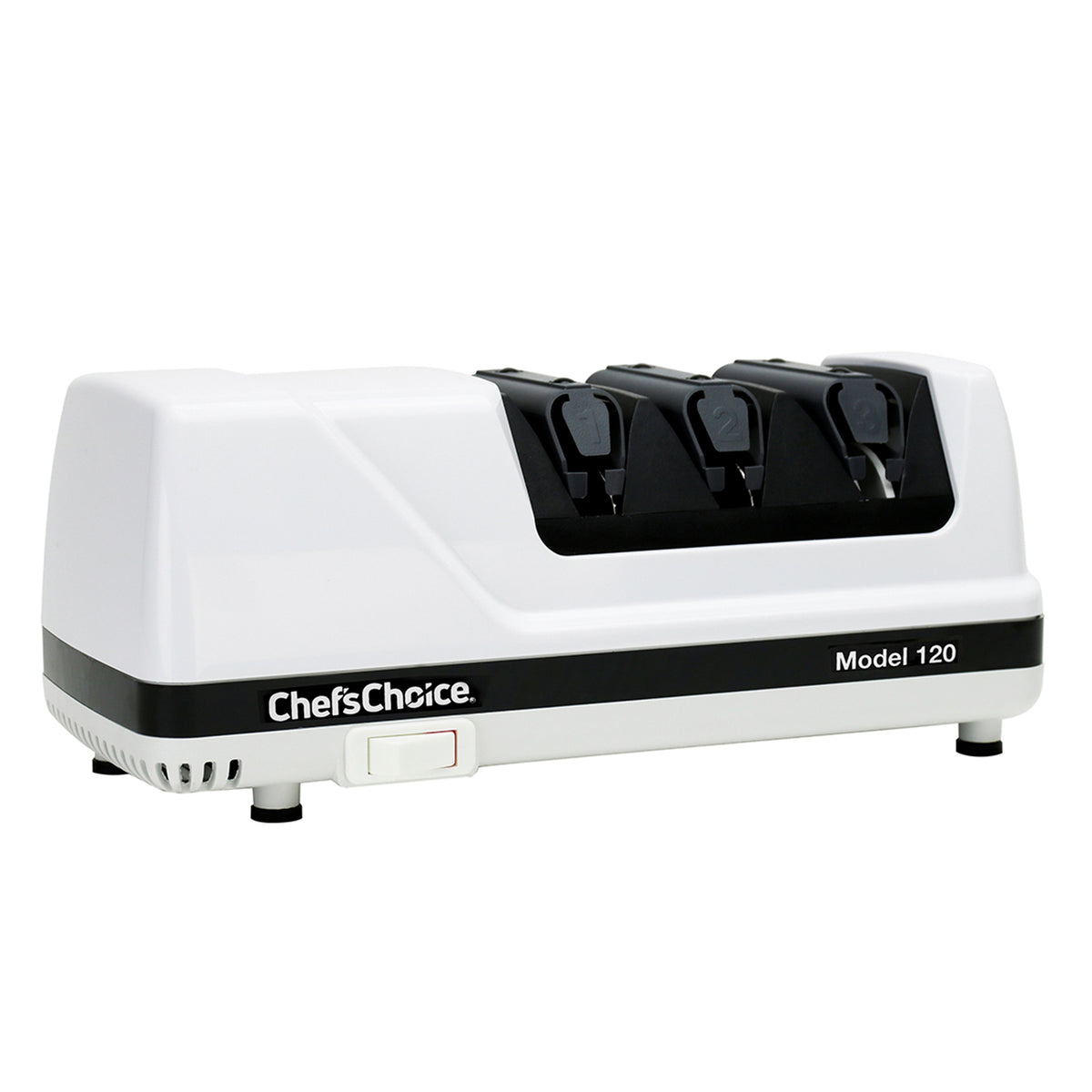
Explore this need in the finder →Model 120 is a corded countertop sharpener for shoppers who want the maker's three-stage EdgeSelect system rather than a stone, clamp, or abrasive belt. Its official US page identifies SKU 0120000 and describes it for 20-degree-class knives. The useful distinction is the work assigned to each stage: this is not simply a powered V-slot that runs every blade through the same sequence, and it is not the two-stage Model 320 or Diamond UltraHone 312.
Three stages, with different jobs
The Model 120 instructions describe two precision conical sharpening and honing stages using fine diamond abrasives, followed by a third stage of flexible abrasive disks for polishing and stropping. For a straight edge that is new to the sharpener or very dull, the manual says to start with Stage 1; Stage 2 refines the edge and Stage 3 polishes it. For ordinary resharpening, the booklet says Stage 3 may be sufficient, with Stage 2 used less often and Stage 1 reserved for heavier work. The instructions also describe different stage sequences for a smooth edge and for more residual bite, rather than treating every knife as one generic sharpening job.
That sequence gives the machine a more involved routine than the Model 320's two-stage diamond-and-polishing arrangement. Model 120's page and instructions describe a third distinct polishing stage; the two machines should not be collapsed into one review because the number and role of the stages are practical differences. The current page calls Model 120 a 20-degree-class system. The booklet says the angles become several degrees larger from one stage to the next, but does not give a quantified per-side convention in the instructions reviewed here. Our 20-degree filter therefore follows the page's stated class and is not a finding about the existing bevel on any particular knife.
Serrations are a separate procedure
For serrated edges, the manual is unusually clear: ordinary sharpening uses Stage 3 only. It says five to ten alternating pairs of pulls are generally adequate, with more needed for a very dull edge. If serrations are severely damaged, it allows one quick pull through each Stage 2 slot before returning to Stage 3; it warns that too much Stage 2 work removes more metal from the teeth than necessary. That exception is not an invitation to use the plain-edge stages routinely, nor does the maker's 20-degree-class label describe a serration angle. A shopper choosing a motorized method for serrations should read this separate sequence before buying and should not assume that the same process applies to another model.
The page also lists several knife families, including kitchen, pocket, hunting, and sporting knives, and the manual covers knives with straight or serrated edges. That broad category description is not a guarantee that every blade will fit: the instructions explicitly say not to insert blades that do not fit freely. They also prohibit scissors and axes. If non-knife tools are central to your routine, Model 120 is the wrong documented answer even though its page includes many different knife categories.
Ownership details that change the fit
This is an indoor household appliance that belongs on a stable counter or table, not a field sharpener. The manual calls for clean blades, a smooth, continuous pull, light pressure, and unplugging before cleaning. It says not to add honing oil, water, or other lubricant. Its Stage 3 dressing control is a maintenance feature for cleaning/reshaping the finishing disks when they become glazed or lose effectiveness; the instructions caution that dressing removes material and should not be used casually. The manufacturer lists a three-year limited warranty, subject to its stated conditions, but an offer should still be checked for exact model identity, condition, and warranty eligibility.
The Stage 3 disks are described as polishing and stropping abrasives, but that does not establish that a separate leather strop comes in the box. The exact manufacturer page and manual reviewed here do not verify a leather accessory package. If a leather strop is a hard requirement, filter for an exact package that explicitly lists one rather than treating “stropping” in a machine description as equivalent.
Who should compare it, and who should pass
Model 120 is worth comparing when a buyer wants a powered, guided routine, has knives covered by the maker's stated 20-degree class, and values a dedicated finishing stage with a documented serration procedure. It is a poor match for someone seeking manual angle control, a portable system, a 15-degree path, scissors support, waterstone work, or a verified included leather strop. The 15XV is a separate three-stage option whose current page uses a 15-degree-class label; the AngleSelect 1520 documents separate 15- and 20-degree paths; neither should be treated as equivalent to Model 120's single stated class and stage design.
This is a research-based reading of the manufacturer's product page and instructions, not a hands-on review. No sharpening test, measured edge result, speed comparison, durability test, ownership claim, current price, or stock claim is made. Before purchase, confirm that the listing says Model 120 / 0120000, check the package and seller's condition terms, read the exact manual, and compare its stated class with your knife maker's guidance. The finder can show other documented plans, but its matching label cannot certify compatibility for an individual blade.
Key specifications
Key details at a glance
| Power | Powered |
|---|---|
| Sharpening format | Powered three-stage diamond and polishing-disk sharpener |
| Lowest angle setting | 20° |
| Highest angle setting | 20° |
| Included abrasive surfaces | Two precision conical sharpening/honing stages with fine 100% diamond abrasives / Stage 3 flexible abrasive polishing/stropping disks |
| Use dry (no oil or water) | Yes |
| Angle-guide positions | 20° |
Use the exact model’s instructions for operating limits, supplied equipment and version differences.
Sources for this review
Sources for this assessment
Check the requirements that matter to you
Use the finder to compare documented sharpener formats and limits; an unknown capability is not treated as a match.