
Your needs, this model
Does it fit your priorities?
What angle capability does the current 15XV page state?
The current product page describes a 15-degree-class edge and says the sharpener converts traditional 20-degree factory edges to a 15-degree edge. The 2019 manual separately describes each major facet at 14 degrees (28 degrees total); the maker does not reconcile those descriptions. Treat the page's 15-degree label as a capability filter, not as an instruction to reprofile a particular knife.
Explore this need in the finder →What is the documented procedure for a serrated blade?
The Model 15 manual directs serrated blades to Stage 3. It says five to ten alternating pairs of pulls are generally adequate, with additional Stage 3 passes for a very dull edge. If a serration edge is severely damaged, it allows a fast pair of Stage 2 pulls before Stage 3, while warning that excessive Stage 2 use removes more metal than necessary from the teeth. The plain-edge 15-degree setting is not assigned to this serration procedure.
Explore this need in the finder →Does this package include a leather strop or support scissors?
The maker documents Stage 3 stropping/polishing disks, but they are built-in abrasive disks rather than an included leather strop. The manual expressly says not to attempt scissors, axes, or blades that do not fit freely in the slots.
Explore this need in the finder →Can I use the Model 15 without oil or water?
Yes. The manual says not to use honing oils, water, or other lubricant. It also asks users to unplug the unit before cleaning, clean blades before sharpening, use light downward pressure, and follow the separate procedure for traditional single-bevel knives.
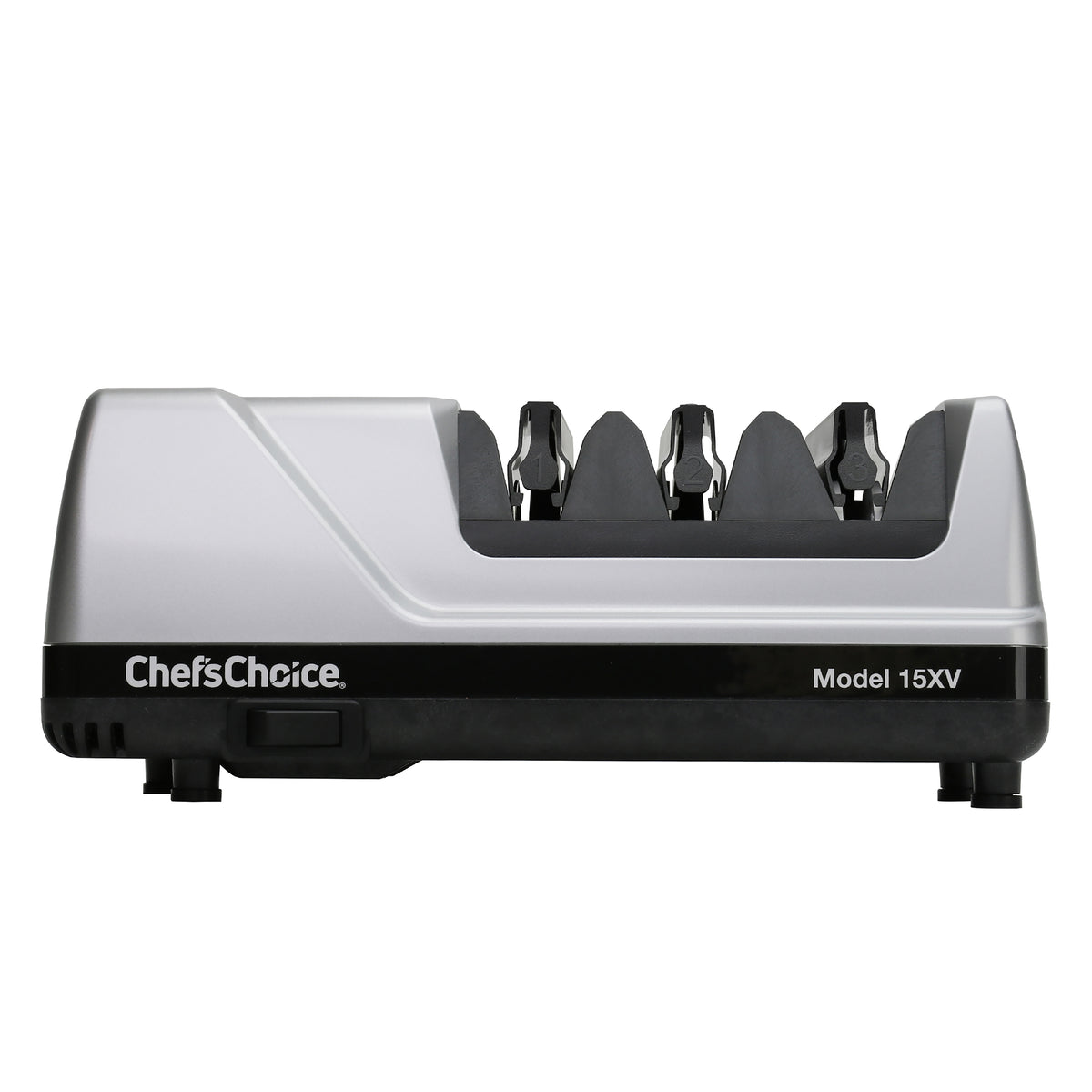
Explore this need in the finder →The current US Chef'sChoice 15XV listing identifies this electric sharpener as SKU 0101500. It uses three guided stages: diamond abrasives shape and refine a plain edge, then built-in disks polish it. The maker describes the resulting edge as 15-degree class and says the unit can convert a traditional 20-degree factory edge to a 15-degree edge. Those are manufacturer descriptions, not measurements made for this assessment. The 2019 Model 15 manual separately says each major facet is set at 14 degrees, or 28 degrees total; the current page and manual do not reconcile that wording. Treat the current 15-degree label as a documented capability, not a prescription for your knife.
Three stages, with different jobs
The stages are not interchangeable slots. Chef'sChoice describes Stage 1 as the shaping stage, using diamond abrasive to establish the main edge. Stage 2 refines and hones that edge. Stage 3 uses the maker's stropping and polishing disks for the finish. The manual's regular straight-edge procedure asks the user to alternate left and right slots, make a burr in the early stage before progressing, and then use a particular number and speed of pulls in the finishing stage. It warns against extra downward force and against stopping the blade while it touches the abrasive.
The older manual also describes the maker's EdgeSelect sequences for different cutting tasks. For a smoother finish it directs users through Stages 1 and 2, then adds Stage 3 pulls; for fibrous foods and game dressing, it describes leaving more bite by going from Stage 1 directly to Stage 3. These are manufacturer instructions for the Model 15, not evidence that one finish is best for every steel or food. The guide is a powered slot system: it standardizes the path and angle guide, but the user still needs to move the blade smoothly and follow the instructions for the particular edge.
Use the exact angle claim carefully
The current product page presents the 15XV as a 15-degree-class sharpener and says it converts traditional 20-degree factory edges to 15 degrees. The linked 2019 manual describes the major bevel facets at 14 degrees each (28 degrees total). A per-side angle and an included angle are different quantities, but the manufacturer does not explicitly explain whether this accounts for the page's 15-degree label. This review therefore records the current page's 15-degree class as a fixed, discrete finder capability and preserves the manual's separate wording rather than silently equating the two.
That distinction matters before changing an edge. The Model 15 manual calls for special, side-specific handling of traditional single-bevel Japanese knives, and it cautions users to follow the dedicated procedure. The maker also says to avoid sharpening scissors, axes, or a blade that does not fit freely in a slot. If your knife maker specifies another geometry, or the knife is unusually thick, asymmetric, or valuable, compare that guidance before committing to a powered reprofile. A matching number does not establish that the resulting bevel is right for your knife.
Serrations use a separate routine
Chef'sChoice explicitly includes straight-edge and serrated knives in the 15XV's stated capabilities. Its manual separates serrations from the plain-edge stages: it directs the serrated blade to Stage 3, generally using five to ten alternating pairs of pulls. For a severely damaged serration edge, the manual permits a fast pair of Stage 2 pulls before finishing in Stage 3, and warns that excess Stage 2 use removes more metal than necessary from the teeth. The manual also notes that a serrated edge will not look or behave like a straight edge. The 15-degree plain-edge guide should not be carried over as a numerical scallop angle; the serration method is its own plan.
Care, package, and practical limits
This exact page identifies SKU 0101500, and its current three-stage description is supported by the linked Model 15 manual. The machine's polishing disks are not a separate leather strop. The review found no maker-listed leather strop or scissor attachment in the exact package information, and the manual expressly prohibits scissor sharpening. It also says not to use honing oil, water, or another lubricant, to clean blades before sharpening, and to unplug the device before cleaning. It includes a manual disk-dressing mechanism and says that if the Stage 3 disks eventually wear, factory replacement is necessary; the manual gives no universal service interval.
The instructions state household use only. Although the maker's use guide discusses field dressing and fish, this is a countertop electric unit, not a portable field sharpener. Its three-stage routine may be appealing to someone who wants a powered, guided workflow and a dedicated serration procedure, but it asks the user to learn multiple sequences rather than using one generic pull-through motion. Its fixed edge designation, angle-language discrepancy, single-bevel precautions, and no-scissors warning are more consequential than the broad phrase “for knives.”
Buying checks
Confirm that the offered package is the US 15XV, SKU 0101500. Chef'sChoice also lists a brushed-metal 15XV under a separate SKU, 0101508; its product page describes the same 15XV three-stage features and links the same Model 15 manual, so that finish variant is covered here rather than counted as another sharpening design. Do not confuse a finish listing with a different angle model, and do not assume a pictured accessory is included unless the exact box description says so.
Before choosing it, check your knife maker's edge instructions, whether a single-bevel procedure applies, how the slot accommodates the blade, and whether you need a real leather strop or scissor capability. This is a source-based assessment of documented features and constraints; it contains no hands-on use, controlled test, measured sharpness result, price, or stock claim.
Key specifications
Key details at a glance
| Power | Powered |
|---|---|
| Sharpening format | Powered three-stage diamond and polishing-disk sharpener |
| Lowest angle setting | 15° |
| Highest angle setting | 15° |
| Included abrasive surfaces | 100% diamond abrasives in Stages 1 and 2 / Stage 3 stropping/polishing disks |
| Strop included | No |
| Use dry (no oil or water) | Yes |
| Angle-guide positions | 15° |
Use the exact model’s instructions for operating limits, supplied equipment and version differences.
Sources for this review
Sources for this assessment
Check the requirements that matter to you
Use the finder to compare documented sharpener formats and limits; an unknown capability is not treated as a match.