
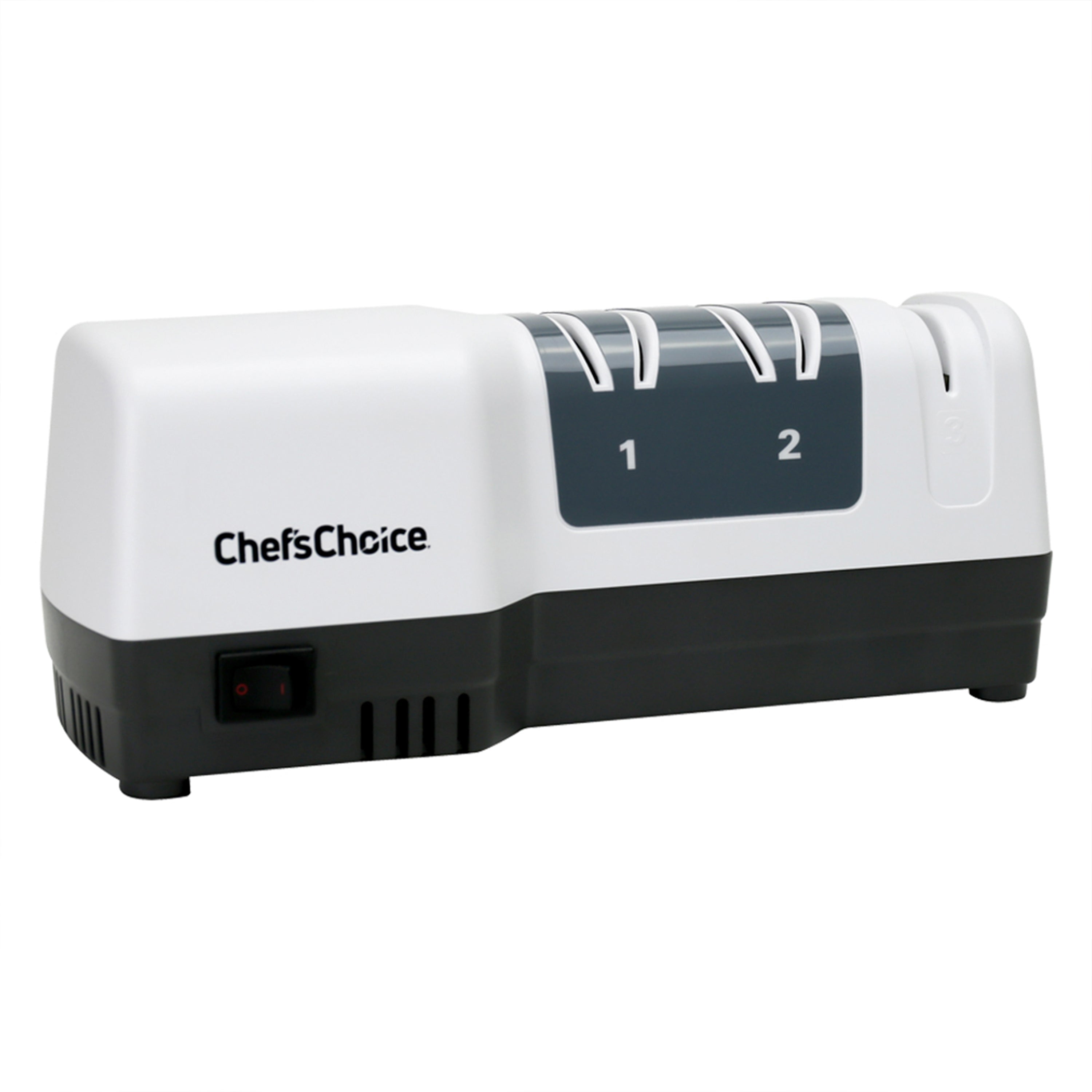
Your needs, this model
Does it fit your priorities?
Is the Chef'sChoice Model 250 a manual or powered sharpener, and what angle does it document?
Its complete plain-edge shaping route uses motor-driven Stages 1 and 2; the Stage 1 primary facet is 20 degrees per side (40 degrees total), and Stage 2 makes a slightly larger but unnumbered secondary bevel. Stage 3 is manually guided. It is a powered hybrid, not a fully manual device or a 15-degree setting. The manual does allow Stage 3-only upkeep after the basic edge has been established, but that maintenance route has no stated numeric angle.
Explore this need in the finder →What is the Model 250's documented serration method?
The Model 250 manual directs serrations to manual Stage 3 and allows only a limited Stage 2 lead-in for very dull serrations; the 250 manual specifies 25 back-and-forth pairs at Stage 3. Do not transfer its straight-edge angle to this special-edge method. The Stage 3 routine is manual and numeric angle filters do not apply to it; a powered lead-in is only described for a very dull edge.
Explore this need in the finder →Can the Model 250 sharpen Asian or single-sided knives?
The exact Model 250 manual permits double-faceted Asian blades at its 20-degree primary facet but recommends a 15-degree sharpener for optimal Asian-style results and prohibits single-sided Kataba/sashimi blades. Check the exact blade maker's edge guidance; a maker-supported example is not universal clearance evidence.
Explore this need in the finder →What should be checked about Model 250's box, strop and ownership terms?
The checked sources do not establish a complete seller-specific box list or a separately included leather strop; the built-in Stage 3 polishing surface is not a leather accessory. Do not treat an unknown package fact as a confirmed strop. The current product page says three years but the linked current Model 250 manual and manufacturer warranty index say one year; verify applicable written terms rather than assuming the discrepancy is resolved.
Explore this need in the finder →The current US product page identifies this white Model 250 Hybrid Knife Sharpener as SKU 0250100. The exact linked instructions describe a compact motorized-and-manual workflow: powered diamond stages shape and hone a plain edge, while the user moves the blade through a manual finishing slot. This is a source-based assessment of the named configuration, not an account of using or testing it.
“Hybrid” describes the work, not a fully manual machine
Stages 1 and 2 are motor-driven. The user still guides each blade stroke, alternating the left and right slots so both sides are worked evenly. Stage 3 is different: it is a hand-moved honing and polishing pass and can be used with the power off. That makes the 250 a powered sharpener with a manual finishing and touch-up mode, not a substitute for a completely unpowered stone or pull-through. A complete first sharpening of a dull plain edge starts with powered stages; Stage 3 alone is the maker's later maintenance option for an edge whose basic geometry is already established.
The primary edge is a fixed 20-degree-per-side route
The Model 250 instructions say Stage 1 forms the main facet at 20 degrees on each side, or 40 degrees included, and Stage 2 uses a finer diamond at a slightly larger angle to make a small secondary bevel. Stage 3 adds a third finishing bevel, but its angle is not stated. There is no adjustment dial or a documented 15-degree setting. The current product copy has an inconsistent “Trizor XV” phrase in one feature bullet; the exact page calls the item a 20-degree sharpener and its model manual repeatedly describes a 20-degree primary facet. For choosing a knife path, the manual-specific geometry is the usable evidence. Do not treat the XV wording as proof of a 15-degree route.
This matters for Japanese-style knives. The manual says the 20-degree primary geometry can sharpen double-faceted Asian blades such as Santoku, while recommending a 15-degree model for optimal results with Asian knives. It specifically rules out single-sided Kataba blades such as traditional sashimi knives because the final slot works both sides. The numeric finder point is a capability check for the manual's 20-degree primary facet, not a recommendation to change a blade's existing bevel. Check the knife maker's guidance first.
Sharpening is a sequence, not three interchangeable slots
For a new or substantially dull plain edge, the manual starts with alternating powered Stage 1 pulls until a small burr can be detected. It then moves to the finer Stage 2 slots for a smaller burr and a secondary bevel, followed by light, centered back-and-forth work in the manual Stage 3. Its example stroke counts and six-inch-blade timing are instructions, not performance measurements or guarantees for every steel, blade condition, or length. The manual also describes stopping after Stage 1 or Stage 2 when a toothier edge is desired; its full three-stage path makes a more polished finish. Treat those as different edge goals, not as evidence that the machine has adjustable angle settings.
For a previously shaped edge, the manufacturer says several refreshes may be possible with the manual Stage 3 before returning to Stage 2 or Stage 1. That separate arrangement is useful if the shopper wants a no-power upkeep stroke, but it cannot answer a 20-degree setting question by itself: the Stage 3 geometry is not numerically specified. Keeping these plans separate avoids claiming that an unpowered finishing pass performs a full motorized reprofile.
Serrations have their own limited method
The Model 250 manual directs serrated blades to Stage 3, with inspection after each set of back-and-forth pairs. It describes a limited Stage 2 lead-in for a very dull serration, then a much longer Stage 3 finish; it cautions that too much powered Stage 2 work can remove metal from the teeth. No numeric angle is attached to that operation. The straight-edge 20-degree value must not be carried over to serrations, and a serrated result should not be judged by the same smoothness as a plain edge. Compared with the similar-looking Model 270, the 250's manual calls for 25 Stage 3 stroke pairs rather than five, so do not borrow the newer model's procedure.
What the evidence does not establish
The manual requires clean blades and a stable counter or table, warns against touching moving parts, and says not to use oil, water, or another lubricant. It excludes scissors, axes, ceramic knives, and blades that do not fit freely in the slots. The instructions do not publish a maximum blade length, bolster clearance, or spine-thickness limit; check the knife's shape and fit against the exact guide. An internal polishing stage is not a separate leather strop, and the checked page and manuals do not give a complete seller-specific box inventory or confirm replacement disks or spare-part availability.
There is also a material warranty discrepancy to verify before purchase: the exact product page advertises a three-year limited warranty, while the current linked Model 250 manual and the maker's warranty index state a one-year reference. That conflict is preserved rather than resolved by assumption, and neither statement guarantees eligibility for a particular used or third-party listing. Confirm the exact Model 250/SKU 0250100, condition, box, returns, and applicable written warranty with the seller. The manufacturer's product image shows the white-and-black three-stage body but does not establish any package contents.
Where it fits among the hybrids
The Model 250 is worth considering when a countertop powered routine, a fixed 20-degree-per-side primary plain-edge facet, and a manual final stage fit the knife and upkeep style. Its separate manual plans do not make it fully manual, and the model's 20-degree route is not the maker-preferred 15-degree path for Asian knives. Model 270 has a model-specific five-pair serration sequence, stainless guide surfaces, and a current three-year warranty reference; the 250 has its own 25-pair directions and a conflicting warranty record. Both manuals exclude scissors and single-sided sashimi-style blades. Confirm the exact model and instructions rather than treating “Hybrid” as a guarantee that procedures or packages are interchangeable.
Key specifications
Key details at a glance
| Power | Powered |
|---|---|
| Sharpening format | Powered hybrid diamond stages with manual honing |
| Lowest angle setting | 20° |
| Highest angle setting | 20° |
| Included abrasive surfaces | Stage 1 motor-driven diamond abrasive disks for the primary plain-edge facet / Stage 2 motor-driven finer diamond abrasives for an unnumbered secondary bevel / Stage 3 manually guided polishing/honing surface; manual does not identify a leather strop |
| Use dry (no oil or water) | Yes |
| Angle-guide positions | 20° |
Use the exact model’s instructions for operating limits, supplied equipment and version differences.
Sources for this review
Sources for this assessment

Check the requirements that matter to you
Use the finder to compare documented sharpener formats and limits; an unknown capability is not treated as a match.