
Your needs, this model
Does it fit your priorities?
Does Model 312 document a powered kitchen route at 20 degrees?
Yes, the current product page identifies a powered two-stage sharpener for straight-edge 20-degree-class knives. Its model-specific manual describes Stage 1's fine diamond disks forming the initial bevel and Stage 2's ultrafine diamonds honing and polishing it. The sources do not define that class label as a per-side versus total angle or recommend reprofiling a particular knife, so check the knife maker's bevel guidance and confirm the blade fits freely.
Explore this need in the finder →What does Model 312's manual say about serrated knives?
It directs ordinary serration sharpening to Stage 2, with alternating left- and right-slot pulls. For a severely damaged serrated edge, the manual allows one quick pull in each Stage 1 slot before Stage 2, but warns that unnecessary Stage 1 passes remove more metal than needed from the teeth. This is a distinct, nonnumeric procedure; do not transfer the straight-edge 20-degree-class label to serrations.
Explore this need in the finder →Do Model 312's two diamond stages mean that a separate leather strop or scissor method is included?
No. The manual describes two abrasive stages inside the powered sharpener, not a separate leather accessory, and the reviewed package information does not confirm a boxed leather strop. More decisively, the manual says not to sharpen scissors or axes and requires a blade to fit freely in the slots. If a separate strop or scissors is essential, use a product with affirmative exact-package and tool evidence instead.
Explore this need in the finder →How should a buyer compare Model 312 with Models 120 and 320?
Model 312 has two stages, both using fine then ultrafine diamond abrasives. Model 120 is a distinct three-stage machine with a third flexible polishing-disk stage, while Model 320 is a two-stage design whose second stage uses flexible finishing disks. These stage descriptions do not establish a separate leather strop in any package. All three are powered, but their stage layouts and manuals are not interchangeable.
Explore this need in the finder →This source-based assessment concerns the exact US Chef'sChoice Model 312, SKU 0312000. No hands-on sharpening, performance test, measurement or ownership experience is claimed.
Two diamond stages, with different jobs
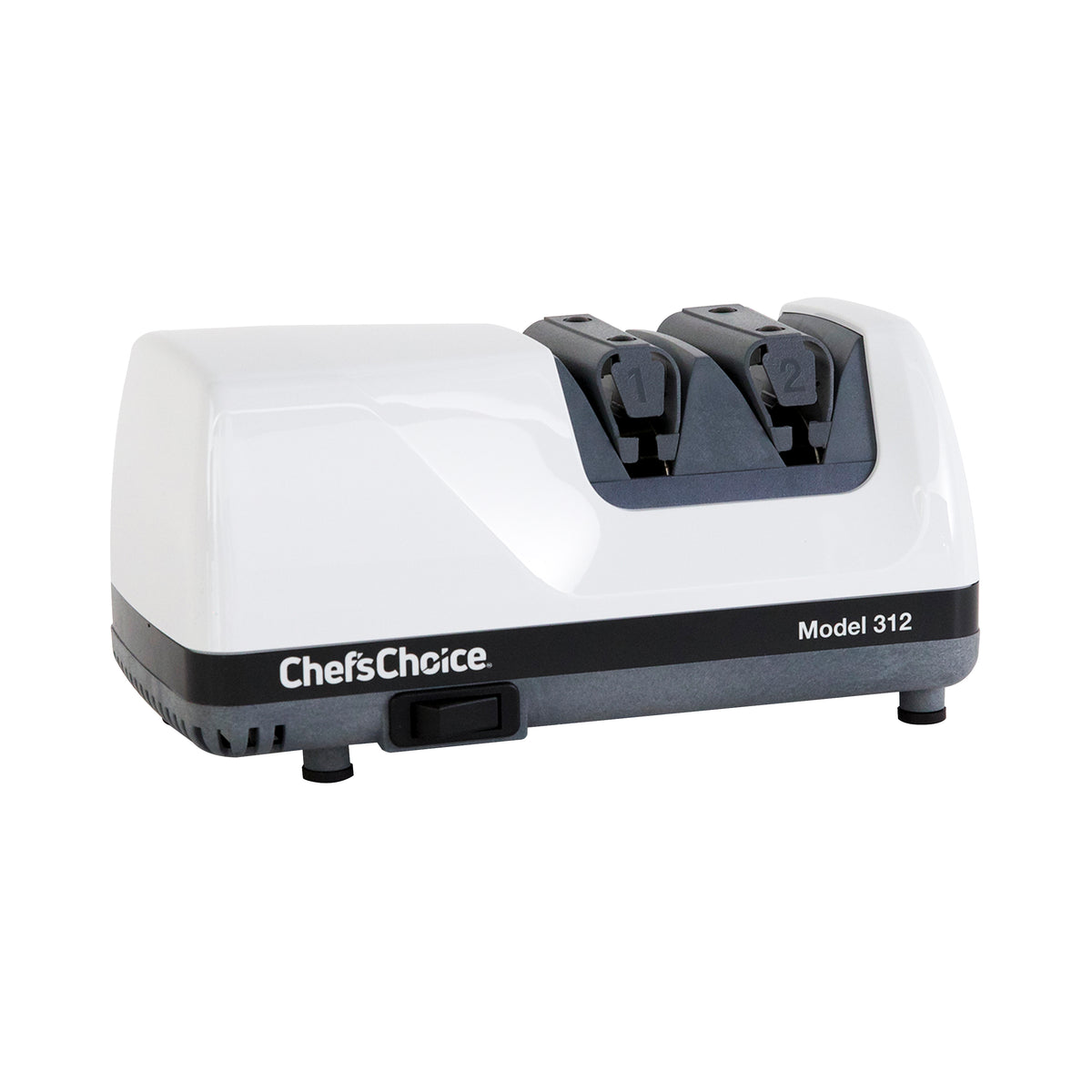
The Model 312 is a powered countertop machine with two stages, not a hand stone and not a three-stage Model 120. Its 2014 instructions describe fine diamond-coated disks in Stage 1 forming the first facets, followed by ultrafine, micron-sized diamonds in Stage 2 that hone and polish near the edge. Guided slots and flexible positioning springs hold the blade against the disks. The booklet says the second stage works at a slightly larger angle than the first, but neither that comparison nor the product page's 20-degree-class language specifies a per-side versus total-angle convention.
For a straight edge being sharpened for the first time, the manual starts with Stage 1. It describes alternating left and right pulls and advises confirming a burr before moving to Stage 2. The instructions emphasize a steady, uninterrupted pull and light downward pressure rather than pressing harder to speed the process. For routine touch-ups, Stage 2 alone may be enough; if it no longer restores the edge promptly, the manual returns to Stage 1 before Stage 2. These are maker procedures, not independently tested performance claims.
Choosing a finish is still part of the workflow
The manual offers different Stage 2 routines for the intended cut. More quick finishing pulls are described for a smoother edge used on clean cuts, while fewer Stage 2 pulls preserve more bite for fibrous foods. This means the two-stage label is not simply a coarse-to-fine checklist: the user selects a finish through the prescribed strokes. The sources do not provide an independent grit-equivalence scale or measured edge result, so those comparisons should stay within the manufacturer's own instructions.
Serrations receive their own procedure. The ordinary approach uses Stage 2 alone, where the manual describes alternating pulls through both slots; it says that a very dull serrated blade may need more passes. Only for severe damage does it permit one fast pass in each Stage 1 slot before Stage 2, cautioning that excessive first-stage use removes more metal from the teeth than needed. There is no numeric angle assigned to this separate serration plan in the manual. A straight-edge 20-degree-class label is not a serration angle recommendation.
Where Model 312 differs from the other Chef'sChoice machines
The exact US product page identifies this white Diamond UltraHone as Model 312, SKU 0312000, and places it in the maker's current electric-sharpener collection. Its useful distinction is the pairing of fine and ultrafine diamond stages. Model 120 adds a third, flexible polishing-disk stage after its two diamond stages. Model 320 also has two stages, but its second stage is described as flexible abrasive finishing disks rather than Model 312's ultrafine diamond disks. The Model 1520 is a different layout again, with separately guided 15-degree and 20-degree paths. Those machines should not be treated as equivalent merely because all are powered countertop sharpeners.
For Model 312, the product page lists a 20-degree-class capability for straight-edge knives, while the manual describes a relative stage angle without a side convention. This assessment treats that as one fixed capability point—not a continuous adjustment range, not proof that every 20-degree knife fits, and not advice to alter a factory bevel. Check the knife maker's recommended geometry and the actual heel, bolster and blade clearance before choosing an edge routine.
Limits, care and the package to verify
The manual identifies household and pocket knives plus selected sports knives as intended work. It specifically excludes scissors and axes, and warns against any blade that does not enter and travel freely through a slot. That is a meaningful limit for broad or unusually shaped blades and heavy bolsters; the sources do not state a maximum blade length or guarantee clearance for every knife. It is a household appliance for a stable counter or table, not an outdoor field tool.
Before sharpening, the instructions call for a clean blade, alternating strokes and only enough pressure for consistent disk contact. They prohibit honing oils, water and other lubricants during normal sharpening. Care has an important nuance: if food residue slows Stage 2, the manual's cleaning procedure is done with the sharpener unplugged, using only a small amount of dilute detergent solution on a brush, then lightly rinsing the disks and allowing them to dry fully before power is restored. Routine maintenance also includes clearing accumulated metal dust from the underside clean-out cover. Follow the complete manual rather than treating the sharpener as an immersion-safe or wet-sharpening device.
The current exact product page states a three-year limited warranty. However, the page and linked 2014 manual do not provide a complete current box inventory. A buyer who needs a separate leather strop should not infer one from the words “honing” or “UltraHone”; the reviewed documentation describes abrasive disks inside the machine and does not verify a separate strop. Dimensions, voltage, weight, replacement-disk availability and condition-specific coverage also remain unverified here. Confirm the exact SKU, included package, blade fit, applicable warranty and return terms for the offer being considered.
Model 312 is therefore most relevant when the documented two-stage diamond sequence and separate serration directions suit the knives at hand. Its case is weaker if you require a scissors method, axes, a portable sharpener, a selectable angle, a confirmed leather-strop accessory or evidence about a particular knife's bevel. Compare the original model-specific instructions—not a neighboring machine's manual—before making that fit decision.
Key specifications
Key details at a glance
| Power | Powered |
|---|---|
| Sharpening format | Powered two stage fine and ultrafine diamond disks |
| Lowest angle setting | 20° |
| Highest angle setting | 20° |
| Included abrasive surfaces | Stage 1 fine diamond-coated conical disks for the first bevel / Stage 2 ultrafine micron-sized diamond disks for honing and polishing |
| Use dry (no oil or water) | Yes |
| Angle-guide positions | 20° |
Use the exact model’s instructions for operating limits, supplied equipment and version differences.
Sources for this review
Sources for this assessment
Check the requirements that matter to you
Use the finder to compare documented sharpener formats and limits; an unknown capability is not treated as a match.