
Your needs, this model
Does it fit your priorities?
Does Model 320 document a 20-degree-class kitchen route?
Yes, the current product page names 20-degree-class straight-edge knives. The manual describes Stage 1 forming the first bevel and Stage 2 refining it with flexible polishing/stropping disks. It does not reconcile the class label with a per-side versus included-angle convention, so use the number only as a capability filter and check the knife maker's own bevel advice and blade clearance.
Explore this need in the finder →Which Model 320 routine is documented for a serrated blade?
The instructions direct serrated-knife work to Stage 2 and give a separate alternating-slot procedure. For a badly damaged edge, the manual allows one quick pass in each Stage 1 slot before Stage 2, while warning against unnecessary Stage 1 use because it removes more metal. The 20-degree-class plain-edge point is not applied to this separate serration plan.
Explore this need in the finder →Do the built-in finishing disks mean a separate leather strop is included or that scissors are supported?
No. The manufacturer documents flexible polishing/stropping disks inside Stage 2 but does not verify a separate leather strop in the package. The Model 320 manual explicitly says not to sharpen scissors or axes, and requires a blade to fit freely in its guides.
Explore this need in the finder →What care and setup conditions accompany this countertop machine?
The manual calls for clean blades, a stable counter or table indoors, a steady pull with light contact pressure, and no honing oil, water or other lubricant. Its built-in disk-cleaning lever is for use only when Stage 2's performance declines; frequent dressing removes abrasive material. Unplug the appliance before cleaning.
Explore this need in the finder →This is a source-based assessment of the exact US Model 320, SKU 0320000. It is not a hands-on test; no edge result, speed measurement or ownership experience is claimed.
What the two stages are for
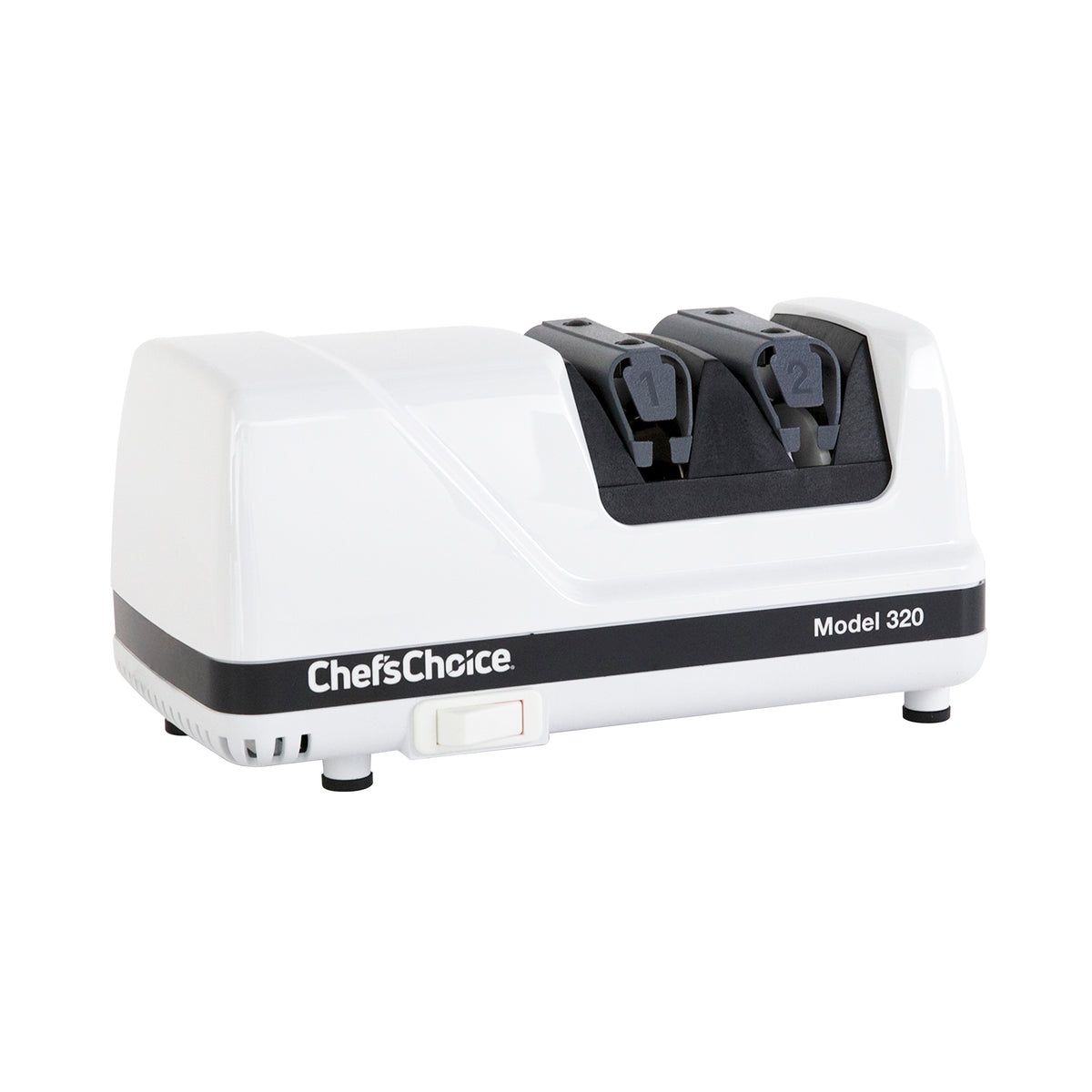
The Model 320 is a powered countertop sharpener organized around two different jobs. Its manual describes fine diamond-coated conical disks in Stage 1, which establish the initial facets, followed by flexible abrasive disks in Stage 2 that polish and strop those facets into a microbevel. The second stage is set at a slightly larger angle than the first, but the documents do not quantify that relationship as a per-side or total angle. The current product page describes the machine as suitable for 20-degree-class straight-edge knives. That label is useful as a documented capability, not as permission to reprofile every knife to a chosen geometry.
For a straight edge being sharpened for the first time, or one the manual characterizes as very dull, the instructions begin with Stage 1. They describe alternating left and right pulls, steady movement, and only enough downward pressure to keep the blade in contact. Stage 2 then finishes the edge. For subsequent touch-ups, the manual says Stage 2 alone can often restore the edge; if touch-ups take too many pulls, it directs the user back to Stage 1 and then Stage 2. That staged approach is more informative than treating the switch as a one-pass sharpening promise.
Finish depends on the task
The instructions distinguish a smoother edge for clean cuts from an edge retaining more bite for fibrous material. More alternating Stage 2 pulls are suggested for a polished kitchen finish; the manual instead describes one Stage 2 pair after Stage 1 for game, fish and fibrous foods. Those are maker-described procedures, not comparative performance results from independent testing. They also mean that “two stages” is not a simple grit ladder: the strokes and the intended finish matter as much as the stage count.
Serrations follow a separate path. The manual directs ordinary serrated sharpening to Stage 2 only and describes a series of alternating pulls there. If a serrated edge has been severely damaged, it permits one fast pass in each Stage 1 slot before returning to Stage 2, while cautioning that unnecessary Stage 1 work removes extra metal from the teeth. A serrated knife does not inherit the numeric 20-degree-class setting used for straight edges in this assessment.
Where Model 320 fits among the Chef’sChoice machines
Model 320 is a current-reference US product identified as SKU 0320000 in the manufacturer’s electric collection and exact-model page. It differs in a practical way from the other reviewed Chef’sChoice machines. Model 120 has two diamond sharpening/honing stages followed by a separate third polishing/stropping stage; Model 320 instead has two stages, with its finishing disks in Stage 2. Model 1520 documents two discrete plain-edge paths, 15° and 20° per side, as well as separate serration directions. Model 320’s available evidence supports a single 20-degree-class plain-edge point, not a selectable 15°/20° arrangement or a continuous adjustment range. None of these machine labels settles what bevel a particular knife should have.
The Model 320’s polishing disks are built into the appliance. The product page and instruction booklet do not establish that the box contains a separate leather strop, so buyers who require that accessory should not infer it from “FlexHone/Strop” in the model-family name. Similarly, a powered guide does not mean a manual format is available: this is a corded electric appliance, not a hand-operated sharpener.
Limits, maintenance and questions to verify
The Model 320 manual says not to use it on scissors, axes or blades that do not fit freely between its guides. It is intended for household use on a stable counter or table indoors. The instructions call for clean blades, a consistent pull, light contact pressure and no honing oil, water or other lubricant. The Stage 2 dressing lever cleans the polishing disks when their effectiveness declines; the manual warns that unnecessary dressing removes abrasive material and can shorten disk life. The available sources do not establish a maximum blade length, exact fit around every bolster, the full current box list or whether replacement disks are presently available.
There is also a material warranty discrepancy worth resolving before relying on a coverage claim: the current exact product page advertises a three-year limited warranty, while the manufacturer’s warranty-and-manual directory assigns Model 320 one year of parts and maintenance. The reviewed 2014 instruction booklet does not resolve that difference. Confirm the applicable terms for SKU 0320000 and the specific offer rather than assuming either period applies to every seller or condition.
For a buyer with conventional kitchen or household knives, the strongest case for Model 320 is its clearly documented powered workflow and separate plain-edge and serration instructions. Its constraints are equally specific: one 20-degree-class plain-edge capability, no verified separate leather strop, no scissor use, and a manual that expects deliberate, alternating pulls rather than extra pressure. Compare the exact blade’s bevel and clearance with the maker’s instructions, and check the seller’s model suffix, condition, return terms and warranty before choosing an offer.
Key specifications
Key details at a glance
| Power | Powered |
|---|---|
| Sharpening format | Powered two stage diamond and flexible finishing disks |
| Lowest angle setting | 20° |
| Highest angle setting | 20° |
| Included abrasive surfaces | Stage 1 fine diamond-coated conical disks / Stage 2 flexible abrasive polishing/stropping disks |
| Use dry (no oil or water) | Yes |
| Angle-guide positions | 20° |
Use the exact model’s instructions for operating limits, supplied equipment and version differences.
Sources for this review
Sources for this assessment
Check the requirements that matter to you
Use the finder to compare documented sharpener formats and limits; an unknown capability is not treated as a match.