
Your needs, this model
Does it fit your priorities?
Which function sequence is documented for a 15°-class or 20°-class straight edge?
For a blunt or chipped straight edge, the manual directs the 20°-class route through Function 1 Coarse, Function 2 Medium 20°, and Function 3 Fine. For regular wear it says to use Function 2 or Function 5 Medium according to the knife's marked class, then Function 3 Fine. Function 5 is the 15°-class medium/honing route; the manual does not direct it through coarse Function 1. The maker's degree labels are a capability reference, not a settled per-side or total-angle convention or a bevel recommendation for your exact knife.
Explore this need in the finder →Can SH6N1BKG14 handle serrated knives without applying its straight-edge angle labels?
The exact manual assigns bread and serrated knives to Function 6, which uses a single fine-grit ceramic rod. It describes moving the blade back and forth along its length; it supplies no numeric serration angle or detailed tooth-by-tooth method. Do not transfer the 15° or 20° straight-edge labels to that separate slot, and read the exact instructions before choosing the amount of work.
Explore this need in the finder →Does the exact model have a documented scissors operation?
Yes. Function 4 is a separate scissors station; the manual says to open the scissors, place the cutting edge in that slot and move back and forth until sharp. It does not describe the scissor edge with the 15° or 20° knife settings. This is a separate tool plan rather than a claim that every knife function also sharpens scissors.
Explore this need in the finder →What care, replacement-part and package details should be checked?
The manual says the exterior can be wiped with a damp soft cloth, no oil or other lubricating liquid is necessary, and the sharpener must not be immersed or put in a dishwasher. It states spare parts are not available for this model. Neither the model page nor instructions establish a separate included leather strop or every seller's box contents, so an essential strop should not be inferred from the integrated fine stage.
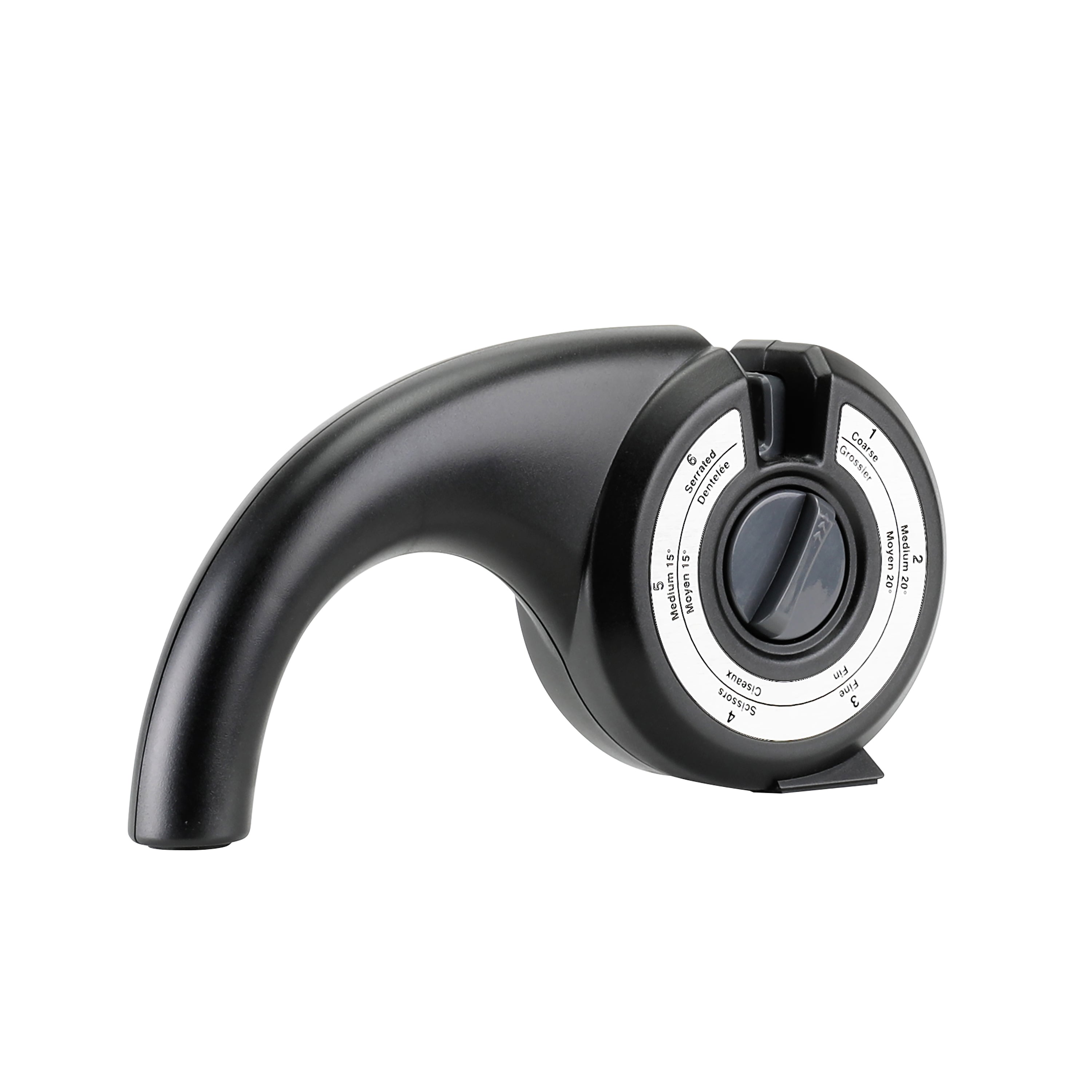
Explore this need in the finder →Chef'sChoice identifies the black-and-gray SH6N1BKG14 as its 6-in-1 Multifunctional Manual Knife Sharpener. This assessment is based on its exact US product page, the model-specific manual, and the current manual-sharpener collection; it is not a claim of ownership, hands-on use, or comparative testing. The six selector functions are not six interchangeable sharpening passes: Functions 1, 2 and 3 form the 20°-class straight-edge sequence; Function 5 is a separate 15°-class medium route that shares Function 3 as its finish; Functions 6 and 4 are distinct serration and scissors stations.
Six functions, four different jobs
The product page lists six functions: Coarse, Medium 20°, Fine, Scissors, Medium 15°, and Serrated. The exact instructions make the routing clearer. For a blunt or chipped straight edge, they specify Function 1 Coarse, followed by Function 2 Medium 20° and Function 3 Fine. For regular wear, the manual says to choose Function 2 or Function 5 according to the knife's angle, then finish at Function 3. In its examples, traditional knives are associated with the 20° path and most thinner or Asian-type blades with 15°. The maker also says Function 5 may be used for extra sharpness before polishing at Function 3.
That means the 15° and 20° choices are separate selector positions, not a continuous adjustment range. Function 1 is specified for the 20° sequence; the instructions do not say to put a 15°-class knife through the coarse slot first. The stages also use different materials: the manufacturer identifies tungsten blades at coarse, ceramic rods in the medium and fine functions, a ceramic scissors blade, and a single fine ceramic rod for serrations. These design details help distinguish it from a two-slot pull-through or a clamp guide, but they do not by themselves tell how much material a user's knife needs removed.
What the angle labels do—and do not—settle
The exact manual marks the two knife paths 15° and 20° but does not expressly clarify whether those numbers are per side or the total included angle. Nor does it give a separate secondary-bevel angle for Function 3. The route should therefore be read as a documented model capability, not a prescription for every knife described as “Asian,” “thin,” or “traditional.” If your knife's maker gives an angle convention or a specific sharpening sequence, compare that guidance with the exact SH6N1BKG14 instructions before using an abrasive. The manual's reference to most thinner or Asian-type blades is not a substitute for confirming a particular blade's geometry, and it does not expressly address single-bevel knives.
Serrations and scissors are separate stations
Function 6 is identified for bread or serrated knives. The manual tells the user to place the knife in that slot and move it back and forth along the length of the blade. The product page identifies a single fine-grit ceramic rod there. The written method is brief: it gives no numeric serration angle, tooth-by-tooth adjustment, or stroke count. In particular, neither 15° nor 20° is stated as the serration setting. A buyer who needs a detailed scallop-specific method should compare the manual's directions with the blade maker's guidance rather than borrowing the straight-edge sequence.
Function 4 is a dedicated scissors station with a medium-grit ceramic blade. The manual says to open the scissors, place the cutting edge in the slot, and move back and forth until sharp. That is useful breadth for one hand-operated tool, but it is not evidence that all blade functions can be applied to scissors or that all scissor styles fit the slot. The sources do not specify clearance for unusual scissors, blade dimensions, or a separate angle guide for them.
Setup and ownership checks
The instructions call for a clean knife blade and a level work surface around waist height. They give separate hand positions for right- and left-handed users, and caution the user to keep fingers clear of the blade. For straight-edge work, the manual instructs back-and-forth strokes along the entire blade, says the blade need not be lifted after each stroke, and recommends little or no downward pressure. These are maker directions, not a prediction about comfort or a guarantee of a particular result. After sharpening, the blade should be wiped or rinsed and dried; the manual describes periodic sharpness checks rather than a timed cycle.
For care, the manual says to wipe the sharpener's exterior with a soft damp cloth, use no oil or other lubricating liquid, and not immerse the unit or put it in a dishwasher. It also states spare parts are not available for this model. That makes it worth checking what replacement or warranty support a seller actually offers, without assuming a consumer-replaceable abrasive. The manual lists a one-year limited warranty for indoor household use, subject to its terms and proof-of-purchase conditions. Neither the exact page nor the manual confirms a separate leather strop or a complete seller-specific box inventory; the built-in Fine function should not be counted as an included leather accessory.
How it compares
The SH6N1BKG14 is a hand-guided selector with separate coarse, two medium-angle, fine, scissors, and serrated functions. Chef'sChoice's Model 4643 is another manual product with both 15°-class and 20°-class paths plus serration capability, but it uses a different three-stage slot arrangement and has its own model-specific cautions. Model 463, by contrast, has a distinct fixed-angle two-stage route and a different serration sequence. These differences matter more than a shared brand or similar slot appearance: choose from the instructions for the exact model, not a nearby product's routine.
Consider this six-function sharpener when a manual tool with an integrated 15°-class option, 20°-class option, serration slot, and scissors station fits your actual maintenance tasks. Compare another setup if continuous angle adjustment, a published angle convention, documented blade-clearance dimensions, replaceable parts, or a confirmed included leather strop is essential. Before purchase, confirm the exact SH6N1BKG14/SKU, seller package, condition, return terms, and whether the blade or scissors you intend to use fall within the model's actual instructions. This is a source-based fit assessment—not a performance ranking or a claim that the listed functions ensure compatibility with every edge.
Key specifications
Key details at a glance
| Power | Manual |
|---|---|
| Sharpening format | Manual six function selector with fixed slots |
| Lowest angle setting | 15° |
| Highest angle setting | 20° |
| Included abrasive surfaces | Function 1 Coarse: paired tungsten blades / Function 2 Medium 20°: paired medium-grit coated ceramic rods / Function 3 Fine: paired fine-grit ceramic rods / Function 4 Scissors: a medium-grit ceramic blade in a separate scissors slot / Function 5 Medium 15°: a coated ceramic rod for the maker-described thinner/15°-class knife route / Function 6 Serrated: one fine-grit ceramic rod |
| Angle-guide positions | 15 / 20° |
Use the exact model’s instructions for operating limits, supplied equipment and version differences.
Sources for this review
Sources for this assessment
- Chef'sChoice 6-in-1 Multifunctional Manual Knife Sharpener, exact US product page and SKU SH6N1BKG14
- Chef'sChoice Multi-functional Manual Knife Sharpener instructions, exact Model SH6N1BKG14 manual revision A26
- Chef'sChoice US Manual Knife Sharpeners collection
- Exact black-and-gray Model SH6N1BKG14 product image linked from the manufacturer page

Check the requirements that matter to you
Use the finder to compare documented sharpener formats and limits; an unknown capability is not treated as a match.