
Your needs, this model
Does it fit your priorities?
Does SHPKTBKG14 offer an adjustable angle or a fixed 20-degree setting?
The exact product page describes both stages as 20-degree bevel sharpening and honing, while the model-specific manual describes two fixed rod slots without giving a numeric range. Treat the documented 20-degree label as one capability point, not a dial or a knife-specific bevel recommendation; the sources do not establish whether the angle is per side or total. Check the knife maker's geometry before changing an existing bevel.
Explore this need in the finder →Which knife edges and tools does the SHPKTBKG14 manual support?
The product page names pocket, chef's and Santoku knives among its intended users, and the linked instructions describe guiding a clean knife through the coarse or fine slot. The same model-specific manual says the sharpener is not recommended for serrated knives or scissors. Do not treat the product page's broad bread-knife wording or general knife tags as permission to use it on a serrated edge; no scissor arrangement is documented.
Explore this need in the finder →What is included in the two stages, and is a leather strop confirmed?
The maker identifies Stage 1 as coarse tungsten-carbide rods for very blunt or chipped edges and Stage 2 as fine ceramic rods for regular sharpening; a few fine-stage strokes are described as a maintenance option. Neither the exact product page nor the manual confirms a separate leather strop or a complete seller-box inventory, so an essential included-strop request is not verified. The manual also says no oil or lubricating liquid is necessary, the sharpener should not be put in a dishwasher, and spare parts are not available for this model.
Explore this need in the finder →What setup and safety instructions are provided for the portable sharpener?
The model-specific instructions call for a clean blade, a level surface around waist height, a hand-held sharpener, and a stroke that travels from near the knife handle toward its tip; they warn the user to keep fingers clear. The manual describes starting in the coarse slot for very blunt or chipped edges and following with the fine slot, while routine maintenance can use the fine slot alone. These are manufacturer directions, not hands-on performance findings or a claim that every blade shape clears the slots.
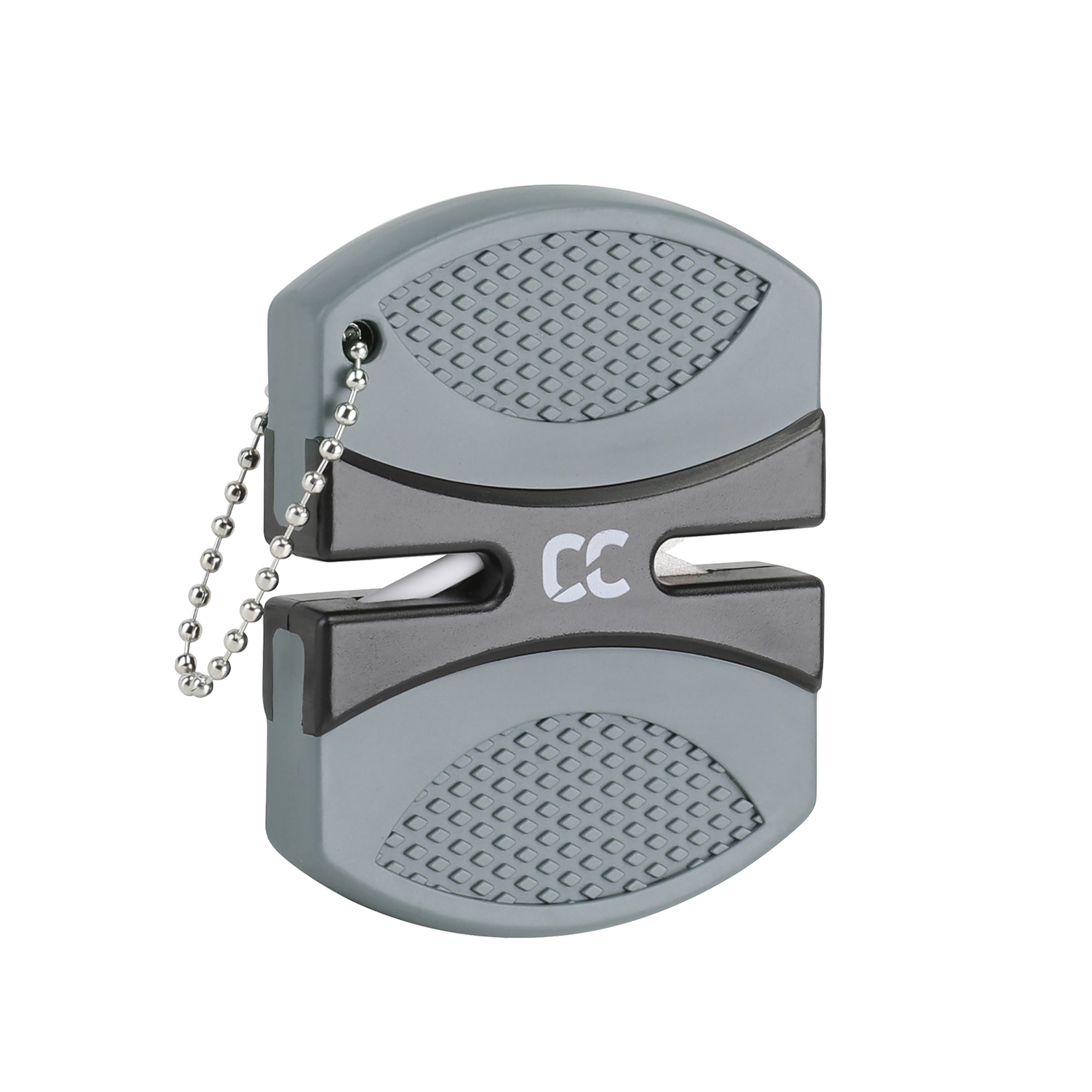
Explore this need in the finder →The Chef'sChoice Manual Pocket Knife Sharpener (SHPKTBKG14) is a compact, hand-held two-stage tool rather than a benchtop guide or a powered machine. Its appeal is the small format and a simple coarse-to-fine choice: a user guides a knife through either a tungsten-carbide rod slot or a ceramic rod slot. The exact model page describes a 20-degree bevel at both stages and names pocket, chef's and Santoku knives among its intended uses. The separate model-specific instructions add meaningful limits: they say the model is not recommended for serrated knives or scissors. This is a source-based assessment, not a hands-on test of sharpening results.
Two stages, two different abrasives
The manufacturer assigns Stage 1 coarse tungsten-carbide rods to very blunt or chipped edges and Stage 2 fine ceramic rods to regular sharpening. If Stage 1 is used, the manual allows the same handle-to-tip stroke in Stage 2 afterward; for routine upkeep, it says a few strokes in the fine slot are often enough. That is a useful distinction from products that use two diamond stages or a separate leather strop. The page and manual do not establish a leather accessory, grit ratings, a replacement abrasive schedule or a complete package list, so none should be inferred from the two-stage label.
The short workflow keeps the choice straightforward, but it does not create a guided clamp or lock down blade geometry in a reviewable adjustment scale. The manual asks for a clean blade, a level surface around waist height and strokes from near the handle toward the tip while covering the whole edge. It advises keeping fingers away from the blade and describes separate hand positions for right- and left-handed use. Those are maker directions; they are not evidence that every blade length, bolster or handle clears the slots. No maximum blade length or clearance dimensions are supplied in the sources reviewed here.
What the 20-degree label does—and does not—settle
The exact product page calls the coarse and fine stages 20-degree bevel stages. That gives the matcher one fixed 20-degree-class capability point, not a selectable range. The model-specific manual does not repeat the number or define whether the product-page label is per side or total. A knife maker's recommended edge may use a different convention or geometry; do not treat this product label as a recommendation to reprofile a particular pocket knife, chef's knife or Santoku. Check the knife and sharpener instructions together before changing an existing bevel.
The name and product copy also deserve careful reading. The product page calls out bread knives, and the retailer-style tags include “serrated,” but the exact manual says not to use this sharpener on serrated knives. For this assessment, that more specific operating instruction takes precedence: the supported matcher plan is for plain edges only. The same manual also advises against scissors, so the sharpener should not be chosen as a scissors tool. This distinction matters when comparing it with other models whose manuals give a dedicated serration process or a separate scissor component.
Where it fits in a shortlist
For a pocket-knife owner who wants a compact manual format for ordinary maintenance, SHPKTBKG14 is a different proposition from a clamp-and-rod system: there is no clamping step or documented adjustment range, but the user still guides the blade and must respect the fixed slots. It can also suit a kitchen routine when the intended knife is a plain-edge chef's or Santoku-style blade and the maker's instructions fit. A general category word such as “kitchen” is not a substitute for checking the actual blade, especially when a bread knife may be serrated.
Within Chef'sChoice's own range, it should not be mistaken for the larger Model 478. Both have two manual stages and the product pages identify a 20-degree-class capability, but Model 478's stages use diamond abrasives and its page marks serrations despite an incomplete serration procedure in that model's manual; SHPKTBKG14 instead uses tungsten carbide and ceramic and its manual explicitly discourages serrated use. Their materials, instructions and edge limits are not interchangeable. Neither product page settles the angle convention, and a matching number does not establish fit to a specific knife.
Care, durability and purchase checks
The instructions say no oil or other lubricating liquid is necessary, the exterior can be wiped with a damp soft cloth, and the sharpener should not go in a dishwasher. They also say spare parts are not available for this model, which is worth weighing if replaceability is important to your ownership plan. The manual's one-year limited warranty is stated for household use; confirm the exact seller's condition and warranty terms rather than assuming that every listing carries the same coverage.
Before choosing a listing, confirm the exact black-and-gray SHPKTBKG14 package, inspect what the seller actually includes, and compare the slots with the blade and handle you intend to maintain. No separate strop, blade-length limit, price, stock status or seller condition is verified here. The strongest fit case is narrow and practical: a portable hand-guided sharpener, coarse carbide plus fine ceramic, and a documented fixed 20-degree-class plain-edge capability. If you need serration sharpening, scissors, a broader angle range or a replaceable abrasive system, this is not the supported match.
Key specifications
Key details at a glance
| Power | Manual |
|---|---|
| Sharpening format | Manual two stage portable rod slots |
| Lowest angle setting | 20° |
| Highest angle setting | 20° |
| Included abrasive surfaces | Stage 1 coarse tungsten-carbide sharpening rods / Stage 2 fine ceramic sharpening rods |
| Angle-guide positions | 20° |
Use the exact model’s instructions for operating limits, supplied equipment and version differences.
Sources for this review
Sources for this assessment
Check the requirements that matter to you
Use the finder to compare documented sharpener formats and limits; an unknown capability is not treated as a match.