
Your needs, this model
Does it fit your priorities?
What is actually included in The Duo CLSTC?
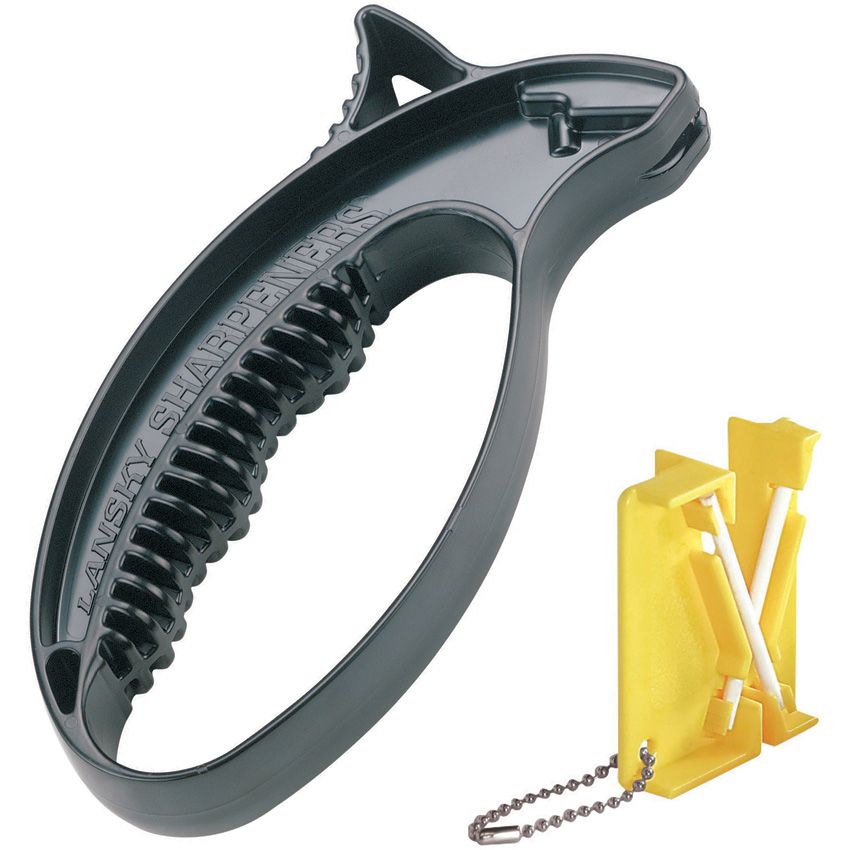
The exact Lansky record lists a Quick Edge carbide sharpener and a separate Mini Crock Stick with two removable ceramic rods and a keychain. It does not list the C-Clip sharpener or Eraser Block that appear in the separate CCLIP Combo. Verify the CLSTC SKU and both tools in the exact offer.
Explore this need in the finder →Do the two Duo tools create different knife angles?
For plain-knife use, the exact listing gives both the Quick Edge and Mini Crock Stick a fixed 22.5°-per-side path. They differ in abrasive and stroke method—carbide pull-through versus two ceramic rods—not in a documented angle range. The product page does not prescribe them as one mandatory two-stage routine.
Explore this need in the finder →Can the Mini Crock Stick handle fishhooks?
Lansky says its two ceramic rods can be removed and held side-by-side in the supplied groove for fishhooks, darts, or other pointed objects. That is a separate arrangement from the clipped-rod knife method; do not assume the knife's 22.5° guide label applies to a hook or dart.
Explore this need in the finder →The Lansky Duo Quick Edge® & Mini Crock Stick® Sharpeners (SKU CLSTC) is a package of two different manual sharpeners, not one device with a sequence switch. The first is a carbide pull-through Quick Edge; the second is a small ceramic-rod Mini Crock Stick with a keychain. This source-based review compares the exact listed package and instructions and does not claim personal use or performance testing.
Two distinct sharpening paths
The Quick Edge portion is a single tungsten-carbide pull-through slot with a molded grip, finger guard, and thumb rest. Lansky identifies it for kitchen, work, and outdoor sporting knives and sets its slot at 22.5° per side (45° inclusive). The Mini Crock Stick portion has two removable alumina-ceramic rods listed as fine 1,000 grit; Lansky also sets its plain-knife angle at 22.5° per side. The two tools therefore share a published knife angle but differ in abrasive material, handling, and maintenance task.
It may be tempting to read the package as a required coarse-to-fine sequence: carbide to restore an edge, then ceramic to refine it. The source lists both tools, but does not prescribe that order or define a combined progression for every knife. Treat them as separate paths and choose the one that suits the current knife and its maker’s edge guidance. The carbide element is described as removing metal; the 1,000-grit ceramic rods provide a different surface, but the manufacturer does not promise a specific finish or number of sessions.
Setting up each tool
The Quick Edge instructions call for a stable, flat surface, an edge-up knife with about half an inch projecting, and a guarded grip on the sharpener. Draw from the heel toward the tip at roughly 90° to the blade, using three or four strokes with light pressure, then clean the blade. That 90° instruction is a hand-position cue; it is separate from the 22.5°-per-side sharpening path. Lansky warns against heavy pressure and notes that effort varies with steel.
For the Mini Crock Stick, the maker says to place the base on a flat surface and make sure the rods are secured by their clips. Keep the blade straight up and down, then slice down and across one rod and repeat with the opposite edge on the other rod. The rods, not a hand-estimated lean, establish the angle. They can be removed for cleaning or repositioned side-by-side in the supplied groove for sharpening fishhooks, darts, and other pointed objects. That pointed-object setup is separate from the normal knife routine; do not carry the knife-angle assumption over to a loose hook or dart.
What the Duo does not include
The exact CLSTC record lists the two sharpeners but not the C-Clip tool or Eraser Block included in Lansky’s separate C-Clip Combo. The Duo therefore should not be treated as that three-piece package. It also has no documented leather strop, adjustable angle mechanism, knife clamp, or dedicated serration procedure. Its two knife paths are both fixed at the same nominal setting, so the “Duo” name means two tools, not two angles.
The ceramic rods can accumulate dark metal transfer. Lansky says to rotate the rods to expose a clean side and clean them when they are fully dark, using an Eraser Block or kitchen cleanser; the exact Duo package page does not list that block as included. The carbide element is reversible and replaceable. No replacement schedule, grit number for that carbide, blade-length limit, or exact cleaning product for the carbide slot is established in the product record.
Who it suits and what to verify
The CLSTC makes the most sense for someone who wants a compact, straightforward carbide path alongside a separately handled ceramic maintenance tool. Its angle labels fit common fixed-angle needs only when the particular knife’s bevel and the manufacturer’s convention agree. Do not assume the duplicate 22.5° labels make the abrasive paths interchangeable or that a quick pull-through will suit a thin, flexible or unusually shaped blade; Lansky supplies no profile compatibility chart.
Before buying, check that the exact offer is CLSTC and includes both the black Quick Edge and the Mini Crock Stick assembly. A standalone LSTCS, LCKEY, or C-Clip Combo is a different package. Confirm whether a cleaning block is offered separately if rod maintenance is important. Follow both tools’ instructions, keep fingers clear of the blade, and use light pressure on the carbide. The Lansky Duo product instructions are the source for this exact package; a similar name or a shared component image is not proof of package contents.
Bottom line
The Duo is a two-tool manual set with one carbide slot and one fine ceramic-rod arrangement, both documented at 22.5° per side for plain knives. Its value is the availability of two different maintenance methods in one package. The limitations are equally specific: fixed geometry, no documented strop or serration tool, and no included Eraser Block in the exact page’s listed contents.
Key specifications
Key details at a glance
| Power | Manual |
|---|---|
| Sharpening format | Two separate manual tools: carbide pull-through sharpener and a two-rod ceramic mini crock stick |
| Lowest angle setting | 22.5° |
| Highest angle setting | 22.5° |
| Included abrasive surfaces | One reversible, replaceable tungsten-carbide pull-through slot; two removable fine 1,000-grit alumina-ceramic rods |
| Benchtop base included | Yes |
| Strop included | No |
| Angle-guide positions | 22.5° |
Use the exact model’s instructions for operating limits, supplied equipment and version differences.
Sources for this review
Sources for this assessment

Check the requirements that matter to you
Use the finder to compare documented sharpener formats and limits; an unknown capability is not treated as a match.