
Your needs, this model
Does it fit your priorities?
What angle positions does the CSHARP provide?
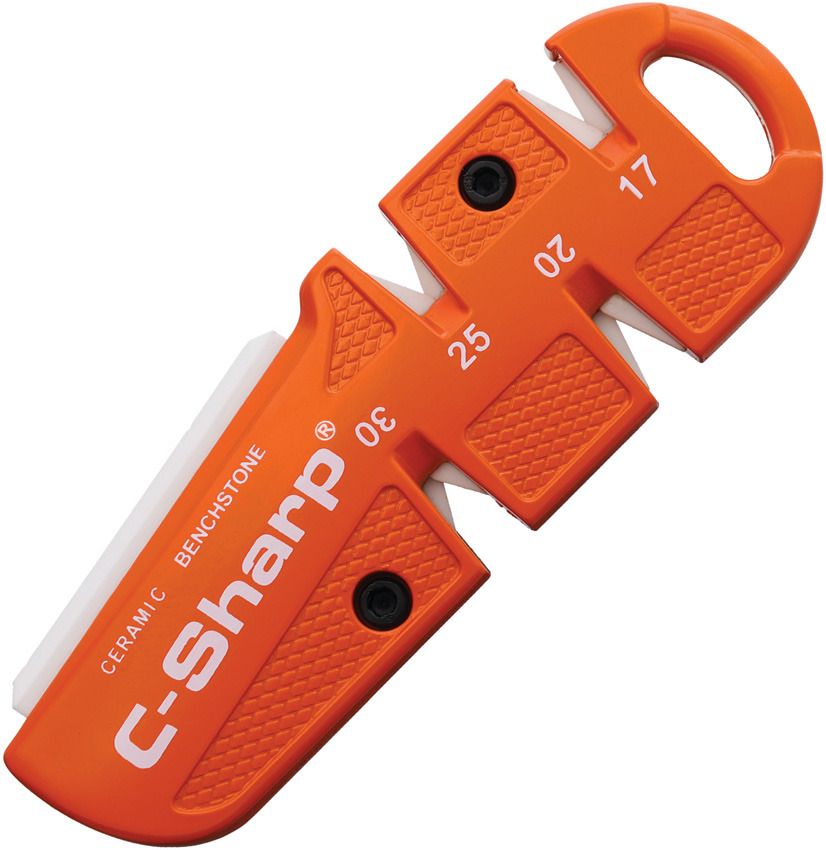
The product record lists four fixed ceramic slots at 17°, 20°, 25° and 30°. It does not describe continuous adjustment or resolve whether those labels are per-side or inclusive. Check the exact knife's bevel and manufacturer's guidance rather than selecting an angle from the range alone.
Explore this need in the finder →What is the C-Sharp's two-stage ceramic setup?
Its product feature list assigns 600 grit to the four pull-through slots and 800 grit to a tapered benchstone. That second element is described for maintenance/polishing and serration work. One wording conflict calls the 800-grit element fine in the feature list but medium in the instruction paragraph.
Explore this need in the finder →Can the CSHARP work on serrations?
Lansky documents a separate method using the tapered ceramic element, one serration at a time. No numeric angle or universal scallop-size fit is published, so do not apply the four plain-edge slot labels to that operation.
Explore this need in the finder →This research-based review follows the current U.S. Lansky CSHARP product record and its instructions; it does not claim hands-on use or measured sharpening results.
A portable angle tool with ceramic throughout
The C-Sharp® All Ceramic (SKU CSHARP) is a manual, compact pull-through sharpener shaped around four marked knife angles and a separate tapered benchstone surface. Lansky presents it both as a stand-alone sharpening option and as a companion to its controlled-angle systems and Turn Boxes. Its product page describes a durable metal casing with ceramic sharpening elements. The exact page does not provide dimensions, blade-clearance limits, or a complete seller-box list, so do not transfer those details from a similarly shaped Lansky model.
Its four knife slots are marked 17°, 20°, 25° and 30°. The marks correspond to discrete choices, not an adjustment dial or a continuous range between the lowest and highest numbers. Lansky’s page says the sharpener maintains an angle chosen with a controlled-angle kit, but this record does not resolve whether the printed labels are per-side or inclusive. The numeric setting is a capability marker; it does not tell you which bevel belongs on your knife. Compare your blade’s existing geometry and instructions before drawing it through a slot.
Two ceramic jobs, at different grit descriptions
The pull-through grooves are identified as 600-grit medium ceramic. The integrated tapered benchstone is listed as 800-grit ceramic and is described for fine polishing, regular maintenance, or serrations. One wording inconsistency is worth noticing: the feature list calls the benchstone “fine” at 800 grit, while the user-instruction paragraph calls that same 800-grit element “medium.” The numeric grit and the physical component agree; the adjectives do not. This review preserves the published grit number rather than pretending the labels are consistent.
Lansky’s own comparison with the QuadSharp helps clarify the role. Both share the four marked slots, metal form, tapered 800-grit ceramic benchstone and compatibility with controlled-angle systems. The C-Sharp’s angle slots are ceramic instead of the QuadSharp’s carbide. Lansky characterizes C-Sharp as the gentler, slower way to maintain an edge, while carbide is presented as more aggressive for very dull blades or rapid correction. That is the maker’s intended distinction; it is not a comparative performance test.
This split gives CSHARP a plausible maintenance-oriented routine: use a fixed ceramic slot if the intended angle matches the knife, then rely on the separate ceramic surface for upkeep or the model’s documented serration method. The product is not a motorized or clamped system, and its compact body does not supply the broad adjustment or staged stone set of a full kit. If a substantial amount of metal has to be removed, the exact CSHARP page does not describe a separate coarse abrasive or a repair progression.
Serrations are a separate procedure
The tapered ceramic element is explicitly described for serrated edges. Lansky’s instructions call for working the groove one at a time with the ceramic, using a rolling motion around larger serrations where appropriate. That support belongs to this element and its separate method. No numeric serration angle or universal fit for all scallop shapes is given. The four marked slots should not be treated as a numeric setting for serrations, nor as proof that the pull-through grooves fit every blade profile.
For plain-edge maintenance, the instructions call for moderate pressure and rinsing the blade after sharpening. The ceramic can develop dark steel-transfer streaks; Lansky directs users to clean it with an Eraser Block. Keep fingers clear of the edge and follow the tool’s actual safety instructions. “All ceramic” describes the sharpening surfaces, not a guarantee that the tool can safely or correctly sharpen every ceramic knife; the sources do not specify that use.
Who it suits and who may prefer another approach
The C-Sharp is worth considering for someone who wants a manual portable tool with four fixed angle choices, ceramic contact at the knife slots, a built-in finishing/maintenance surface and manufacturer-documented serration capability. It also offers a useful option when a user wants the angle marks shared with a Lansky kit but would rather not use that kit’s abrasive arrangement. Compatibility with a larger system does not mean that the C-Sharp includes the system’s clamp, rods, case or other kit pieces; verify the precise package if any accessory matters.
The tradeoff is limited choice and documented aggressiveness: four fixed marks are not arbitrary angle control, and ceramic is positioned as a steadier, gentler alternative rather than a fast coarse repair surface. Compare the QuadSharp review if you need the maker’s more aggressive carbide option, or the D-Sharp review if a 400-grit diamond slot is the relevant alternate. Those materials are distinct models, not bundle levels of CSHARP.
Assessment: The C-Sharp’s appeal is the all-ceramic construction with a separate 600-grit slot and 800-grit benchstone role. Its most important caveats are the unresolved angle convention, the fixed four-position set, the contradictory “fine/medium” label for the 800-grit surface, and the absence of a published universal blade-fit guarantee. It is best viewed as a narrow maintenance tool whose exact procedure should match the knife and edge in front of you.
Key specifications
Key details at a glance
| Power | Manual |
|---|---|
| Sharpening format | Portable manual four-angle ceramic pull-through sharpener with an integrated tapered ceramic benchstone |
| Lowest angle setting | 17° |
| Highest angle setting | 30° |
| Included abrasive surfaces | Four fixed ceramic pull-through slots listed as 600 grit / Integrated tapered ceramic benchstone listed as 800 grit; feature copy calls it fine while the instruction paragraph calls the 800-grit element medium |
| Benchtop base included | No |
| Angle-guide positions | 17 / 20 / 25 / 30° |
Use the exact model’s instructions for operating limits, supplied equipment and version differences.
Sources for this review
Sources for this assessment
- Knife Sharpeners — Lansky US catalogue, page 1
- Portable Sharpeners — Lansky US category, page 1
- C-Sharp® All Ceramic, SKU CSHARP — exact Lansky product record and instructions
- Should I use the QuadSharp or the C-Sharp? — Lansky official comparison
- C-Sharp® All Ceramic CSHARP — exact first-gallery Lansky product image

Check the requirements that matter to you
Use the finder to compare documented sharpener formats and limits; an unknown capability is not treated as a match.