
Your needs, this model
Does it fit your priorities?
Do the red and camo Deluxe Quick Edge use different sharpening paths?
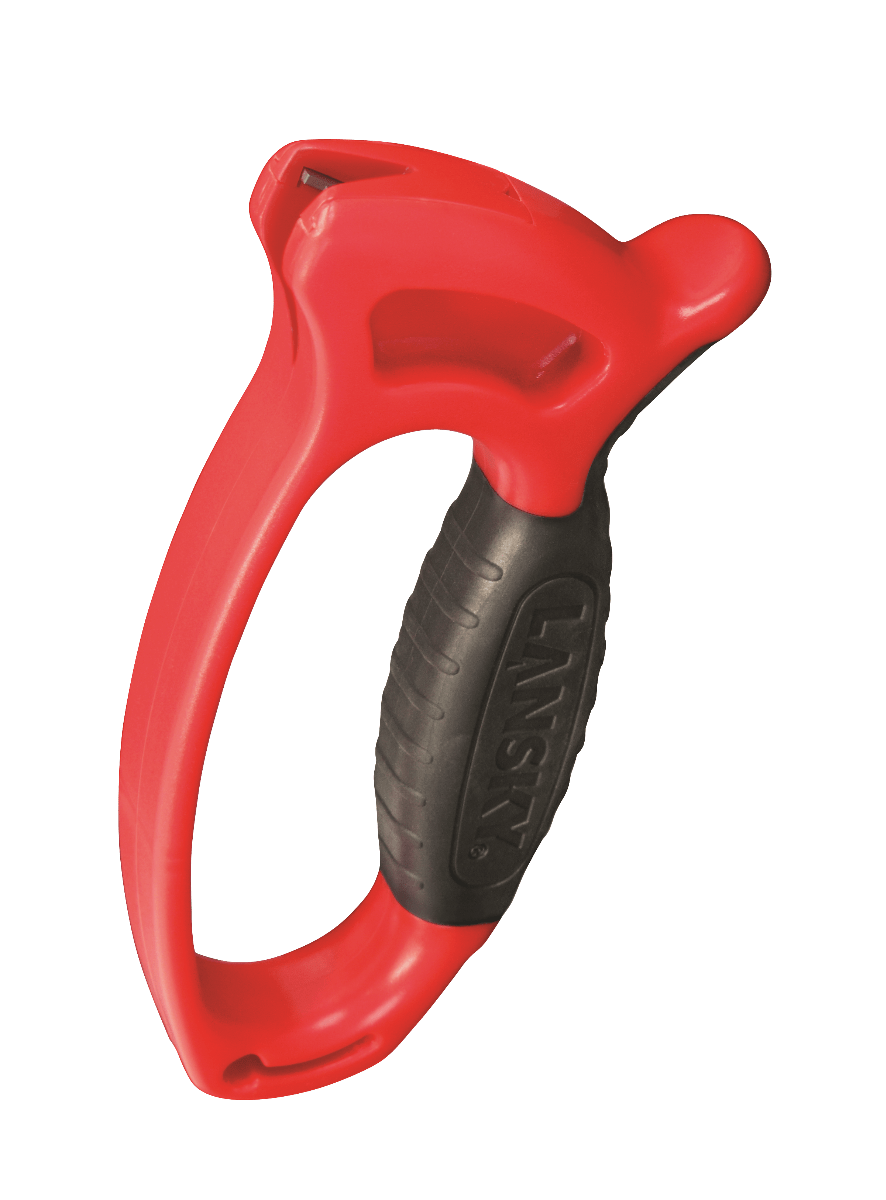
The SKU-specific records show separate red LSTCN and camouflage LSTCNCG finishes, but both describe the same fixed 22.5°-per-side carbide V-slot and the same flat-surface, heel-to-tip pull-through procedure. The finishes are retained as exact SKUs and images; the available sources do not establish a different angle or abrasive for either one.
Explore this need in the finder →What changes from the black Quick Edge LSTCS?
The Deluxe pages add an overmolded rubber grip, safety thumb rest and lanyard hole; the camouflage description explicitly notes right- or left-handed use. The black LSTCS page lists a molded housing and finger/thumb guards and also allows either hand. These are grip and carrying differences, not a different angle setting or a second abrasive stage.
Explore this need in the finder →Is the Deluxe Quick Edge meant to remove metal quickly or to polish an edge?
The exact listings identify only a tungsten-carbide pull-through element, give no grit, and direct three to four light-pressure strokes. They do not document a ceramic or polishing stage. Lansky warns against heavy pressure; inspect the edge and stop rather than treating a few strokes as a guaranteed result for every steel or bevel.
Explore this need in the finder →The Lansky Deluxe Quick Edge® is a manual, one-slot carbide pull-through sharpener sold in two finish-specific SKUs: red LSTCN and camouflage LSTCNCG. Their manufacturer records describe the same fixed-angle sharpening path and the same basic procedure, while the colors and some wording differ. This assessment treats them as a finish-only family for sharpening decisions and retains both exact package identities. It is a document-based comparison of current product records, not a hands-on test.
One carbide slot and one angle
Both exact product pages state that the sharpening angle is preset at 22.5° to achieve a 45° inclusive angle. That makes the setting 22.5° per side, not 22.5° total. Neither page describes an angle selector, an intermediate setting or an adjustable range. If a knife specification calls for a different angle, the Deluxe Quick Edge cannot meet that numeric requirement. The finder can verify a documented number; it cannot determine whether that number is right for an individual blade.
The source identifies a tungsten-carbide pull-through element but gives no grit rating. There is no second ceramic, stone or strop surface documented in either SKU record. That matters because a quick carbide path is not the same thing as a complete coarse-to-fine progression or a dedicated polishing routine. Lansky says carbide removes metal and directs three or four strokes with no more than light pressure; the short stroke count is an instruction, not a guarantee of sharpness for every steel.
Red and camouflage are separate exact SKUs
The red version is SKU LSTCN, listed as “Deluxe Quick Edge® Red.” Its product record describes a roomy, overmolded rubber grip, a safety thumb rest and a lanyard hole. The camouflage SKU is LSTCNCG, listed separately as “Deluxe Quick Edge® Camo”; its copy describes a camouflage-and-black overmolded grip, finger guard, thumb rest and carbide cutting heads. The Camo page explicitly calls out right- or left-handed use, and the two pages’ short descriptions both identify a lanyard hole. They are color/configuration variants rather than evidence of two different abrasive systems. Separate exact first-gallery images are shown so the finishes are not silently substituted for one another.
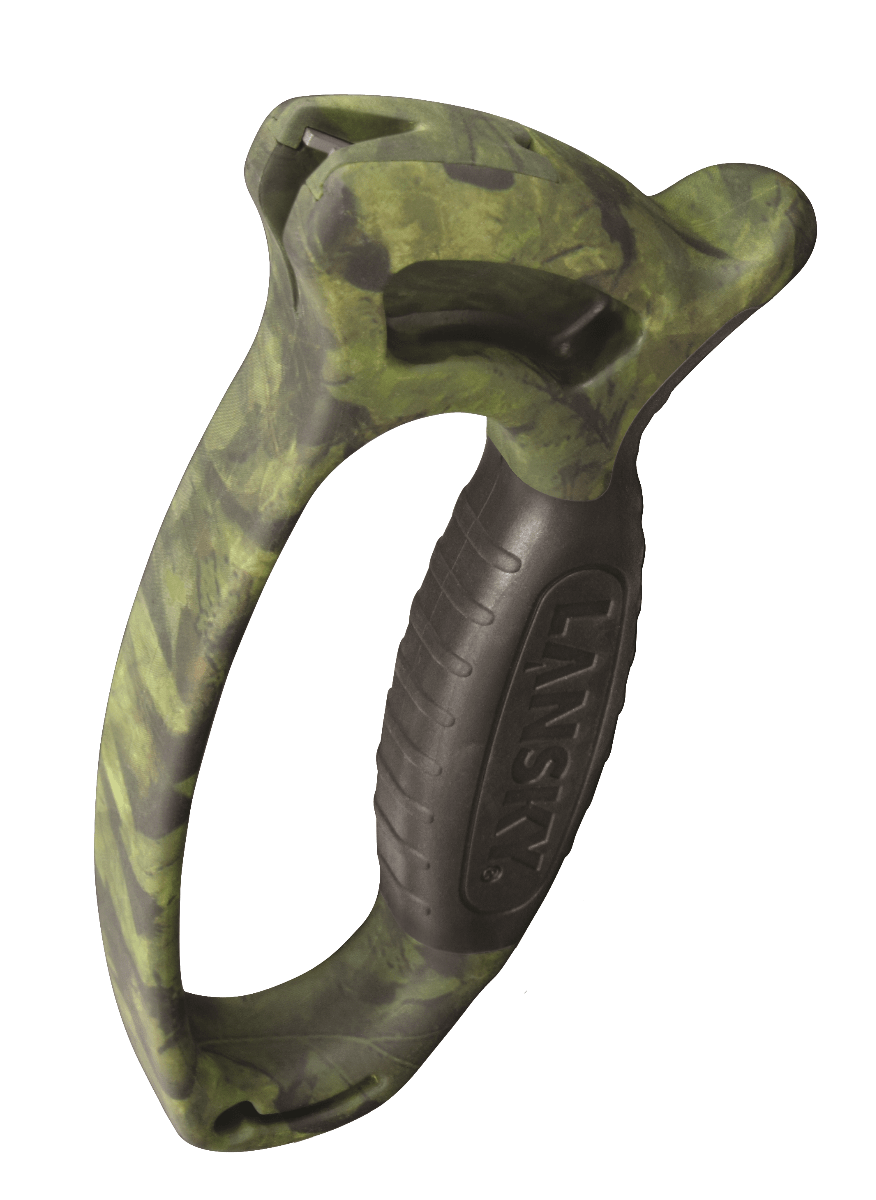
The red listing calls itself an upgrade from the black Quick Edge LSTCS. Its stated additions are the overmolded grip and carry details, not a different angle or a second sharpening stage. The black model’s own page explicitly lists right- or left-handed use; the Camo listing does too, but I do not extend that wording to the red item as a separate claim. For either Deluxe finish, check the retail label and SKU rather than relying on a shared family name or a retailer photograph.
Read the setup closely
Lansky instructs the user to place the knife on a flat, solid surface with the cutting edge up and roughly half an inch of blade beyond the surface. Hold the knife steady with one hand, place the sharpener’s V over the blade near the handle and draw it toward the tip. The maker says to hold the sharpener roughly 90° to the blade and warns that a much different approach can impair sharpening. This is a tool-handling direction, not an alternative to the separate 22.5°-per-side slot geometry.
The method is not a one-handed pull through the knife: the user must steady the blade and guide the sharpener, so the work area and hand placement matter. Follow the finger guard and thumb-rest instructions, keep fingers away from the edge and avoid heavy pressure. Lansky instructs the user to clean the blade thoroughly after the strokes. The product records do not state maximum blade length, thickness, compatible handle clearance, a carbide grit or a separate care method for the insert; verify fit with the actual knife rather than assuming the V accepts every profile.
Where it fits—and where it does not
The two models appear in Lansky’s Portable Sharpeners listing, and both include a lanyard point in their product descriptions. That supports considering them for a compact pocket or outdoor routine. The exact Deluxe pages do not name kitchen knives in the same way that the base LSTCS page does, so this assessment does not treat the Deluxe variants as a documented kitchen-use match. Nor does the maker provide a dedicated serration or scissor procedure for either SKU. A carbide pull-through opening should not be treated as evidence for either task.
One reason to choose the Deluxe over the black LSTCS is the grip: the maker specifies overmolded rubber and a more generous hand rest, plus a lanyard hole for carrying. The evidence does not show that those features sharpen faster, last longer or produce a better edge. The basic and Deluxe designs share the same fixed angle and material, so neither answers a need for exact bevel adjustment, controlled multi-grit refinement or a separately guided edge.
Bottom line
The Deluxe Quick Edge is a focused portable tool for someone whose blade suits one fixed 45°-inclusive carbide path and who values the overmolded grip. The red LSTCN and camo LSTCNCG have distinct finishes and exact manufacturer images, but the available instructions document the same sharpening operation. Its main compromises are the aggressive single abrasive, missing grit and blade-fit specifications, and lack of a dedicated finish or serration stage. Review the LSTCN Red page and LSTCNCG Camo page for the exact SKU and instructions before choosing between variants.
Key specifications
Key details at a glance
| Power | Manual |
|---|---|
| Sharpening format | Handheld single-slot carbide pull-through sharpener with an overmolded grip, finger guard and thumb rest; red and camouflage finish variants share the documented sharpening path |
| Lowest angle setting | 22.5° |
| Highest angle setting | 22.5° |
| Included abrasive surfaces | One reversible and replaceable tungsten-carbide pull-through element; grit is not stated |
| Angle-guide positions | 22.5° |
Use the exact model’s instructions for operating limits, supplied equipment and version differences.
Sources for this review
Sources for this assessment
- Knife Sharpeners — Lansky US catalogue, page 1
- Portable Sharpeners — Lansky US catalogue, page 1
- Deluxe Quick Edge® Red, SKU LSTCN — exact Lansky product record and instructions
- Deluxe Quick Edge® Camo, SKU LSTCNCG — exact Lansky product record and instructions
- Deluxe Quick Edge® Red LSTCN — exact first-gallery Lansky product image
- Deluxe Quick Edge® Camo LSTCNCG — exact first-gallery Lansky product image


Check the requirements that matter to you
Use the finder to compare documented sharpener formats and limits; an unknown capability is not treated as a match.