
Your needs, this model
Does it fit your priorities?
What DSHARP angle choices are documented?
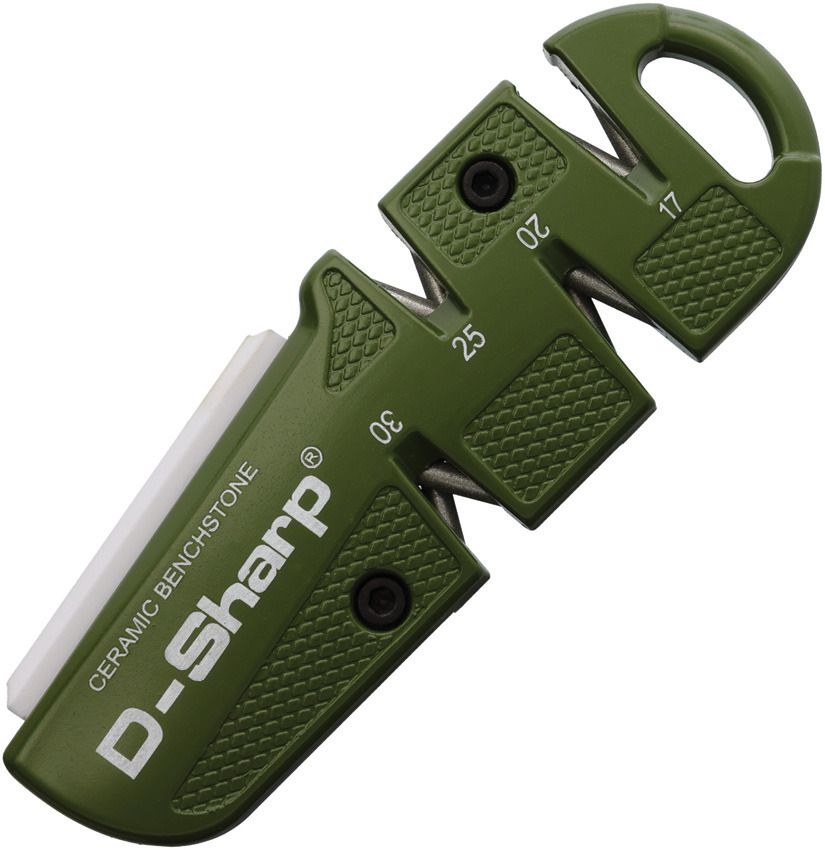
The exact Lansky page lists four fixed diamond-slot positions: 17°, 20°, 25° and 30°. They are discrete marks, not settings between those values. The page does not state a per-side versus inclusive convention, so treat them as capability labels and check the exact knife's bevel guidance.
Explore this need in the finder →Does D-Sharp use the same abrasive in both elements?
No. The exact product source lists 400-grit diamond at the four pull-through slots and a separate 800-grit ceramic mini benchstone. The latter is positioned for maintenance/finishing and serrations. Do not turn those different materials into a performance ranking from grit figures alone.
Explore this need in the finder →Can the D-Sharp numeric slots be used to set serration angle?
No numeric serration angle is documented. Lansky describes a separate method using the tapered ceramic element one serration at a time; its four diamond-slot labels belong to the plain-edge pull-through paths.
Explore this need in the finder →This is a research-based assessment of the current U.S. Lansky DSHARP record and instructions, not a hands-on test or a claim of measured performance.
Four marked slots, diamond plus ceramic
The D-Sharp® Diamond (SKU DSHARP) is a portable manual sharpener with four marked pull-through slots and an integrated ceramic benchstone. Lansky lists the knife slots as 400-grit diamond and the second element as an 800-grit ceramic surface tapered for serrations and finishing. The exact product record gives a body size of 4.3 by 1.4 by 0.5 inches and a weight of 4.3 ounces. This is a compact body, but those dimensions are not a guarantee of clearance for any particular blade, handle or bolster.
The four marked knife positions are 17°, 20°, 25° and 30°. They are distinct fixed slots, not a dial that can be set between the numbers. The exact DSHARP copy describes compatibility with Lansky’s controlled-angle kits and Turn Boxes, but it does not state whether its labels are per-side or inclusive angles. Treat the marks as the tool’s documented capability and check the intended knife’s actual bevel convention before using one. An available mark is not by itself advice to change the blade’s edge geometry.
What the diamond element does—and what the number does not say
Lansky identifies the four slots as 400-grit medium diamond. That gives a useful factual distinction from the ceramic-slot C-Sharp and the carbide-slot QuadSharp. It does not support a simple performance ranking by nominal grit: the three tools use different abrasive materials, and the maker’s exact sources do not provide a standardized comparison or a universal steel/edge result. DSHARP’s positioning is for someone who wants diamond pull-through slots in a portable angle-marked format, not proof that it cuts faster, lasts longer or suits every hard steel.
The second surface is a ceramic mini benchstone listed at 800 grit. It can be used as a separate honing or maintenance element, and Lansky describes a distinct serration procedure using the tapered part. Like CSHARP, the D-Sharp’s feature list labels that surface fine at 800 grit while the instruction paragraph calls it medium (800). The numeric grit is consistent; the descriptive adjective is not. The serration instructions do not assign a number to the angle, so the four plain-edge slot settings should not be carried over to the scallops.
Care and sequence matter
The product instructions tell the user to guide the blade through the selected diamond slot and rinse the blade afterward. The ceramic surface has its own benchstone-like or rod-like method, and Lansky says to clean dark metal-transfer marks from it with an Eraser Block. Those directions describe the two included abrasive elements; they do not establish a complete repair kit with several diamond grades. The exact page presents the 400-grit diamond slots as the medium option and the ceramic surface as a separate finishing/serration task.
Keep the plain-edge and serrated operations separate. A knife can meet a fixed-slot numeric requirement only through one of the four diamond slots. A serrated knife uses the tapered ceramic procedure, which has no numeric angle field. The matcher’s plans therefore separate these tasks rather than implying that a 20° slot setting also governs serrations. As with any sharp blade, keep fingers away from the edge, use a stable position, and follow the model-specific safety directions.
How it compares with QSHARP and CSHARP
The three Lansky portable tools share a general four-angle format and a tapered ceramic element, but their slot materials are materially different. QSHARP uses carbide and Lansky expressly describes it as aggressive for quick correction; CSHARP uses 600-grit ceramic slots as the all-ceramic, gentler alternative; DSHARP lists 400-grit diamond slots. All three also have a separate 800-grit ceramic element for maintenance or serration work, but only CSHARP and DSHARP have the “fine/medium” wording conflict in the exact instructions noted above. Verify the SKU because their similar shape and common angle numbers can obscure different sharpening surfaces.
All three are described as usable on their own or compatible with the Lansky system family. That compatibility does not mean that DSHARP includes the clamping frame, guide rods, storage case, strop, oil or other pieces of a separate kit. If a complete guided setup is the objective, compare exact package contents in the relevant kit reviews rather than assuming this small accessory-style body contains them.
Who may find it useful
DSHARP is worth considering if you want a hand-operated portable tool with four fixed angle labels, diamond contact in the pull-through slots, and a separate ceramic maintenance/serration surface. Its main limitations are the same ones that make its form simple: no continuous angle adjustment, no full stone progression, no published maximum blade length or clearance table, and no stated angle convention. The available material labels help distinguish its design from the carbide and ceramic slot alternatives, but they do not replace an individual fit check.
Assessment: The D-Sharp is a specifically configured combination of fixed-angle diamond slots and a separate ceramic benchstone, not a generic “four-angle Lansky” interchangeable with every other model. The best reason to choose it is the diamond-slot format in a compact body; the important checks are the marked-angle convention, blade geometry, edge type, and exact package. The exact product page supplies no universal claim for all knives or all serration profiles.
Key specifications
Key details at a glance
| Power | Manual |
|---|---|
| Sharpening format | Portable manual four-angle diamond pull-through sharpener with an integrated tapered ceramic benchstone |
| Lowest angle setting | 17° |
| Highest angle setting | 30° |
| Included abrasive surfaces | Four 400-grit medium diamond pull-through slots at fixed 17°, 20°, 25° and 30° labels / Integrated tapered 800-grit ceramic mini benchstone; feature copy calls it fine while the instructions call the 800-grit element medium |
| Benchtop base included | No |
| Angle-guide positions | 17 / 20 / 25 / 30° |
Use the exact model’s instructions for operating limits, supplied equipment and version differences.
Sources for this review
Sources for this assessment

Check the requirements that matter to you
Use the finder to compare documented sharpener formats and limits; an unknown capability is not treated as a match.