
Your needs, this model
Does it fit your priorities?
When does Lansky place LBS6H in its Arkansas sequence?
The exact instructions identify Hard Arkansas for honing or polishing a finished edge and Soft Arkansas for maintaining an already-sharp edge. The LBS6H package is only the Hard stone, so earlier and extra-fine stages are separate choices.
Explore this need in the finder →Does LBS6H guide the blade at a numeric angle?
No numeric setting, clamp, or marked guide is stated. Lansky says to observe the bevel and match it, so this stone depends on the user's freehand angle control.
Explore this need in the finder →What maintenance supply should be checked with this stone?
The maker's exact routine directs the user to lubricate the Arkansas surface with honing oil and clean the stone after use. The exact listing does not confirm that oil comes with an individual seller offer.
Explore this need in the finder →This assessment is based on Lansky's exact Hard Arkansas Stone, SKU LBS6H, and its published instructions. It is not a hands-on test or a report of measured edge results.
What makes the LBS6H different
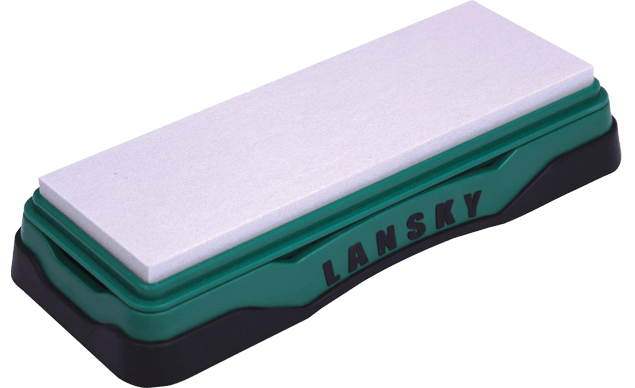
The LBS6H is a manual, single-surface natural Hard Arkansas benchstone. Lansky identifies this version as a six-by-two-inch stone in a base with a non-slip rubber frame, and lists a 450–650-grit range. Unlike the Soft Arkansas LBS6S/LBS8S, this hard grade is the maker-designated finer step: the exact instructions call it the stone for honing or polishing a finished edge, while Soft is listed for maintaining an already-sharp edge. Some product copy applies broad finishing language to both grades, but the step-by-step directions provide the specific distinction used here.
That role distinction matters more than the name alone. A hard stone is not an adjustable angle system and it is not a multi-stage package. Lansky's family instructions suggest a sequence that may include coarser work, a Soft Arkansas stone, this Hard Arkansas stage, and an extra-fine stage. The LBS6H listing supplies one stone and base, not all of those abrasives. If you need to repair a damaged edge or establish an edge from scratch, the exact page does not assign that job to this hard stone; select only after confirming the appropriate earlier stage.
A freehand finishing routine
The manufacturer says to use the stone on a stable, flat surface and lubricate the Arkansas surface with Nathan's Natural honing oil. The user observes the blade's existing bevel, matches that angle, and moves the edge over the stone with light, controlled strokes. The stated sequence alternates sides and repeats until the edge is sharp, then calls for cleaning the stone and storing it in a cool, dry place. Because the page does not identify honing oil as a supplied component, check the seller's exact offer or obtain oil separately.
No number of degrees, fixed guide, clamp, or guide rod is published for LBS6H. The user supplies angle control by hand. That is a meaningful difference from a guided system: the stone can be a finishing surface for a practiced freehand routine, but it does not make the bevel consistent for you. If a specific angle is essential, use a documented angle-setting system or verify your own technique and the knife's existing bevel rather than interpreting the 450–650 grit range as angle guidance.
Where its published use labels help
Lansky lists regular sharpening, lawn-and-garden tools, and woodworking or chisels for this exact model. Those labels indicate that the stone is not limited to a single type of kitchen cutlery, but they do not replace detailed instructions for every edge. The exact attributes do not name pocket/hunting knives, serrations, or scissors, and they do not specify a blade-width or clearance maximum. If you are buying for one of those specialized tasks, the model-specific evidence here is not enough to promise compatibility.
The single flat surface and base make it a benchstone workflow: place the stone, stabilize your work, and bring the bevel to the abrasive. Its physical size is published as six by two inches, but that is a stone dimension, not a supported maximum blade dimension. Blade shape, handle interference, and safe hand placement still need to be considered for the actual knife.
Hard versus Soft, and what grit cannot settle
Compared with the Soft Arkansas family, LBS6H carries the maker-listed harder and finer 450–650 range rather than the Soft 200–350 range. The manufacturer's instructions present Hard as honing/polishing a finished edge and Soft as the maintenance step; its proposed progression places Hard after Soft. For a single purchase, that means LBS6H is best understood as a finishing choice, not a complete sequence. A natural-stone grit range is a useful model identifier but does not tell you how many strokes a knife will need or what finish you will achieve.
There is no included-strop claim verified for LBS6H, and the page's package details do not describe a strop, guide, oil bottle, or multiple grits. Treat those as unconfirmed rather than assume they are part of a seller bundle. The source lists a non-slip base; that is a feature of the product, not a guarantee that any workbench or surface is slip-proof.
Who should consider it
LBS6H is a plausible match for someone who already knows the edge they are maintaining, wants a natural Arkansas finishing stone, and is comfortable with a manual bevel-matching routine using oil. The six-inch length is less storage-intensive than an eight-inch Soft stone but does not imply a six-inch blade limit. It is less suitable for shoppers who need motor assistance, numerical angle settings, a complete abrasive progression in one purchase, or documented scissor or serrated-blade capability.
Buying checks
Confirm SKU LBS6H rather than the visually similar soft model LBS6S or LBS8S. The maker's image shows the Hard Arkansas product on its base, but a photograph cannot establish grit, oil inclusion, or fit. Verify the exact size, oil requirement, and any package additions with the seller. If you need the full sequence that Lansky suggests, compare the separate Soft and extra-fine options and make sure you are not mistaking a single stone for a complete kit.
Bottom line
The LBS6H is a focused freehand finishing stone: maker-listed Hard Arkansas, 450–650 grit, a six-by-two-inch surface, and an oil-lubricated routine that follows the existing bevel. Its clearest drawback is that it is only one step in a broader process and supplies no fixed angle support. For a buyer who needs that specific final-stage role, those boundaries are more useful than an unsupported promise of a razor edge.
Key specifications
Key details at a glance
| Power | Manual |
|---|---|
| Sharpening format | Manual freehand hard arkansas benchstone; set the base flat, use the maker-directed honing oil, and guide the blade across the stone while matching its existing bevel. |
| Included abrasive surfaces | One natural Hard Arkansas stone surface; the exact manufacturer attributes state 450–650 grit. Lansky identifies this hard stage for honing or polishing a finished edge. |
| Benchtop base included | Yes |
| Use dry (no oil or water) | No |
| Angle-guide positions | ° |
Use the exact model’s instructions for operating limits, supplied equipment and version differences.
Sources for this review
Sources for this assessment

Check the requirements that matter to you
Use the finder to compare documented sharpener formats and limits; an unknown capability is not treated as a match.