
Your needs, this model
Does it fit your priorities?
Does LBS6S provide a fixed angle setting?
No numeric angle, clamp or marked guide is listed for this model. Lansky instructs the user to follow the existing bevel, so the angle remains a freehand task.
Explore this need in the finder →What stage does Lansky assign to the Soft Arkansas grade?
Its specific directions assign Soft to maintaining an already-sharp edge and place Hard Arkansas later for honing or polishing. The LBS6S package is only the Soft stone; other stages are separate.
Explore this need in the finder →What should I check before buying this six-inch stone?
Confirm SKU LBS6S rather than the eight-inch LBS8S or finer LBS6H. The exact family instructions call for honing oil, but the product record does not confirm oil is in the seller's package.
Explore this need in the finder →This is a source-based assessment of the Lansky Soft Arkansas Benchstone, six-inch option, SKU LBS6S. It does not report a hands-on test, ownership, measured sharpness, or a claim that this stone fits every knife.
What the LBS6S actually is
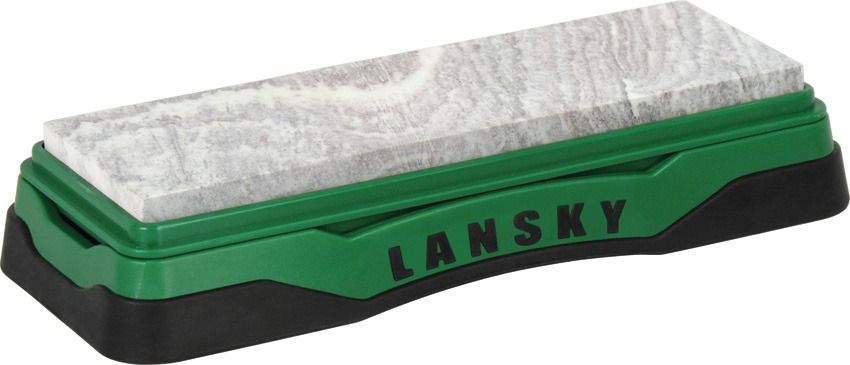
The LBS6S is one manual sharpening surface, not a clamp-and-rod system and not a multi-grit kit. Lansky's current configurable product record identifies the Soft Arkansas family and distinguishes LBS6S as the six-inch length choice. Its exact page describes a natural Soft Arkansas stone in a base with a non-slip rubber frame. The maker labels the abrasive 200–350 grit; that is a stated range, not a promise of a single uniform particle size or measured cutting rate.
The same family page lists LBS8S as an eight-inch alternative. These are separate SKUs, not the same model with a different name. The six-inch version is the more compact choice when storage space matters; the eight-inch version provides two more inches of stone length. Those are size differences only. Lansky does not publish a maximum blade length or a clearance chart for either version, so the longer stone should not be treated as proof that a particular knife will fit.
Where the maker places the soft grade
The exact instructions distinguish Soft from Hard Arkansas: Soft is for maintaining an already-sharp edge, while Hard is identified for honing or polishing a finished edge. A broad promotional sentence on the Soft listing also uses finishing language, so this assessment follows the more specific step-by-step grade distinction rather than treating that general copy as a performance guarantee. The manufacturer recommends a progression from coarser work through Soft to Hard and then an extra-fine stage. The LBS6S package is one stone, so that progression is not all included here. If an edge is damaged or needs substantial reshaping, choose only after verifying a product whose instructions explicitly support that work; the name “soft” does not document a repair capability.
This difference is useful when comparing the LBS6S with the Hard Arkansas LBS6H. The Soft stone's maker-listed 200–350 range places it below the Hard stone's published 450–650 range. That comparison can help organize a sharpening sequence, but it cannot determine the bevel your knife needs or establish a guaranteed finish. Blade steel, existing edge condition, pressure, and angle remain outside what a grit label settles.
How the documented routine works
Lansky's instructions call for a stable, flat work surface and honing oil on the Arkansas stone. The user observes the existing bevel, brings the edge to the stone at that angle, and makes light, controlled strokes across the surface; the directions describe pushing the edge in one motion rather than pulling it toward the hand. Work both sides and repeat as needed. Clean the stone after use and store it in a cool, dry place. Treat a care instruction as part of the buying decision: the product record does not say that Nathan's Natural honing oil is included, so check the exact seller package or plan to obtain the required lubricant separately.
Angle control is entirely manual. The instructions say to match the blade's bevel, but they provide no numeric angle setting, marked guide, clamp, or angle range. That makes the LBS6S a poor match for someone who needs a stated degree value or wants a fixture to hold the blade. A novice can still learn freehand technique, but this assessment cannot promise that the process will feel easy or produce a particular edge.
What the use labels do and do not establish
Lansky's exact attributes list regular sharpening, lawn-and-garden use, and woodworking or chisels. That supports a broader bench-tool role, but it is not the same as an explicit kitchen-knife, pocket-knife, serration, or scissor claim. The category listing confirms that Lansky sells the stone as a knife sharpener, yet the specific use selections do not name a kitchen or pocket/hunting class. If one of those uses is essential, check model-specific guidance for the blade before choosing rather than translating “regular” into a more specific promise.
Practical tradeoffs and checks
A single natural stone keeps the setup simple and avoids a motor or powered accessory, but it requires the user to supply a steady angle, manage the oil, and select any additional abrasive stages independently. The non-slip base is a useful documented feature; it does not eliminate the need to place the sharp edge safely or secure the work area. No verified strop, angle clamp, or complete progression is listed for this SKU.
Before buying, confirm the seller's package says LBS6S and the six-inch option, not the LBS8S or LBS6H; check whether oil is supplied; and make sure the stone's manual, freehand method fits your routine. For a longer bench surface, compare the eight-inch LBS8S. For a finer finishing stone, compare the Hard Arkansas LBS6H. Neither comparison turns a stone length or grit range into an individual blade-compatibility guarantee.
Bottom line
The LBS6S is a compact, manually guided Soft Arkansas benchstone for the maker-described maintenance role, with a non-slip base and an oil-dependent routine. It is most defensible for a buyer who wants this specific 200–350-grit soft grade and is comfortable controlling the bevel by hand. Its six-inch length is a package distinction, not a documented blade-capacity rating. Verify the exact SKU, lubricant, and intended knife use before treating it as the right stone.
Key specifications
Key details at a glance
| Power | Manual |
|---|---|
| Sharpening format | Manual freehand soft arkansas benchstone; set the base flat, apply the maker-directed honing oil, and guide a knife edge across the stone while matching its existing bevel. |
| Included abrasive surfaces | One natural Soft Arkansas stone surface; the manufacturer lists the grade as 200–350 grit and distinguishes it from the separate Hard Arkansas finishing stage. |
| Benchtop base included | Yes |
| Use dry (no oil or water) | No |
| Angle-guide positions | ° |
Use the exact model’s instructions for operating limits, supplied equipment and version differences.
Sources for this review
Sources for this assessment

Check the requirements that matter to you
Use the finder to compare documented sharpener formats and limits; an unknown capability is not treated as a match.