
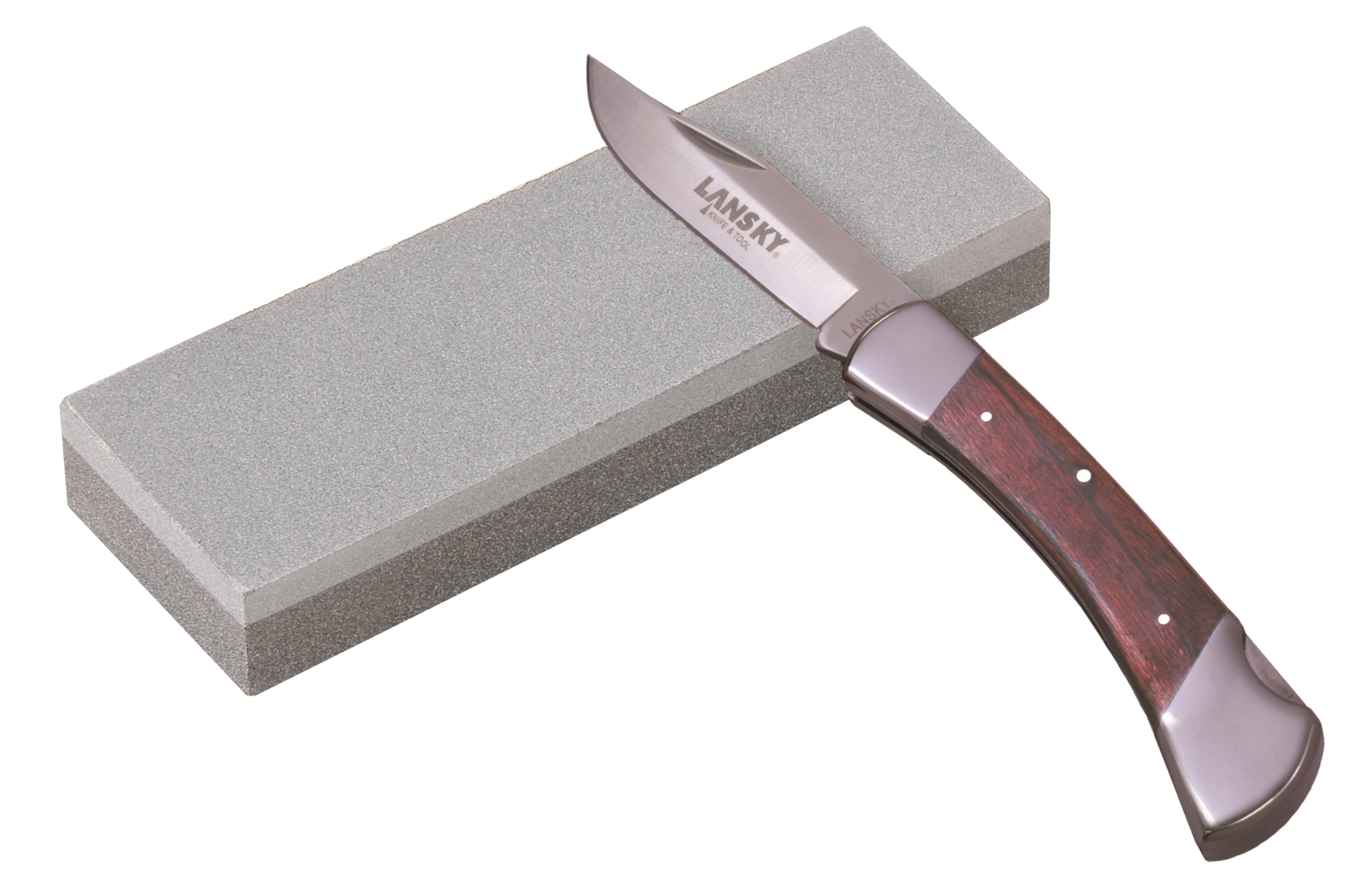
Your needs, this model
Does it fit your priorities?
Does the LCB6FC give me a fixed angle such as 20°?
No. Lansky instructs the user to observe and match the blade's existing bevel on a stable flat surface. The exact page supplies no numeric setting or angle guide, so a required 20° or 25° guide is not verified for this stone.
Explore this need in the finder →Which LCB6FC face does Lansky assign to repair and which to upkeep?
The current manufacturer family page calls the dark-gray side coarse, 120 grit, for a completely dull or damaged edge; it calls the light-gray side fine, 600 grit, for touch-up or maintenance of an already-sharp edge. It recommends progressing from coarse to fine. Retail text for the SKU conflicts at 100/240, so verify the current package if the exact grade is decisive.
Explore this need in the finder →Does the LCB6FC package include honing oil or a leather strop?
The instructions say honing oil is optional but recommended and that the same lubricant should be used consistently if chosen. The exact manufacturer page does not confirm oil as a supplied item and does not identify a leather strop; check the exact seller package rather than treating either as included.
Explore this need in the finder →Is LCB6FC the six- or eight-inch Combo Stone?
The exact manufacturer variant record maps LCB6FC to the 6-inch length option. It maps LCB8FC to 8 inches. The page does not state usable working-face length, width or height, so the nominal option is not a blade-clearance measurement.
Explore this need in the finder →This research-based assessment covers the exact Lansky Combo Stone variant LCB6FC, the 6-inch length option in the maker's configurable family record. The current product page describes one two-sided alumina-oxide stone, with a dark-gray coarse face and a light-gray fine face, and gives a freehand procedure rather than an angle jig. The manufacturer lists pocket knives, hunting and fishing knives, utility blades, and several workshop or garden-tool tasks. This is a source-based comparison, not a report of ownership, sharpening trials or measured results. The Lansky Combo Stone product page and its exact variant data are the primary evidence used here.
What the 6-inch option tells you—and what it does not
Lansky's public family record maps LCB6FC to “Combo Stone 6-inch” and a length selector value of 6 inches; LCB8FC is the separate 8-inch selection. The maker gives no width, height, measured working-face length or blade-clearance chart, so 6-inch is a nominal option, not proof of fit for a particular knife.
The family record lists length as its only configurable difference. It does not describe a different abrasive, guide, holder or operating method for LCB6FC versus the 8-inch variant. If the shorter nominal length suits the storage spot or work surface you have, this variant preserves the same two-face routine. If the extra length itself is important, compare it directly with LCB8FC rather than assuming a longer listing guarantees fit or a better edge.
Two faces, one maker-described progression
The current Lansky record calls the stone alumina-oxide and assigns two roles: its dark-gray coarse side is maker-listed at 120 grit for a completely dull or damaged edge; its light-gray fine side is listed at 600 grit for touch-up or maintenance of an already-sharp edge. The maker says to start on the side appropriate to the edge and to move from coarse to fine when using both faces. Unlike the three-surface BSTR100 Tri-Stone Benchstone, this family offers two faces of one abrasive material.
There is a published specification discrepancy worth keeping in view. The current manufacturer's family page gives 120 and 600 grit, while exact-SKU retailer text for LCB6FC lists 100 and 240. Those entries do not explain whether the difference reflects old packaging, an out-of-date database or an error, so I do not silently replace the manufacturer's current figure or claim a later version. If a specific grade is important to your purchase, verify the present LCB6FC package with the seller or Lansky before relying on either listing.
Freehand means the user sets the bevel
The maker's directions say to put the stone on a stable, flat surface, observe the blade's existing bevel, and match that angle by hand. The described stroke is a light push across the stone in one motion; the instructions then call for repeating on one side, switching sides and continuing until the edge is sharp. No clamp, guide slot, numeric angle, adjustment interval or per-side-versus-inclusive convention is stated for LCB6FC. A shopper who requires a verified 20-degree setting should not treat “benchstone” or “fine side” as a substitute for a documented angle guide.
Lansky says honing oil is optional but recommended with its Combo Stones. Its directions also say that if lubricant is used, the same lubricant should be used each time; oil can help clean the surface and limit metal-shaving buildup. The page does not say the oil is included. It also does not confirm a stand or base, a leather strop, a knife clamp or a seller-specific package, so check the exact offer rather than reading those accessories into the product photo.
Documented use is not universal blade fit
The exact maker description names pocket knives, hunting and fishing knives, utility blades, garden cutting tools, woodworking and industrial cutting-edge maintenance. That supports the pocket/hunting category used in the finder, but not every individual blade geometry or a guaranteed fit. The page gives no maximum blade length, clearance diagram or technique for serrations. It does not describe a scissor procedure. It also does not explicitly name kitchen knives in the text used for this assessment; that is a limit of the documented use claim, not evidence that a kitchen knife cannot contact the stone.
The source supplies no independent test of material removal, sharpening time or finished edge. The maker's stated use instructions—not a general grit chart—are the basis for the coarse-versus-fine advice here.
Where LCB6FC sits beside other Lansky formats
Compared with LCB8FC, this is the 6-inch selection with the same two face roles. BSTR100 instead has diamond, alumina-oxide and ceramic surfaces plus a documented base. Lansky's guided clamp kits use guide rods and angle marks; LCB6FC leaves the bevel to the user. These are setup differences, not a performance ranking.
Practical checks before choosing it
Confirm the exact SKU is LCB6FC, not LCB8FC, if the shorter size option is what you intend to compare. Ask the seller to identify the current package and confirm any holder, oil or strop you require. If a particular grit grade is purchase-critical, resolve the manufacturer's 120/600 description versus retailer 100/240 text before ordering. Consider your available flat workspace and the knife's own instructions; the page does not provide a measured clearance envelope or a fixed bevel guide. If the required job is serration maintenance, scissor sharpening or a specific angle, this record does not establish that capability.
LCB6FC is therefore best understood as a manually used, two-face 6-inch nominal option for someone willing to follow a freehand bevel and a coarse-to-fine routine. Its maker-listed pocket and hunting uses provide a clearer task boundary than the compact name alone, while the missing angle guide, unconfirmed package accessories and conflicting published grit numbers are real checks—not details to guess. No hands-on performance, price, stock, seller rating or customer experience is claimed.
Key specifications
Key details at a glance
| Power | Manual |
|---|---|
| Sharpening format | Two-sided freehand alumina-oxide benchstone: place it on a stable flat surface, select the coarse or fine face and guide a light push stroke while matching the existing bevel by hand. |
| Included abrasive surfaces | Dark-gray coarse alumina-oxide face, maker-listed 120 grit, for a completely dull or damaged edge / Light-gray fine alumina-oxide face, maker-listed 600 grit, for touch-up or maintenance of an already-sharp edge |
| Use dry (no oil or water) | No |
| Angle-guide positions | ° |
Use the exact model’s instructions for operating limits, supplied equipment and version differences.
Sources for this review
Sources for this assessment

Check the requirements that matter to you
Use the finder to compare documented sharpener formats and limits; an unknown capability is not treated as a match.