
Your needs, this model
Does it fit your priorities?
What edge angle does the LCSTC Quick Fix use?
The exact LCSTC page states one preset 22.5° path that produces a 45° inclusive angle. It is not adjustable, and the source gives no intermediate position. Compare that convention with your knife maker's guidance instead of assuming the number suits every blade.
Explore this need in the finder →What is the carbide-to-ceramic routine on LCSTC?
Lansky directs the user to stabilize the tool on a solid, flat surface, hold it firmly with fingers clear of the blade, and keep the knife upright. The exact instructions call for three or four draws through the gray carbide side, then turning the tool over for three or four draws through the white fine 1,000-grit ceramic side, followed by careful blade cleaning. The maker warns against hurrying.
Explore this need in the finder →Does the exact LCSTC record establish fit for serrated or particular knife types?
No specific knife category or serrated-edge procedure is named in the LCSTC record. The page calls it a compact pocket sharpener and refers generally to a knife blade, but that does not resolve blade length, handle clearance, edge geometry, or serration fit. Check the exact knife and manual rather than treating portability as proof of compatibility.
Explore this need in the finder →A two-surface tool, not a full angle system
The exact Lansky LCSTC listing describes a compact manual sharpener with tungsten carbide on one side and a fine ceramic Crock Stick slot on the other. It gives one preset edge angle: 22.5 degrees per side, or 45 degrees inclusive. That is the useful starting point for evaluating it. The Quick Fix is not an angle-adjustable guide, and its ceramic side does not create a second bevel setting. The product record describes a carbide sharpening pass followed by a ceramic touch-up or polish; it does not say that the ceramic surface can be used at another angle.
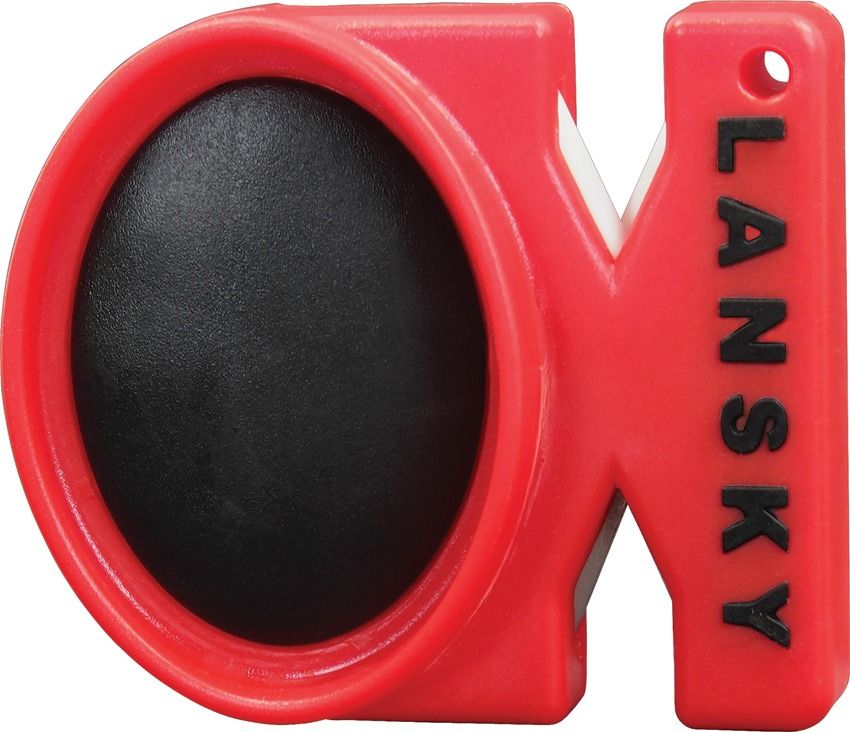
This is a different configuration from similarly named Lansky tools. The LCSTC is the red Quick Fix model with a carbide slot and a fine ceramic side. Do not confuse it with the single-surface Quick Edge or the CLSTC “Duo,” which is a separate package containing a Quick Edge tool and a separate Mini Crock Stick. The SKU matters because the names overlap while the configurations do not.
What the instructions ask you to do
Lansky's LCSTC directions describe a stable, flat work surface. The tool is held firmly with the fingers away from the blade, and the knife is held upright, as if slicing bread. The manual says to draw the blade through the gray carbide slot three or four times, turn the sharpener over, then use the white Crock Stick side for three or four strokes before carefully cleaning the edge. It calls for moderate pressure and warns against rushing. Those details are more informative than the page's short “fast tune-up” language: the path is user-guided, and care around the exposed knife remains part of the job.
The exact page identifies the ceramic as fine 1,000 grit but gives no grit for the carbide. That leaves a useful distinction and a meaningful unknown. The carbide side is the maker's sharpening surface; the ceramic side is described as a touch-up or polish step. There is no published removal-rate test, edge-retention result or measured finish in the source record, so the sequence should be read as the manufacturer's method rather than a guarantee about a particular steel or dullness level.
Check the fixed bevel against the knife
The 22.5-degree-per-side setting is explicit and fixed. A 45-degree inclusive edge may not be appropriate for every knife, and a guide number alone does not tell you whether it matches the edge already on your blade. Compare it with the knife maker's instructions before drawing the edge through either slot. The LCSTC listing does not offer another angle, an adjustment range, or an intermediate position.
The product title calls the tool a pocket sharpener and the page says it is small enough to carry in a pocket, tackle box, daypack, briefcase or purse. That establishes portability, not a complete compatibility promise for every pocket, hunting, kitchen or fishing knife. The exact page does not list a blade-length maximum, handle or bolster clearance, steel table, serration procedure, scissors use or a method for other tools. The review therefore leaves those uses outside the match claims. If an edge is serrated, a handle crowds the slot, or a blade has unusual geometry, the exact knife manual and maker guidance matter more than the compact format.
LCSTC red versus the Camo model
The separately listed LCSTCCG Camo has the same documented carbide-and-ceramic arrangement, 1,000-grit ceramic surface and 22.5-degree-per-side setting. Its page adds a camouflage finish and describes a comfort-grip rubber over-mold. The red LCSTC page does not make a corresponding statement about grip material, so this is not evidence that the red version lacks one. The sources also do not quantify any handling difference. Choose between the exact SKUs based on the documented finish and the seller's exact package, not an assumed improvement in sharpening performance.
Neither exact page lists a leather strop, a case, oil or replacement carbide insert. The ceramic polishing step should not be mistaken for an included leather stropping stage. The LCSTC image confirms the red body and brand mark, but it shows only one face; the text, rather than the photograph, establishes the two abrasive surfaces and angle. The online product record does not specify maintenance intervals or how to clean the ceramic.
Who should consider it—and what to verify
LCSTC is worth considering when the requirement is a small, hand-operated tool with a clearly stated fixed angle and two distinct abrasive sides. Its main advantage on paper is the simple, maker-described progression from a carbide slot to fine ceramic, without a larger base or powered motor. Its constraints are equally clear: one angle, guided strokes that still require care, no listed leather strop, and unresolved compatibility for particular knife types or blade profiles. This is a source-based assessment, not a report of personal use or measured performance.
Before choosing an offer, confirm SKU LCSTC and the red configuration, then check that the maker's 22.5-degree-per-side setting fits your knife's specified bevel. Verify the handle and blade can be held safely in the described upright draw-through position. If you need a documented serration method, a different angle, a dedicated strop, or an exact clearance limit, the LCSTC page does not provide it; look for an exact model whose instructions address that need rather than assuming a sibling's features transfer.
Key specifications
Key details at a glance
| Power | Manual |
|---|---|
| Sharpening format | Compact two-sided pull-through sharpener: a fixed carbide slot and a separate fine ceramic crock stick slot |
| Lowest angle setting | 22.5° |
| Highest angle setting | 22.5° |
| Included abrasive surfaces | One tungsten-carbide sharpening slot / One fine 1,000-grit alumina-ceramic Crock Stick slot |
| Benchtop base included | No |
| Strop included | No |
| Angle-guide positions | 22.5° |
Use the exact model’s instructions for operating limits, supplied equipment and version differences.
Sources for this review
Sources for this assessment

Check the requirements that matter to you
Use the finder to compare documented sharpener formats and limits; an unknown capability is not treated as a match.