
Your needs, this model
Does it fit your priorities?
How does the diamond package differ from LKC03?
The Standard Diamond kit includes 200/400/600-grit monocrystalline-diamond hones and a soft nylon brush; the LKC03 instead lists 120/280/600-grit alumina-oxide hones and honing oil. They share the manual clamp concept but not the abrasive or cleaning routine.
Explore this need in the finder →Should I oil the diamond plates?
No. The exact page says not to use honing oil on diamond hones; Lansky says to wash with dish soap and water, use the soft brush and let the plates dry before the next use. Diamond plates can wear over time, so the maker also recommends light pressure.
Explore this need in the finder →Is there a serrated hone in the box?
The listed three diamond hones are plain sharpening plates, not a dedicated serrated hone. Lansky says to add a serrated hone separately if the chosen kit lacks one; the general burr-cleanup instruction does not establish scallop-by-scallop sharpening.
Explore this need in the finder →Which angle should I use?
The maker lists 17°, 20°, 25° and 30° settings, but the checked product copy does not state the angle convention. These are discrete clamp marks rather than a continuous dial range; confirm the blade’s intended edge with its maker before choosing.
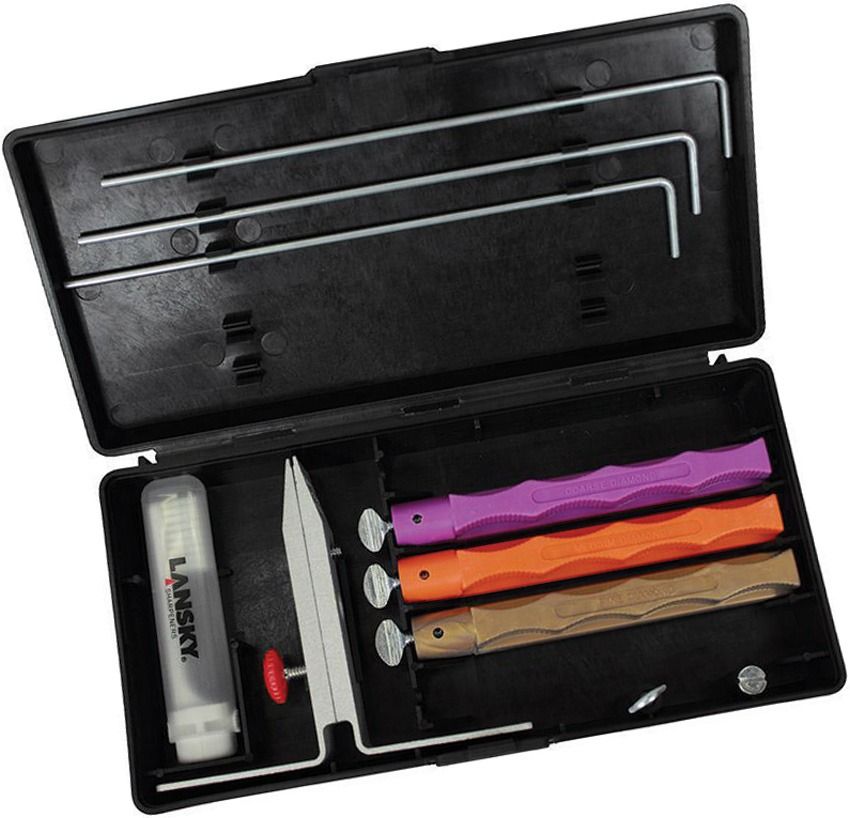
Explore this need in the finder →The Lansky 3-Hone Standard Diamond System (LK3DM) keeps the company’s clamp-and-rod approach but swaps its standard stones for three diamond plates. The exact product page lists 200-, 400- and 600-grit hones and a soft nylon brush; that abrasive and care distinction is more important than the similar-looking family name. This is a document-based assessment, not a hands-on review. Sources are the LK3DM page and Lansky’s FAQ.
Three diamond steps, with a different cleaning routine
Lansky describes the coarse 200-grit, medium 400-grit and fine 600-grit diamond hones as a progression for edge work and touch-ups. A knife clamp, guide rods, a storage case and a soft-bristle nylon brush are listed with the kit. The maker says diamond hones do not need honing oil; use the specified brush/water cleaning method and dry them. That makes this package materially different from the oil-listed standard-stone LKC03 and LKCLX, even though all share the controlled-angle clamp format.
It is a three-step set, not the complete range of Lansky diamond hones. It lacks the 100-grit extra-coarse plate found in the four-hone LKDMD and the 1,000-grit ultra-fine plate in the five-hone LKDMD5. No leather strop or dedicated serrated hone is listed. Check exact package contents before purchase; a replacement plate or accessory is not the complete LK3DM system.
Four discrete clamp marks
The maker-marked positions are 17°, 20°, 25° and 30°. The current product material gives broad examples for the Lansky settings, but does not state whether the labels represent each side or the complete included angle. They are discrete guide positions, not a continuously adjustable range. A number between them is not established as a match, and a setting that appears on the clamp does not guarantee that it suits a particular blade. Check the knife maker’s recommended geometry and the current bevel before changing it.
The controlled format has a practical consequence for longer blades: Lansky’s directions call for clamping and sharpening in successive short sections on blades over seven inches, repositioning the clamp along the edge. The user remains responsible for stable clamping, even strokes and matching work across zones; no performance result follows from the guide alone.
Who may prefer the diamond variant?
LK3DM is worth comparing for someone who wants a manual guided routine with a dry-care diamond set and already understands that its 200/400/600 sequence leaves out the coarsest and finest Lansky diamond steps. Its brush is the listed maintenance tool; the oil belongs to other Lansky hone materials and should not be assumed here. It may be a poor fit if the job needs a dedicated serrated routine, a leather strop, scissors support, motorized speed or a guide point between the four marks.
Before buying, verify the exact LK3DM SKU, three diamond hones, brush, rods, clamp and case. Consider whether the supported clamp geometry fits the intended knife, especially with longer blades that require several setups. The maker’s page supports these configuration details but does not guarantee fit for every blade shape or quantify sharpening speed, durability or edge quality.
Primary references: Lansky 3-Hone Standard Diamond System and Lansky Frequently Asked Questions.
Key specifications
Key details at a glance
| Power | Manual |
|---|---|
| Sharpening format | Manual controlled-angle clamp with three diamond hones |
| Lowest angle setting | 17° |
| Highest angle setting | 30° |
| Strop included | No |
| Angle-guide positions | 17 / 20 / 25 / 30° |
Use the exact model’s instructions for operating limits, supplied equipment and version differences.
Sources for this review
Sources for this assessment

Check the requirements that matter to you
Use the finder to compare documented sharpener formats and limits; an unknown capability is not treated as a match.