
Your needs, this model
Does it fit your priorities?
Which abrasives come in the LKC03?
The exact page lists coarse 120-, medium 280- and fine 600-grit alumina-oxide hones, one guide rod per hone, a clamp, honing oil and a storage/carry case. The middle and fine steps are useful for upkeep; a severely damaged edge may need a more aggressive hone than this box supplies.
Explore this need in the finder →Does its 20° marking mean 20 degrees per side?
The product page names a 20° setting but the checked maker copy does not define a per-side versus total-angle convention. Treat 20° as the system’s marked clamp position, compare with the knife maker’s own geometry and do not infer a universal bevel.
Explore this need in the finder →How does the clamp handle a long blade?
Lansky’s online directions tell the user to work a blade longer than seven inches in successive short target zones, flip the clamped blade for the second side, and keep a similar stroke count. It is a set-up-and-repeat workflow, not one continuous pass down the whole edge.
Explore this need in the finder →Is a serrated hone included?
No dedicated serrated hone appears in the LKC03 kit list. The maker’s FAQ recommends adding a serrated hone separately when the selected kit does not include one; a general burr-removal note is not a full serration-sharpening routine.
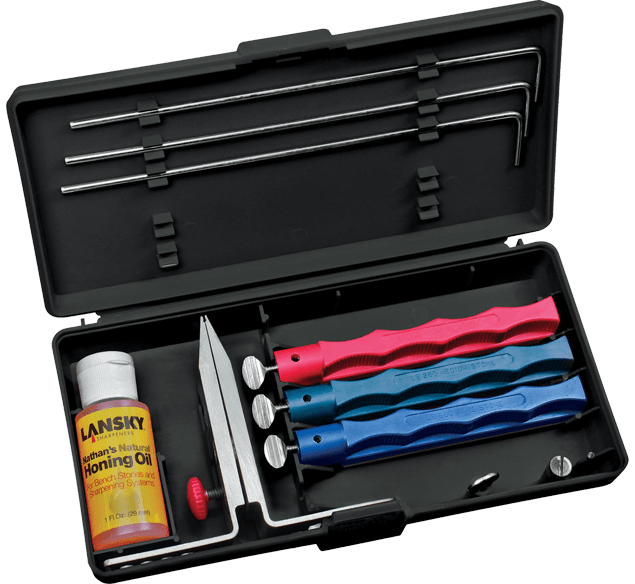
Explore this need in the finder →The Lansky Standard 3-Stone System (LKC03) is a manual, clamp-and-guide-rod sharpener built around three alumina-oxide hones. Its main distinction is a simple coarse-to-fine sequence without the extra-coarse or polishing stages found in larger kits. This is a source-based review of the listed package, not a hands-on test or a claim of personal ownership. The LKC03 product page and Lansky’s care and use FAQ are the primary references.
Three stones and a clamp
The exact package lists a red 120-grit coarse hone for reconditioning, a green 280-grit medium hone for sharpening and less frequent touch-ups, and a blue 600-grit fine hone for frequent upkeep. Lansky also lists a multi-angle knife clamp, one guide rod per hone, honing oil and a storage/carry case. The setup holds a blade in the clamp while the user moves a hone on its rod; it does not automate the strokes. The box’s included oil is part of the standard-stone routine, not proof that oil belongs on every kind of abrasive.
That 120/280/600 progression is practical for ordinary edge work, but it does not include a listed 70-grit extra-coarse hone for aggressive damage removal or an ultra-fine ceramic hone for a more polished final stage. Nor does the LKC03 page list a serrated hone or a separate leather strop. The tradeoff is focus: a smaller progression and fewer specialty tools than some sibling packages.
Discrete marks are not angle advice for every knife
The maker marks four clamp positions: 17°, 20°, 25° and 30°. Its copy associates 17° with delicate edges such as fillet knives, 20° with higher-quality kitchen and slicing knives, 25° with many knives needing a more durable edge, and 30° with heavy-duty cutting. These are the manufacturer’s broad examples, not a prescription for changing a particular blade. Lansky’s current text does not specify whether those figures mean per side or the complete included angle; confirm the knife’s existing geometry and maker guidance before selecting a setting.
The settings are discrete. A request for 22° or another in-between number is not verified just because it lies between two marks. The angle is also tied to the clamp/rod position, not to a digital measurement of the finished bevel.
Plan for setup and long blades
Lansky’s instructions tell users to center a blade up to seven inches in the clamp, turn the clamped knife over for its second side, and repeat the chosen sequence. For blades longer than seven inches the maker describes working successive short zones, shifting the clamp position along the blade. That is a stop-and-reset workflow rather than one continuous pass. Check the knife’s handle and spine clearance at the jaws before purchase; the reviewed page does not establish a universal fit for every shape.
The manufacturer says a compatible optional mount can support the system, but it is not listed as included with LKC03. Check that a seller’s box is the exact kit and that the clamp, rods, three hones, oil and case are all present. Do not confuse separately sold accessories with standard contents.
Who may shortlist it
The LKC03 merits comparison if a manual guided routine and three ordinary abrasive steps suit the intended kitchen or pocket/outdoor knife work. It is less suitable when a required feature is an included strop, a dedicated serration method, a powered motor, or a numeric angle between its four guide positions. It asks the user to clamp the knife securely, guide each hone carefully, maintain the stones and work the blade in zones when it is long. The specifications establish package contents and maker-marked settings; they do not establish edge-life results, speed, or compatibility with an unexamined knife.
Primary references: Lansky Standard 3-Stone System and Lansky Frequently Asked Questions.
Key specifications
Key details at a glance
| Power | Manual |
|---|---|
| Sharpening format | Manual controlled-angle clamp with three standard hones |
| Lowest angle setting | 17° |
| Highest angle setting | 30° |
| Strop included | No |
| Angle-guide positions | 17 / 20 / 25 / 30° |
Use the exact model’s instructions for operating limits, supplied equipment and version differences.
Sources for this review
Sources for this assessment

Check the requirements that matter to you
Use the finder to compare documented sharpener formats and limits; an unknown capability is not treated as a match.