
Your needs, this model
Does it fit your priorities?
What does the Professional kit include for serrations?
The exact SKU LKCPR lists a dedicated 800-grit serrated medium hone alongside the plain-edge 120/280/600/1,000-grit sequence. The serrated method is an independent plan and does not inherit the plain-edge guide angle.
Explore this need in the finder →How does it compare with the Universal system?
Both list the 800-grit serrated hone and 120/280/600 plain-edge hones. LKCPR adds a 1,000-grit ultra-fine ceramic hone; neither is powered, and the added finish stage does not replace the clamp-and-rod work.
Explore this need in the finder →Does Professional mean a commercial sharpener?
No conclusion about throughput follows from the name. The page describes a manually clamped consumer sharpening system, with storage case and hand-guided hones. Treat it as a manual kit rather than assuming workplace capacity from the marketing name.
Explore this need in the finder →Is there an included leather strop?
No separate leather strop appears in the exact package list. The ceramic ultra-fine hone and the 800-grit serrated hone are different tools; a finishing hone should not be counted as a leather strop.
Explore this need in the finder →The Lansky Professional System (LKCPR) is a manual clamp-and-guide-rod kit that pairs a familiar three-stone plain-edge progression with a ceramic finishing hone and a separate serrated hone. The “Professional” name is not evidence of commercial throughput: the reviewed package is still hand operated. This assessment uses the exact package list and manufacturer instructions, not hands-on testing or personal ownership. See the LKCPR product page and the Lansky FAQ.
Five hones with two edge tasks
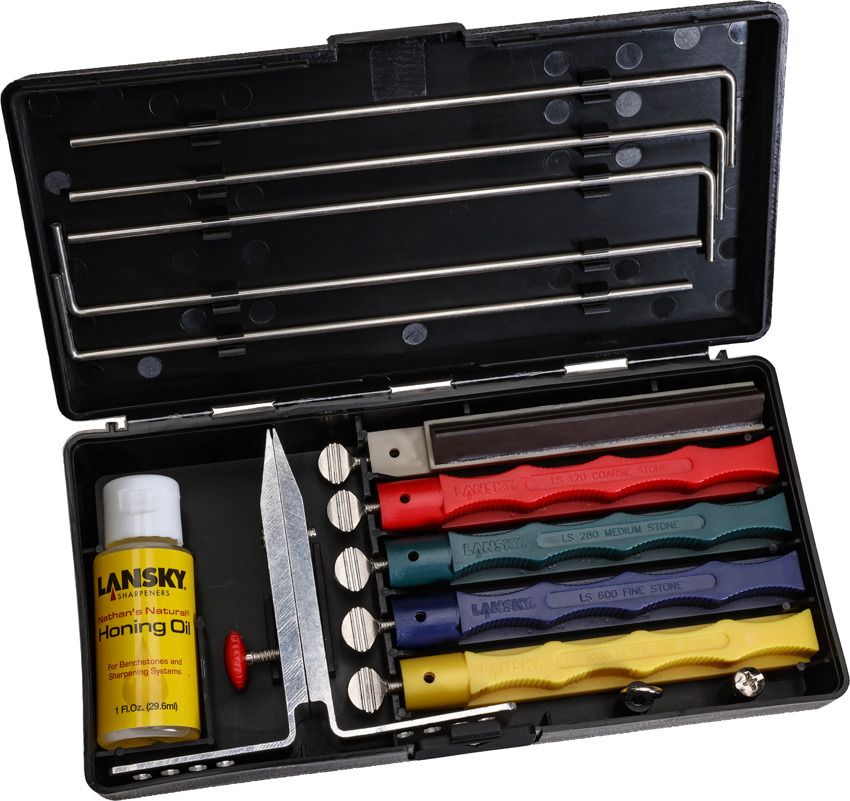
The plain-edge sequence lists coarse 120-, medium 280- and fine 600-grit alumina-oxide hones, followed by an ultra-fine 1,000-grit ceramic hone. A separate 800-grit serrated hone is also included. The clamp, guide rods, honing oil and case complete the listed kit. This makes LKCPR more extensive than the Universal System’s three plain-edge stones: it adds the 1,000-grit ceramic refinement step while retaining the serration hone. It does not “upgrade” the serrated hone into a plain-edge finishing surface; these are separate tools for separate work.
There is no leather strop in the standard product list, and the ceramic hone should not be counted as one. The system is also not a scissors sharpener on the evidence reviewed. If those are requirements, confirm another exact product rather than extrapolating from the number of hones.
Keep the serration routine separate
The 800-grit hone is the package’s dedicated serrated component. The manual plain-edge guide positions do not transfer automatically to serrations, and no numeric angle is given for that distinct task in the product listing. For plain edges, Lansky marks 17°, 20°, 25° and 30°; its copy gives broad use examples, including 20° kitchen/slicing and 25° durable outdoor edges. The material does not clarify per-side versus total-angle convention. Use the knife maker’s geometry and treat the guide positions as discrete capability points rather than a universal angle prescription.
Setup and maintenance tradeoffs
The LKCPR workflow remains a clamped blade and a hone moving along a guide rod, so it requires setup and repeated manual strokes. Lansky’s directions for blades over seven inches describe successive short sections with the clamp repositioned along the edge. The product page does not establish that every handle or blade shape will fit securely. For its standard stones, the package lists honing oil; follow the particular care instructions rather than using the dry brush method specified for Lansky’s diamond plates.
A mount is not listed as standard equipment. Check an offer for the correct LKCPR SKU and verify the 120/280/600 standard hones, 1,000 ceramic hone, dedicated 800 serrated hone, clamp, rods, oil and case. This avoids confusing a “Professional” title with a different bundle or a promise of workplace speed.
Fit summary
Compare LKCPR when a manual oil-stone controlled-angle system must address both plain and serrated edges and the ceramic 1,000-grit step is useful. Against LKUNV, that added ceramic hone is the clearest distinction; both have a separate 800-grit serrated hone. Its limitations remain the manual workflow, discrete guide positions, unknown angle convention, no included leather strop and no confirmed scissor method. The product copy establishes what the package lists, not how quickly a particular edge will be restored or how a specific knife will sit in the clamp.
Primary references: Lansky Professional System and Lansky Frequently Asked Questions.
Key specifications
Key details at a glance
| Power | Manual |
|---|---|
| Sharpening format | Manual controlled-angle clamp with four standard/ceramic plain-edge hones and dedicated serrated hone |
| Lowest angle setting | 17° |
| Highest angle setting | 30° |
| Strop included | No |
| Angle-guide positions | 17 / 20 / 25 / 30° |
Use the exact model’s instructions for operating limits, supplied equipment and version differences.
Sources for this review
Sources for this assessment

Check the requirements that matter to you
Use the finder to compare documented sharpener formats and limits; an unknown capability is not treated as a match.