
Your needs, this model
Does it fit your priorities?
What does the four-hone diamond kit add?
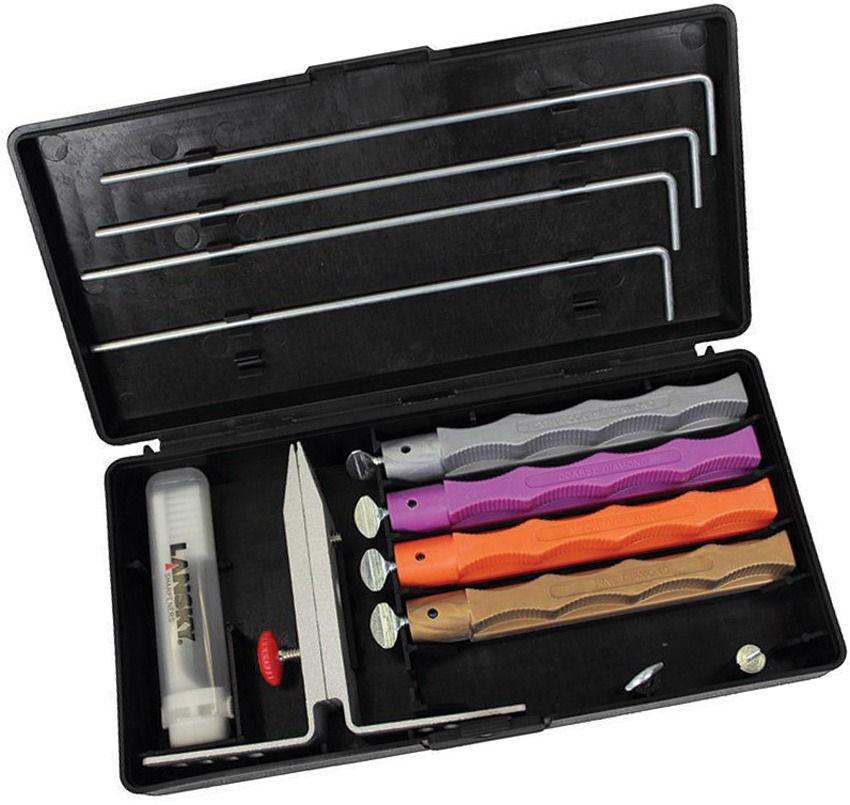
Its exact listing identifies 100/200/400/600-grit diamond plates; the 100-grit extra-coarse hone is for bevel re-profiling, followed by progressively finer plates. The LKDMD stops at 600 grit, unlike the newer LKDMD5 which adds a 1,000-grit plate.
Explore this need in the finder →How should I clean it?
Lansky says not to apply honing oil to the diamond plates. Use water and the included nylon brush, then dry them fully. The maker also notes diamond hones wear with use and recommends the weight of your hand rather than heavy pressure.
Explore this need in the finder →Does the kit have a serrated hone or strop?
The exact four-hone list is a diamond plain-edge sequence, not a dedicated serrated hone; no separate leather strop is listed in the package. Internal polishing or a fine hone is not evidence that a leather strop is supplied.
Explore this need in the finder →Are the 17°–30° guide marks adjustable continuously?
No. The exact system describes four marked settings, not intermediate positions. It also does not define whether the numbers are per side or total in the text reviewed, so treat them as maker markings and check the exact knife’s edge guidance.
Explore this need in the finder →The Lansky 4-Hone Deluxe Diamond System (LKDMD) is a manual guided kit with more coarse-range coverage than the three-hone LK3DM. It adds a 100-grit extra-coarse plate ahead of 200, 400 and 600 grit. The maker’s exact product page, rather than the shared Lansky family description, establishes the package and care routine. This written assessment does not claim to have used or tested the sharpener. See the LKDMD product page and the manufacturer’s FAQ.
What the four-hone sequence adds
The listed hones are extra-coarse 100, coarse 200, medium 400 and fine 600 grit, all diamond. A clamp, guide rods, case and soft-bristle cleaning brush are also listed. The 100-grit step can be relevant when the edge needs substantial reconditioning; the later plates provide a progression toward routine refinement. The kit page does not list an ultra-fine 1,000-grit plate, so do not mistake the four-stone Deluxe for the separate five-stone LKDMD5.
This is a dry diamond setup: the Lansky guidance says not to oil its diamond hones and describes cleaning with a brush and water before drying. That matters in a family where some standard-stone packages include honing oil. Follow the exact abrasive instructions rather than choosing care by brand alone. The package list does not include a leather strop or dedicated serrated hone.
Guide positions and setup limits
Four marks—17°, 20°, 25° and 30°—are listed for the controlled-angle clamp. They are discrete settings, not continuous adjustment. Lansky’s broader product copy describes uses for those marked angles, but it does not define a per-side or inclusive convention. Do not interpret the number as proof of the final bevel on every blade, or as a recommendation to change a knife’s existing edge. Check the maker’s advice for the knife itself.
The clamp-and-rod process takes setup and hand-guided strokes. Lansky’s instructions call for working long blades in successive short zones, repositioning the clamp along an edge longer than seven inches. That may be less convenient than a machine for someone seeking fast, repeatable throughput; the system is manual and the user sets the progression and monitors the edge. The page does not state a maximum blade length or thickness.
Comparison and buying checks
Compared with LK3DM, the extra 100-grit hone extends the coarse end but the rest of the sequence remains 200/400/600. Compared with LKDMD5, this package ends at 600 rather than adding a 1,000-grit diamond finish. Neither comparison changes the common clamp workflow. Verify the exact SKU, all four plates, brush, clamp, rods and case in the seller’s box list. A universal mount is a separate accessory, not listed as included.
Who should shortlist it
LKDMD is a reasonable model to compare when a manual controlled-angle system and a 100-grit diamond starting plate suit the intended kitchen or pocket/outdoor knife work. Its dry maintenance is distinct from oil stones, but the package is still not a powered sharpener and does not document scissors or dedicated serration sharpening. Choose it for the four identified plates, not for an assumed 1,000-grit finish, strop, angle between the marks, or a promise of fit with an unexamined knife.
Primary references: Lansky 4-Hone Deluxe Diamond System and Lansky Frequently Asked Questions.
Key specifications
Key details at a glance
| Power | Manual |
|---|---|
| Sharpening format | Manual controlled-angle clamp with four diamond hones |
| Lowest angle setting | 17° |
| Highest angle setting | 30° |
| Strop included | No |
| Angle-guide positions | 17 / 20 / 25 / 30° |
Use the exact model’s instructions for operating limits, supplied equipment and version differences.
Sources for this review
Sources for this assessment

Check the requirements that matter to you
Use the finder to compare documented sharpener formats and limits; an unknown capability is not treated as a match.