
Your needs, this model
Does it fit your priorities?
What does the newer 5-hone version add?
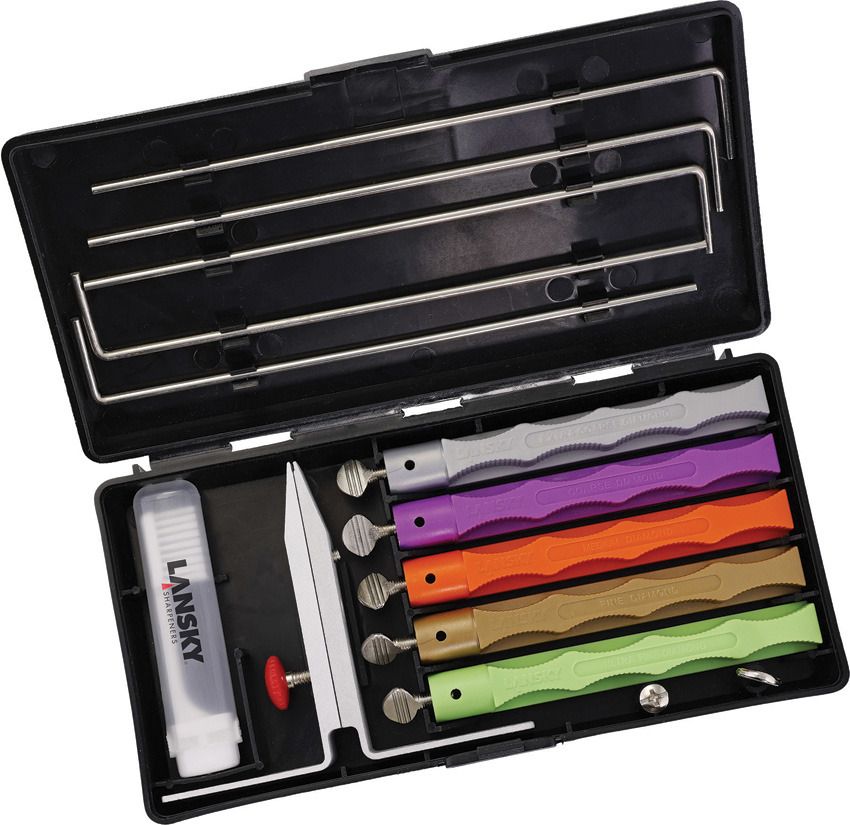
The exact LKDMD5 page lists 100-, 200-, 400-, 600- and 1,000-grit diamond hones, so this package adds an ultra-fine 1,000-grit diamond finishing plate beyond the four-hone LKDMD. Check the exact SKU because the two packages are not interchangeable.
Explore this need in the finder →Does the LKDMD5 have a settled 25° guide?
Not from the checked sources. A shared paragraph on the current exact page includes 25°, but its exact-model specification table says 22.5° (45° inclusive); the manufacturer-hosted preview repeats both pieces of copy. The common 17°, 20° and 30° markings are consistent, while the disputed value is not used as a match.
Explore this need in the finder →How do diamond hones affect setup and care?
The maker recommends no oil, light pressure and brush-and-water cleaning followed by drying. Diamond plates can wear and may need replacement; the 1,000-grit stage is a polishing step, not evidence of a leather strop.
Explore this need in the finder →Can I use it on a serrated knife?
The five listed hones are diamond plates and do not include a dedicated serrated hone. Lansky recommends adding such a hone separately when the chosen system does not include one; do not equate a general deburring note with a full serration workflow.
Explore this need in the finder →The Lansky 5-Stone Deluxe Diamond System (LKDMD5) extends the diamond-kit progression from an extra-coarse 100-grit plate through 200, 400 and 600 to an ultra-fine 1,000-grit plate. It retains the manual clamp-and-guide-rod workflow and the maker’s brush-and-dry care routine. The angle evidence needs a caveat: one current Lansky page section conflicts with its displayed angle diagram about the fourth mark, so this review does not treat that position as settled. It is a source-based model assessment, not a use report. Primary references are the LKDMD5 product page and the Lansky FAQ.
Five diamond plates, including a true ultra-fine stage
The named progression is 100, 200, 400, 600 and 1,000 grit. The exact page lists a knife clamp, guide rods, storage case and soft nylon brush. Unlike the standard-stone LKCLX or LKC03, the diamond plates are not used with honing oil according to Lansky’s care guidance; the maker directs users to brush and water-clean the diamond surface and dry it. These distinctions matter when comparing systems that share a similar clamp but use different abrasives.
The 1,000-grit plate extends the diamond sequence past the 600-grit endpoint of the LKDMD. It is not a leather strop, and no dedicated serrated hone appears in the standard package list. A separate finishing step or accessory should not be inferred from a high grit alone.
Angle conflict: do not assume every mark
The product page’s general prose names 17°, 20°, 25° and 30°; its embedded angle graphic instead shows 17°, 20°, 22.5° (45° inclusive) and 30°. Because these are not the same fourth position, the evidence does not support treating 25° or 22.5° as a verified LKDMD5 setting. The common values 17°, 20° and 30° are the only points this assessment treats as resolved. Lansky also does not make the per-side versus total-angle convention clear across this material. Treat the marks as guide capability, not universal bevel advice, and check your knife’s own geometry.
The numeric filter should therefore not match this model at the disputed fourth position. Nor should a range across two marks be invented. If a specific target is essential, confirm the exact clamp or the current manufacturer’s written specification before buying.
Setup and maintenance
As with the other Lansky controlled-angle systems, the user secures the blade in a clamp and works the hone along a guide rod. For a blade longer than seven inches the maker describes short successive zones with clamp repositioning, not a single full-length pass. This requires re-setting along the edge, and the product material does not state a universal maximum knife length or thickness. Check clearance where the blade meets the jaws.
The box’s brush is the listed cleaning accessory for its diamond plates; Lansky’s FAQ says diamond hones do not need oil and should be cleaned and dried. Keep the exact SKU and all five plates in mind when checking an offer. The seller’s phrase “five-stone” alone does not confirm that an ultra-fine plate, clamp, rods, brush and case are present.
Fit summary
LKDMD5 is worth comparing when a manual clamp-and-rod routine and five-stage diamond progression are desired. Against the four-hone LKDMD, the extra 1,000-grit plate is a concrete difference. Its limitations are equally concrete: no listed strop, no dedicated serrated hone, no powered operation, and unresolved evidence for the fourth guide position. The documented package does not guarantee that its clamp fits every handle or blade profile, nor does it establish performance results. Use the verified configuration and angle evidence—not the “Deluxe” label—to decide whether it belongs on a shortlist.
Primary references: Lansky 5-Stone Deluxe Diamond System and Lansky Frequently Asked Questions. The conflicting angle diagram is embedded in the exact product-page evidence archived for this assessment.
Key specifications
Key details at a glance
| Power | Manual |
|---|---|
| Sharpening format | Manual controlled-angle clamp with five diamond hones |
| Lowest angle setting | 17° |
| Highest angle setting | 30° |
| Strop included | No |
| Angle-guide positions | 17 / 20 / 30° |
Use the exact model’s instructions for operating limits, supplied equipment and version differences.
Sources for this review
Sources for this assessment
- Precision Sharpening Kits — Lansky US category with full pagination
- Lansky 5-Stone Deluxe Diamond System — exact Lansky product page
- Frequently Asked Questions — Lansky Sharpeners
- Lansky 5-Stone Deluxe Diamond System — exact first-gallery manufacturer kit image
- 5-Stone Deluxe Diamond product specification route — manufacturer-hosted preview

Check the requirements that matter to you
Use the finder to compare documented sharpener formats and limits; an unknown capability is not treated as a match.