
Your needs, this model
Does it fit your priorities?
What stones are included in the Natural Arkansas System?
The exact page lists a soft Arkansas stone at about 300 grit equivalent, a hard stone at about 650 equivalent and a black hard stone at about 1,200 equivalent. “Equivalent” matters: these figures should not be treated as direct standardized grit comparisons with every synthetic abrasive.
Explore this need in the finder →How does Arkansas stone care differ?
Lansky directs users to apply honing oil to Arkansas hones and keep them oiled while working. That differs from the diamond kits, whose instructions prohibit oil and use water/brush cleaning; use each material’s own maintenance directions.
Explore this need in the finder →Does the package handle serrations?
The included list is three flat natural hones, with no dedicated serrated hone listed. Do not transfer a general plain-edge technique or the other kits’ serration capability to this package.
Explore this need in the finder →Are the four angle marks exact per-side bevels?
The page lists 17°, 20°, 25° and 30° positions but does not say whether those are per side or inclusive. Treat them as marked settings and compare against the exact knife manufacturer’s edge guidance; the numeric filter is not a bevel recommendation.
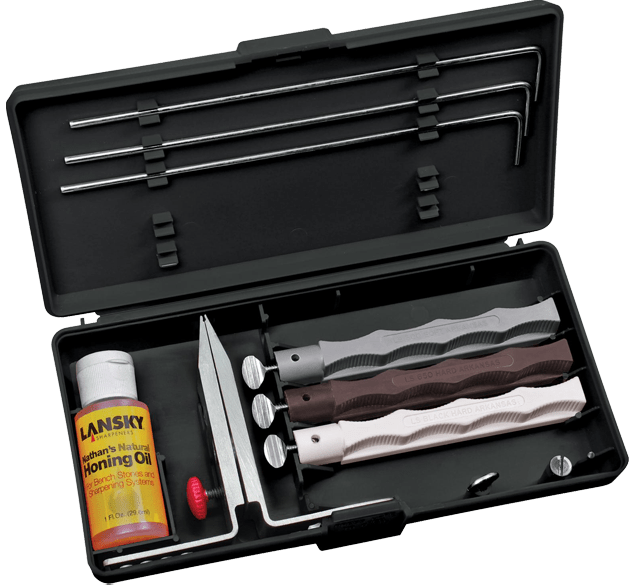
Explore this need in the finder →The Lansky Natural Arkansas Sharpening System (LKNAT) combines three natural Arkansas hones with the company’s manual controlled-angle clamp and guide rods. Its stones are presented as approximate grit equivalents rather than as the same synthetic abrasive scale used for Lansky’s alumina-oxide or diamond packages. This is a specification-based review, not a report of personal use or test results. The exact product listing is at Lansky’s Natural Arkansas System page; care information is in the manufacturer’s FAQ.
Three Arkansas grades and oil care
The package lists a soft Arkansas hone rated about 300 grit equivalent, a hard Arkansas hone about 650 equivalent, and a black hard Arkansas hone around 1,200 equivalent. The number sequence suggests a coarse-to-fine progression, but “equivalent” is not a guarantee that these natural stones behave like a synthetic abrasive carrying the same grit label. The system includes a knife clamp, guide rods, honing oil and a case. Lansky’s care instructions state Arkansas hones should be used with oil, so this kit’s maintenance differs from its dry diamond systems.
The exact list does not include a separate serrated hone, a leather strop or an ultra-coarse stone for major damaged-edge removal. Its top hone is a finishing stone, not a strop. If a dedicated serration routine or a high-removal abrasive is essential, check the available kit contents rather than assuming another Lansky accessory is included.
Guide marks are fixed points
The clamp uses 17°, 20°, 25° and 30° marks. Lansky’s broader angle descriptions associate the positions with different edge-use examples, but its current page does not define whether the displayed angle is measured per side or across the full bevel. Treat them as discrete guide points; do not infer that every in-between angle is selectable or that one mark should replace the geometry supplied with a knife. Confirm the intended bevel from the knife maker before making a change.
The manual arrangement puts the clamp on the blade and guides each hone on a rod. Lansky’s published procedure has users sharpen longer-than-seven-inch blades in short zones, moving the clamp along the edge. That repositioning may matter for long kitchen knives; the reviewed material does not state a maximum length or promise fit for every handle and blade profile.
Who should compare it?
LKNAT is worth considering for someone who specifically wants natural Arkansas stones, approximate 300/650/1,200 grit-equivalent steps and the guided clamp workflow. Its character is different from the synthetic Standard or Diamond kits: oil is part of the stated care and grit equivalence should be read as approximate. It may be a less straightforward choice if the buyer wants explicitly standardized synthetic grits, a dedicated serrated hone, a strop or a numeric angle outside the listed points.
Verify the exact LKNAT package and check that all three stones, rods, clamp, oil and case are present. The product description supports the listed materials and approximate grades, but does not provide a universal knife-compatibility guarantee or quantified performance evidence. Treat the natural-stone choice as a preference to compare, not a promise of a particular edge outcome.
Primary references: Lansky Natural Arkansas Sharpening System and Lansky Frequently Asked Questions.
Key specifications
Key details at a glance
| Power | Manual |
|---|---|
| Sharpening format | Manual controlled-angle clamp with three natural arkansas hones |
| Lowest angle setting | 17° |
| Highest angle setting | 30° |
| Strop included | No |
| Angle-guide positions | 17 / 20 / 25 / 30° |
Use the exact model’s instructions for operating limits, supplied equipment and version differences.
Sources for this review
Sources for this assessment

Check the requirements that matter to you
Use the finder to compare documented sharpener formats and limits; an unknown capability is not treated as a match.