
Your needs, this model
Does it fit your priorities?
What is the documented role of the LSS8CF grit?
Lansky specifies a fine 1,000-grit ceramic rod and describes light touch-ups and honing on kitchen knives. The separate medium LSS8CM listing specifies 600 grit. These are the maker’s distinctions; the record does not quantify performance or require a two-stick progression.
Explore this need in the finder →Can LSS8CF maintain an exact angle?
The instructions ask the user to match the existing bevel and maintain a consistent stroke. The page does not give a numbered setting, so a required 15°, 20° or 25° guide position is not documented for this model.
Explore this need in the finder →What is the cleaning instruction for the LSS8CF ceramic surface?
When residue clogs the stick, Lansky says to clean it with Nathan’s Natural Honing Oil or its Eraser Block. The exact product record does not establish that these care items are in the box or that oil is a required sharpening lubricant.
Explore this need in the finder →The Lansky Ceramic Sharp Stick LSS8CF is a manual kitchen-knife rod with a wooden grip and a maker-specified fine 1,000-grit ceramic surface. Lansky describes it for light touch-ups and honing, while its operating instructions still rely on the user to match a knife’s bevel. No numeric angle guide or hands-on result is claimed here.
Fine means a different documented role
LSS8CF is the fine member of Lansky’s 8-inch ceramic Sharp Stick pair. Its exact US product record names the model as Ceramic Sharp Stick (Fine), gives SKU LSS8CF and specifies a 1,000-grit ceramic rod with a wood-grip handle. The exact page says it is intended for light touch-ups and honing on kitchen knives. That description is more useful than assuming that any rod with “fine” in its name suits every maintenance task.
The separate LSS8CM listing is marked medium and specifies 600 grit. Those two rods should not be merged into a finish-only variant: Lansky publishes different grit designations and different use descriptions for the exact models. The maker does not, however, present them as a required pair, promise a particular progression or quantify a resulting edge. If you need a more substantial sharpening stage, the reviewed LSS8CF page does not document one inside this single-stick package.
How Lansky says to use the stick
The instructions for LSS8CF describe placing the rod tip on a stable surface, holding the handle firmly and trying to match the knife’s bevel. Draw the knife edge down the rod as though slicing a thin layer from it; Lansky suggests three or four strokes with light-to-moderate pressure, then repeating on the opposite side while keeping a consistent angle. The user supplies the angle control. The rod itself is not described as a clamp, guided sharpener or adjustable fixture.
That matters when comparing maintenance routines. A freehand rod may suit someone comfortable preserving the existing bevel by hand, but this product record publishes no numeric angle, set of guide marks or angle range. It also gives no convention for per-side versus inclusive angles. If a particular setting is mandatory, do not infer it from the 1,000-grit figure, the ceramic surface or the rod’s model name; choose a product whose exact documentation provides the angle requirement.
Kitchen use is specific, not unlimited
The current LSS8CF page names kitchen knives and describes light touch-ups and honing. It does not give a blade-length limit, clearance dimensions, geometry chart or instructions for scissors and other tools. It does not document a serrated-edge routine, ceramic-blade support, pocket/hunting use or a separate sharpening stage. A general kitchen label therefore supports only the maker-named task; it is not a guarantee for every kitchen knife or edge style.
Likewise, “fine 1,000 grit” is a manufacturer specification, not an independently measured performance ranking. Lansky’s description supports treating LSS8CF as the finer sibling of LSS8CM, but does not say how many strokes a particular knife needs or what edge condition will result. The recommendation to compare them should be read as a choice between documented roles—medium 600 grit versus fine 1,000 grit—not a claim that one universally replaces the other.
Care and safe handling
When ceramic material becomes clogged with sharpening residue, Lansky says to use its Natural Honing Oil or Eraser Block to clean the LSS8CF. This exact page does not say that oil is included in the package or must be applied as a sharpening lubricant. Check the instructions supplied with the exact item, and do not transfer care instructions from a diamond or steel rod just because the models share a product family.
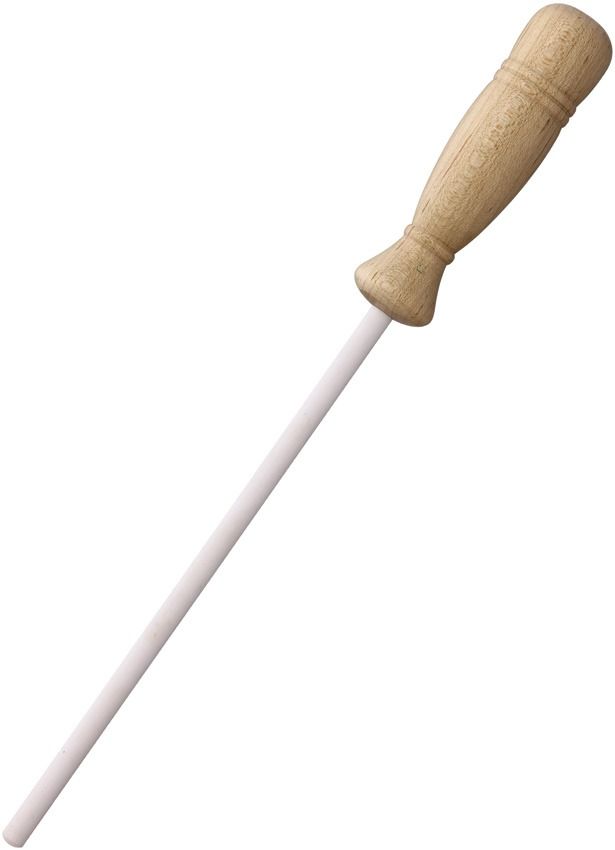
The rod tip is meant to rest on a stable surface during the hand-guided stroke, so a secure, uncluttered work area matters. Lansky flags sharpening as inherently dangerous and warns against careless blade handling. The manufacturer image corresponds to the LSS8CF gallery label and shows a pale ceramic rod with a wooden handle; the image does not establish dimensions, a hand guard, package accessories or abrasive behavior. Keep the edge pointed away from the supporting hand and stop if the rod or knife shifts.
Who should compare this model
LSS8CF is the closer match when the needed job is a maker-described fine ceramic rod for light kitchen-knife touch-ups and honing. It is not a documented answer for a fixed-angle system, broad damaged-edge repair, serrations, scissors or a package that must include a strop. In each of those cases, the source simply lacks the matching evidence; that is not proof that no product elsewhere can meet the need.
Before purchase, check the exact LSS8CF SKU and the package contents rather than relying only on a thumbnail or a generic “ceramic rod” title. Verify that a freehand, bevel-matching stroke is appropriate for the knife’s existing edge and that the item offered is not the medium LSS8CM. If you want the medium sibling instead, read its separate review: its exact product record says 600 grit, not the fine model’s 1,000-grit specification.
Evidence note: This review is based on the exact LSS8CF product data and instructions. No ownership, hands-on use, sharpening test, measured result, price, seller-stock claim or customer experience is represented.
Key specifications
Key details at a glance
| Power | Manual |
|---|---|
| Sharpening format | Hand-guided ceramic rod with a wood-grip handle; the user places the tip on a stable surface and draws the knife edge down the rod while matching the knife’s existing bevel. |
| Included abrasive surfaces | One fine 1000-grit ceramic rod |
| Angle-guide positions | ° |
Use the exact model’s instructions for operating limits, supplied equipment and version differences.
Sources for this review
Sources for this assessment

Check the requirements that matter to you
Use the finder to compare documented sharpener formats and limits; an unknown capability is not treated as a match.