
Your needs, this model
Does it fit your priorities?
Does the LSS9D set a numeric edge angle?
No numeric setting is listed. Lansky tells the user to try to match the knife's own bevel and keep the angle consistent while drawing the edge down the rod. That is a freehand task, not evidence that the tool supplies a particular 15°, 20° or 25° guide position.
Explore this need in the finder →What knife use and abrasive does Lansky name for LSS9D?
The exact product record calls this a medium 400-grit diamond Sharp Stick and says it is intended for kitchen and carving knives. That maker-stated use is narrower than a universal fit promise: the page does not chart blade length, clearance, edge geometry or every kitchen knife.
Explore this need in the finder →How does Lansky say to maintain the LSS9D diamond surface?
The exact directions say not to apply oil to the diamond surface. Clean the diamond hone with water, wipe shavings away with a lint-free rag and ensure it is completely dry before the next use. This is the LSS9D care note, not a cleaning rule for every Lansky abrasive.
Explore this need in the finder →The Lansky Diamond Sharp Stick LSS9D is a manual rod rather than an angle-setting jig. Its exact product record identifies a medium 400-grit diamond surface and names kitchen and carving knives, but the user supplies the bevel angle. This assessment is based on Lansky’s exact model instructions and product data, not a hands-on test.
What makes the LSS9D distinct
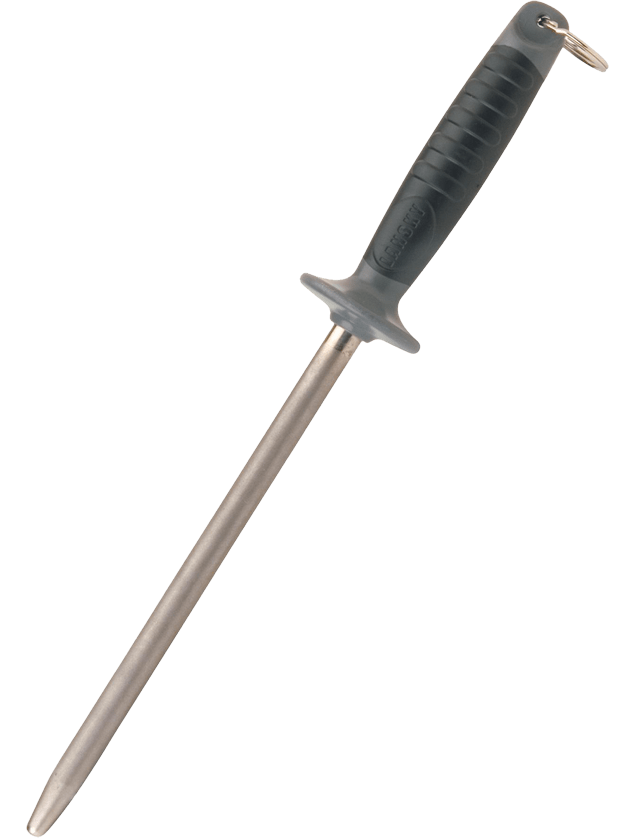
LSS9D is the diamond member of Lansky’s 9-inch Sharp Stick pair. The manufacturer describes its abrasive as medium 400-grit diamond permanently bonded to a heavy-duty steel rod. It also specifies a hand guard and an over-molded rubber, non-slip comfort-grip handle. Those are documented construction and package features; they are not evidence of a quantified improvement in grip, speed, edge life or sharpness.
The exact page names kitchen and carving knives as its intended work. That gives the model a more specific use description than the companion LSS9S Steel Sharp Stick page, which describes knives generally without naming a kitchen or carving category. Neither statement proves that every blade in the named group will fit the rod comfortably. Lansky publishes no maximum blade length, handle-clearance chart or blade-profile matrix for LSS9D in the record reviewed here.
The method is freehand, not angle-controlled
The instructions ask the user to place the rod tip on a stable surface, grip the handle, and try to match the knife’s bevel while drawing the edge down the rod as if shaving a thin layer from it. The maker suggests three or four light-to-moderate strokes, then repeating on the other side and maintaining a consistent angle. This is an operating plan that relies on the user’s judgment. The record gives no 15°, 20° or 25° setting, no adjustment range and no convention for converting a blade’s angle to an inclusive number.
That distinction matters when a particular angle is non-negotiable. The LSS9D can be considered for a manual rod routine where the user is following the knife’s existing bevel; it is not the documented answer to a request for a precisely set numeric angle. Do not infer a number from the word “medium,” the rod’s shape or its model name. If repeatable angle positioning is the priority, compare systems with manufacturer-documented guide positions and check whether those positions use the same convention as the knife maker.
What the 400-grit claim does—and does not—tell you
A medium 400-grit diamond surface is the only abrasive specified for this exact stick. Lansky promotes it for maintaining kitchen and carving knives and says a few strokes can restore a factory-like edge. That is the manufacturer’s claim, not a measured performance result. The product record does not give a second finer surface, a progression for a damaged edge, a ceramic finishing step or a leather strop. It also does not state an included-strop inventory, so a required strop should be confirmed separately rather than assumed.
Compared with the steel LSS9S, the LSS9D has an explicit diamond grit and a product-page use statement naming kitchen and carving knives. The two should not be treated as identical rods with different labels. Conversely, LSS9D’s kitchen claim is not a general permission to sharpen serrations, scissors, ceramic blades or any particular steel; the exact page supplies no such procedures.
Care and safe setup
The diamond surface has model-specific care instructions: do not apply oil. Lansky says to clean diamond hones with water, wipe shavings away with a lint-free rag and allow the surface to dry completely before the next use. This is not a blanket cleaning rule for other abrasives or the steel-rod model.
Stable placement and hand position matter because the knife is moving against a rod, and the instructions explicitly treat sharpening as hazardous. Keep fingers behind the hand guard, keep the rod tip steady, and stop if the knife or tool shifts. The page does not document a clamp or base that secures the knife. Anyone expecting a hands-off guide should consider a different format rather than treating a hand guard as an angle-control feature.
Who should compare it—and what to verify
The strongest reason to consider LSS9D is a preference for a compact, hand-guided diamond rod with a stated medium grit and a manufacturer-named kitchen/carving use. Its important limitation is equally clear: the user maintains the bevel by feel, with no numeric guide or published blade-fit limits. A buyer who needs a fixed setting, a serration procedure, scissors support or a named hunting/pocket fit should look for exact documentation for that requirement.
Before choosing an offer, check that it is the Diamond Sharp Stick SKU LSS9D rather than the visually similar Steel Sharp Stick LSS9S or one of Lansky’s ceramic sticks. Confirm the exact supplied rod and the model-specific care directions; do not rely on a marketplace title alone for grit, package contents or dimensions. The image shown with this assessment is the manufacturer’s LSS9D gallery image and is not used to infer dimensions or performance.
Evidence note: No ownership, hands-on use, comparative test, measured result, price, current seller stock or customer experience is claimed. The assessment separates Lansky’s exact SKU data and instructions from unanswered compatibility questions.
Key specifications
Key details at a glance
| Power | Manual |
|---|---|
| Sharpening format | Hand-guided diamond rod with a hand guard and rubber over-molded handle; the rod tip rests on a stable surface while the knife moves along the rod at its own bevel. |
| Included abrasive surfaces | One medium 400-grit diamond surface bonded to a heavy-duty steel rod |
| Benchtop base included | No |
| Angle-guide positions | ° |
Use the exact model’s instructions for operating limits, supplied equipment and version differences.
Sources for this review
Sources for this assessment

Check the requirements that matter to you
Use the finder to compare documented sharpener formats and limits; an unknown capability is not treated as a match.