
Your needs, this model
Does it fit your priorities?
Does LSS9S have a preset angle guide?
No. Lansky tells the user to try to match the bevel of the knife and keep that angle consistent while drawing the edge down the rod. The record does not publish a numeric setting, an adjustment range or a per-side/inclusive angle convention.
Explore this need in the finder →What does the exact LSS9S page say about its rod material and grit?
The model is named Steel Sharp Stick and the short description calls it a classic butcher's-rod-style sharpener. The exact page does not state a steel grade, surface finish or grit, so those details cannot distinguish it beyond the steel-rod format documented by Lansky.
Explore this need in the finder →Is LSS9S verified for kitchen, hunting, serrated knives or scissors?
The exact page refers to restoring an edge on knives generally, but does not identify a kitchen, hunting or other use subtype, a serrated-edge procedure or a scissors operation. Treat that as an evidence limit and verify the exact knife rather than converting the butcher's-rod style name into a compatibility guarantee.
Explore this need in the finder →The Lansky Steel Sharp Stick LSS9S is the steel-rod counterpart to the company’s LSS9D diamond model. The exact page documents a hand guard, rubber over-molded handle and freehand strokes at the knife’s own bevel. It does not state a grit, steel grade, numeric angle or particular knife-use category. This is a source-based assessment, not a hands-on review.
Steel rod, not the diamond version
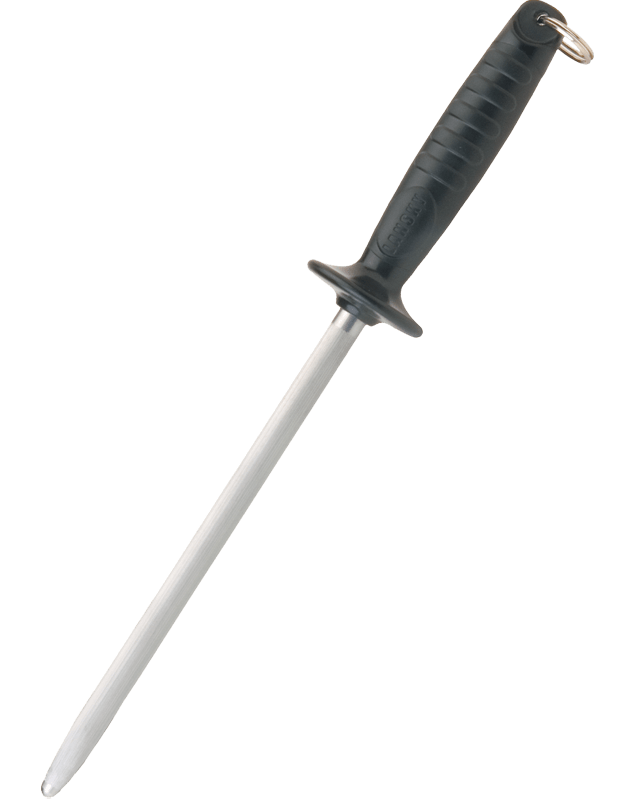
The exact Lansky product record names this model “Steel Sharp Stick® 9-inch” and calls it a classic butcher’s-rod-style sharpener. It describes a hand guard and an over-molded rubber, non-slip comfort-grip handle. The record does not identify the steel grade, surface finish or grit. The model title includes “9-inch,” but the source does not clarify whether that is a usable rod length, total length or another dimension; this review does not treat it as a measured stroke span.
This distinction is more useful than guessing at a hidden specification. The LSS9D sibling is explicitly described as medium 400-grit diamond bonded to a heavy-duty steel rod and named for kitchen and carving knives. LSS9S is a separate SKU and product page: it says “steel” and offers general knife wording, but does not give the same grit or name those use categories. Do not transfer the sibling’s diamond specification, care steps or kitchen claim to the steel model.
How the maker says to use it
Lansky’s LSS9S instructions begin with placing the rod tip on a stable surface and holding the handle firmly. The user is told to try to match the knife’s bevel and draw the edge down the rod as if slicing a thin layer from it, using three or four light-to-moderate strokes and repeating on the other side. The directions emphasize a consistent angle. That is a hand-guided routine; there is no numbered guide, adjustable setting or stated per-side/inclusive angle in the exact record.
A rod may make sense to someone comfortable controlling a freehand stroke, but that description is not a promise that every blade can be managed safely or that the tool will repair every edge condition. No maximum blade length, clearance diagram, steel compatibility chart, edge geometry or step-by-step damaged-edge progression is documented for this exact model. If exact angle control is essential, the LSS9S is not supported by the information Lansky provides here.
What the source leaves unknown
The page says the Steel Sharp Stick can put a “factory-like” edge back on knives; that is promotional manufacturer wording, not an independently measured outcome. It does not explain whether that result is intended as routine maintenance, material removal or another technical task. The source also does not name a kitchen, pocket, hunting, serrated or scissor use, so none of those categories is assigned in the finder. The butcher’s-rod style label is not enough to convert a familiar product format into an exact fit guarantee.
There is also no explicit retail package list, strop statement or grit progression. A strop is therefore not treated as included. The image shows the long rod form, hand guard and handle, but a product photo cannot establish its usable working length, surface specification or fit for a particular knife.
Care is more limited than a full maintenance schedule
The LSS9S page says lubrication is not necessary when using a steel sharpener. It does not provide the LSS9D’s diamond-specific no-oil, water-cleaning and full-dry directions, and those care instructions should not be copied across materials. No complete cleaning schedule or replacement interval is published in the exact record. Check the instructions supplied with the exact item before adding liquids, cleaners or oils.
For use, keep the tip planted on a stable surface, hold the handle as instructed and keep the moving blade on the rod path. The maker warns that careless handling of a blade or pointed object is dangerous. A hand guard is a protective feature, not a substitute for attention or a guarantee that a mismatched blade will clear it.
Who should compare LSS9S?
LSS9S is most relevant when the buyer specifically wants a manual steel-rod format and accepts a freehand, bevel-matching task. It is a poor evidence match for someone requiring a known grit, a numeric angle, documented serration support, a kitchen/hunting category, or a separately included finishing strop. The exact manufacturer information does not answer those requests, so the absence of a match means “not documented here,” not that no steel rod elsewhere can address them.
Check the exact SKU LSS9S and distinguish it from LSS9D, the diamond Sharp Stick, and the 600-grit or 1,000-grit ceramic Sharp Stick models. Confirm the rod itself and the seller’s package description before purchase; do not assume the number in its product title establishes usable reach or that another Sharp Stick’s abrasive, cleaning directions or use claims transfer. The image above is the exact first-enabled Lansky gallery image associated with LSS9S.
Evidence note: No ownership, hands-on use, comparative test, measured performance, price, seller availability or customer feedback is claimed. Unknown grit, alloy, dimensions and specific use compatibility are intentionally left unresolved.
Key specifications
Key details at a glance
| Power | Manual |
|---|---|
| Sharpening format | Hand-guided steel rod with a hand guard and rubber over-molded handle; the rod tip rests on a stable surface while the knife moves along the rod at its own bevel. |
| Included abrasive surfaces | One Steel Sharp Stick rod; grit, steel grade and surface finish are not stated |
| Benchtop base included | No |
| Angle-guide positions | ° |
Use the exact model’s instructions for operating limits, supplied equipment and version differences.
Sources for this review
Sources for this assessment

Check the requirements that matter to you
Use the finder to compare documented sharpener formats and limits; an unknown capability is not treated as a match.