
Your needs, this model
Does it fit your priorities?
What edge angle does the LSTCF make?
The exact Lansky record sets its carbide V at 22.5° per side, stated as a 45° inclusive angle. That is fixed. The roughly 90° instruction is the sharpener's handling direction during a stroke, not another edge angle; check the specific fillet knife's bevel convention before using it.
Explore this need in the finder →How should I use the Quick Edge Fillet and Bait Sharpener?
Lansky says to stabilize the edge-up knife on a flat, solid surface, grip the sharpener inside its finger guard with the thumb on the rest, draw from near the handle toward the tip, and use three or four light-pressure strokes. The maker directs users to clean the blade afterward and warns against heavy pressure.
Explore this need in the finder →Does LSTCF include a fine stage for a more polished edge?
No fine stage is listed for this SKU. The source describes one reversible, replaceable tungsten-carbide pull-through element and does not state its grit or list a ceramic, stone, or leather strop. Do not infer the accessories or care instructions from another Lansky kit.
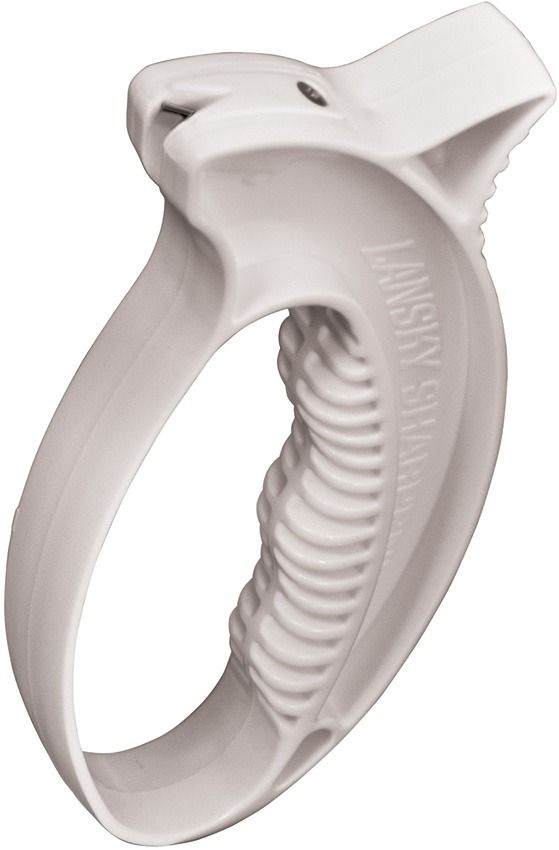
Explore this need in the finder →The Lansky Quick Edge® Fillet and Bait Sharpener (SKU LSTCF) is a manual carbide pull-through tool for a narrow job: touching up fillet and bait knives with one preset slot. This is a source-based assessment, not a hands-on test. The name overlaps with Lansky’s black Quick Edge, but LSTCF is its own white, marine-materials model with its own product record; it should not be confused with LSTCS or the red and camouflage Deluxe Quick Edge versions.
A dedicated fillet-knife format
The exact LSTCF listing identifies tungsten-carbide sharpening heads, an ergonomic grip, finger guard, thumb rest, and plastics described as marine grade and resistant to discoloration in saltwater applications. It also says the carbide inserts are reversible and replaceable. Those features make the sharpener easy to position in an angling or boat kit, but the listing does not state that the abrasive itself is corrosion-proof, nor does the marine-material claim turn it into a waterproof tool. Rinse, dry, and store it according to the directions for the actual item rather than assuming a saltwater-rated abrasive.
There is only one documented sharpening element. Lansky does not list a grit number, a ceramic finishing surface, a stone, or a strop for this SKU. The product is therefore not a staged progression or a way to choose different bevel angles. If the fish knife’s edge needs a particular profile or a finer finishing process, check that requirement against a separate system rather than reading extra capability into “Quick Edge.” The manufacturer gives no blade-length, thickness, or steel-by-steel compatibility chart.
The fixed angle and the prescribed handling are different
Lansky sets the carbide path at 22.5° per side, which it states produces a 45° inclusive angle. That is one fixed geometry. The instructions separately say to hold the handheld sharpener roughly perpendicular to the blade as it is pulled; the roughly 90° direction describes how to hold the tool during the stroke, not a second edge angle. A finder match at 22.5° records that the tool has that setting; it is not advice to reprofile a particular fillet knife.
The listed sequence calls for a flat, solid work surface, with the knife held edge-up and about half an inch of blade extending past the surface. The user grips the sharpener with fingers within the guard and thumb against the rest, places the V over the blade near the handle, then draws toward the tip. Lansky describes three or four strokes with light pressure and directs the user to clean the blade thoroughly afterward. This is not a one-handed knife-and-tool routine: one hand steadies the knife and the other moves the sharpener. Keep the edge controlled and the fingers clear, especially when working with a long, flexible fillet blade.
Where the LSTCF differs from other Quick Edge tools
The LSTCF and the black LSTCS both use a replaceable carbide pull-through element and a fixed 22.5°-per-side path, but the LSTCF record specifically describes marine-grade materials and the fillet-and-bait use case. The Deluxe Quick Edge models have other grip and carry details. Similar names and a shared abrasive do not make their housings or exact packages interchangeable. Verify the SKU and the exact listing before buying replacement inserts: Lansky’s LCAR2 page lists LSTCF compatibility, but a replacement tip set is not a substitute for the sharpener.
Compared with a guided clamp-and-stone kit, the LSTCF trades angle choice and a multi-grit progression for a compact pull-through motion. Compared with a ceramic maintenance tool, its only documented contact surface is carbide. That distinction matters when a user wants to preserve a specific existing bevel or make very small maintenance changes: carbide is described as removing metal, while the page does not give a finer LSTCF stage. There is also no dedicated serration procedure or scissor support in the exact record.
Who should consider it—and what to check
The LSTCF is most relevant to someone who wants a small, guarded sharpener for an appropriate fillet or bait knife, accepts the fixed 22.5°-per-side geometry, and values the replaceable carbide heads. Its guard and thumb rest give a defined hand position; the instructions still require a stable surface and deliberate stroke. If the knife has a nonstandard edge, a flexible or unusually shaped blade, or a maker-specified bevel that differs from this path, the exact LSTCF page does not establish compatibility.
Before purchase, confirm that the offer is the complete LSTCF sharpener and not a loose carbide replacement, a display pack, or another Quick Edge model. Check the exact package and the current instructions; no case, base, lubricant, or polishing accessory is listed in this assessment. The product page’s safety language is worth following: avoid heavy pressure, keep control of the knife, and clean the blade after sharpening. Read the Lansky LSTCF product instructions before using it.
Bottom line
The LSTCF is a specific portable answer for fillet-and-bait knife upkeep, not a general angle-adjustable sharpener. Its marine-material housing, guarded grip, replaceable carbide, and 22.5°-per-side fixed path are documented; grit, blade-fit limits, and a second finishing stage are not. It makes sense only when that limited configuration matches the knife and routine.
Key specifications
Key details at a glance
| Power | Manual |
|---|---|
| Sharpening format | Guarded handheld carbide v-slot; the knife is steadied on a flat surface while the tool is drawn from heel toward tip |
| Lowest angle setting | 22.5° |
| Highest angle setting | 22.5° |
| Included abrasive surfaces | One reversible, replaceable tungsten-carbide pull-through element; grit is not stated |
| Benchtop base included | No |
| Angle-guide positions | 22.5° |
Use the exact model’s instructions for operating limits, supplied equipment and version differences.
Sources for this review
Sources for this assessment

Check the requirements that matter to you
Use the finder to compare documented sharpener formats and limits; an unknown capability is not treated as a match.