
Your needs, this model
Does it fit your priorities?
Can the LTCBH also sharpen a hunting knife?
Lansky explicitly says this broadhead tool can touch up knives, but the source does not publish detailed knife dimensions or steel compatibility. Its carbide V is fixed at 22.5° per side (45° inclusive), so confirm that path fits the specific plain-edge knife. The tool is not presented as a multi-stage knife system.
Explore this need in the finder →Which broadheads fit the integrated wrench?
The exact manufacturer record says the universal broadhead wrench works with 2-, 3-, 4-, and 5-bladed heads. That describes the wrench function, not a knife blade size or a universal fit for every broadhead. Check the head and its instructions before tightening, removal, or sharpening.
Explore this need in the finder →What is the safe sharpening sequence for a broadhead?
Lansky says to secure the head to the arrow first, then hold the arrow firmly with its point facing away from you. Use the guarded grip and light-pressure strokes across each broadhead blade, repeating three or four times as directed, and clean the blades thoroughly. Do not press hard or rush around exposed cutting edges.
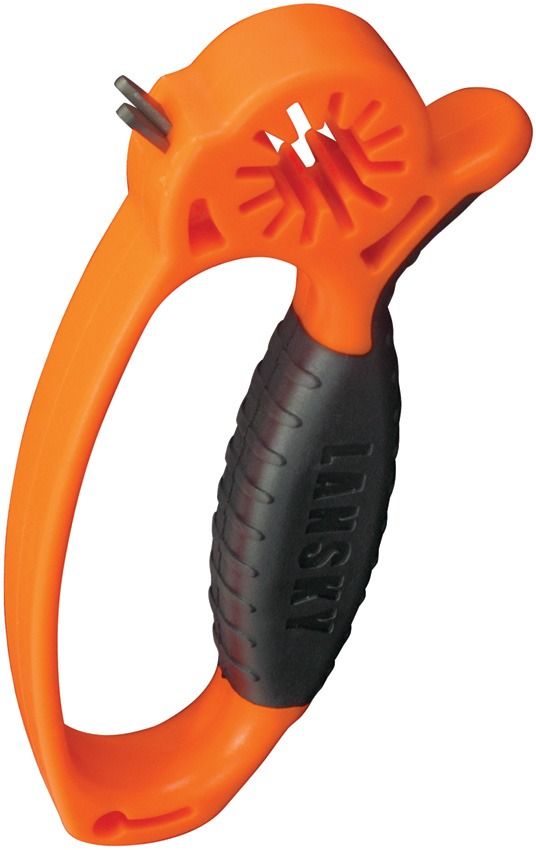
Explore this need in the finder →The Lansky Broadhead Sharpener with Wrench (SKU LTCBH) is an archery-oriented hand tool that also has a documented knife-touch-up use. Its orange guarded handle combines a tungsten-carbide sharpening path with a wrench shaped for broadhead maintenance. This assessment follows the exact manufacturer product record and instructions; it is not a hands-on test, and it does not treat the broadhead function as proof that every knife profile will fit.
Two jobs in one compact tool
Lansky describes three functions: hold broadheads for tightening or replacement, sharpen broadhead blades, and touch up knives. The universal wrench is specified for two-, three-, four-, and five-blade broadheads. That makes the LTCBH more specialized than a basic pocket knife sharpener: the wrench is a functional part of the package, not a generic accessory. Its use for knives is described as touch-up rather than as a complete sharpening system or a full multi-grit progression.
The sharpening surface is tungsten carbide, with a preset path of 22.5° per side and 45° inclusive according to the product record. There is no angle adjustment, alternate slot, ceramic finishing stage, grit number, or strop listed. The actual knife-touch-up capability is a reason to consider it alongside hunting equipment, but a user who needs a very different bevel, a fine finishing pass, serration work, or a dedicated kitchen workflow should compare a separate tool instead. The page gives no maximum blade length or detailed profile compatibility limits.
Broadhead directions require extra care
The manual first says to secure the broadhead to its arrow with the wrench. For sharpening, it calls for gripping the sharpener with fingers inside the guard and thumb against the rest, then holding the arrow firmly with its point aimed away from the user. Place the carbide V over one broadhead blade and draw it toward that blade’s tip, repeating three or four light-pressure strokes before moving to the other blades. The instructions say to clean the blades thoroughly afterward. These details matter: a broadhead has multiple exposed cutting edges, so keep the sharpener and arrow under deliberate control and never rush or press heavily.
The tool’s handling direction and cutting angle are separate concepts. The maker’s roughly 90° instruction concerns the sharpener’s position during each stroke; it does not replace the stated 22.5°-per-side preset. The blade-count range belongs to the wrench’s fit, not a claim about knife size. A buyer should check the broadhead’s actual construction and attachment, then follow the instructions for securing it before sharpening or replacing it.
Using the knife mode conservatively
For a plain knife, the exact product page says it can be used to touch up knives. The published carbide path is still fixed at 22.5° per side, so the relevant check is whether that fixed geometry is suitable for the specific blade. The manufacturer supplies no steel compatibility table or knife dimensions. Because the tool’s principal design is a broadhead wrench and sharpener, its knife mode should be understood as a secondary touch-up capability rather than a promise of universal knife fit.
That is different from the Lansky Quick Edge LSTCS, which is presented as a knife-first carbide pull-through sharpener without an integrated broadhead wrench. Both use a fixed 22.5°-per-side carbide path, but their intended jobs and handles are not the same. The LTCBH is the more relevant assessment when the same item must also secure a compatible broadhead; it is not automatically the better choice for regular kitchen or general-purpose knife maintenance.
Limits and buying checks
No extra sharpening abrasive, adjustable guide, oil, case, bench mount, or polishing surface is listed for this exact SKU. The source also does not publish a grit number, knife-length ceiling, wear interval, or separate serration method. Those are unknowns, not hidden features to infer from other Lansky models. The broadhead wrench accepts the specified 2–5 blade configurations, but a knife buyer should still inspect the exact blade edge and handle clearance before committing to the fixed V-slot.
Confirm the package is the LTCBH Broadhead Sharpener with Wrench, not a standalone broadhead wrench, another broadhead tool, or a replacement sharpener. If your essential requirement is specifically a hunting-knife touch-up, verify that the blade’s maker accepts the 22.5°-per-side path. If the primary task is attaching a broadhead, check the product instructions for safe tightening and removal as well as sharpening. Read the Lansky LTCBH product instructions and keep the pointed arrow away from yourself during use.
Bottom line
The LTCBH combines an archery wrench with a fixed-angle carbide edge tool. Its strongest fit is someone who needs that broadhead function and may also use the documented knife-touch-up path, provided the exact knife suits the 22.5°-per-side geometry. The wrench does not make the sharpening angle adjustable, and the knife mode should not be mistaken for a staged or universal sharpener.
Key specifications
Key details at a glance
| Power | Manual |
|---|---|
| Sharpening format | Guarded handheld carbide v-slot integrated with a broadhead wrench |
| Lowest angle setting | 22.5° |
| Highest angle setting | 22.5° |
| Included abrasive surfaces | Tungsten-carbide sharpening V; grit is not stated |
| Benchtop base included | No |
| Angle-guide positions | 22.5° |
Use the exact model’s instructions for operating limits, supplied equipment and version differences.
Sources for this review
Sources for this assessment

Check the requirements that matter to you
Use the finder to compare documented sharpener formats and limits; an unknown capability is not treated as a match.