
Your needs, this model
Does it fit your priorities?
What angle does the Blademedic's pull-through slot use?
Lansky specifies a preset 22.5° slot angle that produces a 45° inclusive edge. It is a fixed capability, not a dial; the separate serration element and tapered diamond rod do not inherit this numeric angle. Check the knife maker's geometry before changing an existing bevel.
Explore this need in the finder →Does the Blademedic have a dedicated serration element?
Yes. Lansky lists a separate 800-grit serration sharpener designed to enter small serrations and instructs moving the blade away from the hand; for larger serrations it describes a sweeping motion. The product page does not assign a numeric angle to this operation.
Explore this need in the finder →Is the carbide slot for routine maintenance?
Lansky describes tungsten carbide as extremely aggressive and reserves it for quick restoration when needed. The page recommends the ceramic element as the primary maintenance element; it is less aggressive, and its 1,000-grit rods can be used for relatively frequent touch-ups.
Explore this need in the finder →What does the Responder Blademedic Combo Pack UTR7 add?
Lansky’s exact UTR7 page describes a Blademedic sharpener together with a separate Responder folding knife. It gives the knife a 3.5-inch 440C stainless blade, 7-inch overall length, 6-ounce weight, a stainless liner lock and a two-position pocket clip. Those are knife specifications, not sharpener specifications. The combo page does not identify the sharpener’s component SKU; confirm UTR7 if you want the knife-and-sharpener package rather than standalone PSMED01.
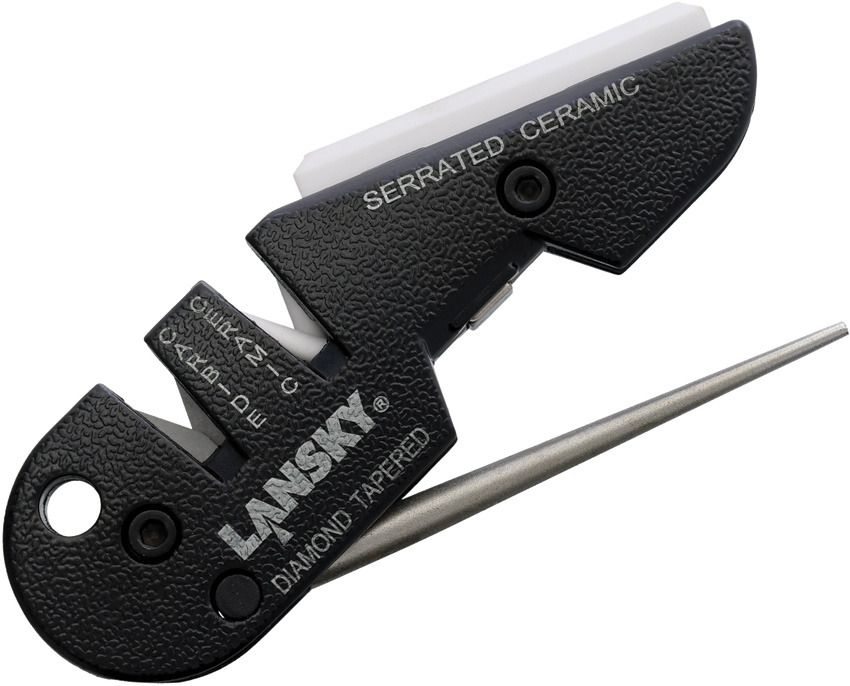
Explore this need in the finder →The Blademedic® PSMED01 is a pocket-sized, manual sharpening tool with four different edge-care elements in one housing. This assessment is based on Lansky’s current US product page, its knife-sharpener catalogue entry and the manufacturer’s exact product image; it is not a hands-on test. The product page also carries its own use guide, which is important here because the four elements are not interchangeable stages in one fixed progression.
Four elements, four different jobs
The tungsten-carbide slot is the most aggressive option. Lansky says a few strokes can restore a very dull blade, but also cautions that carbide removes material quickly and should be used only for quick sharpening when needed. That warning matters more than the “four-in-one” label: the carbide is not the element the manufacturer recommends for routine touch-ups.
The 1,000-grit ceramic rods are the gentler finishing and maintenance choice. The product page says to use them after the carbide step or by themselves on a blade that is already relatively sharp. Lansky presents the ceramic element as the primary maintenance surface, while noting that metal can build up on it and eventually slow its action. The page recommends cleaning that ceramic surface with its Eraser Block; that accessory is not among the four sharpening elements described for the PSMED01.
A separate 800-grit serration element is intended to reach the scallops of a serrated edge. The instructions call for moving the blade away from the hand and describe a sweeping motion for larger serrations. The fourth element is a 600-grit tapered diamond rod, which Lansky describes for rapid reconditioning of straight or serrated edges and for gut hooks. Its taper gives access to narrow and wider curved areas, but the manufacturer recommends sparing use and says not to apply honing oil to diamond sharpeners.
The fixed slot angle is not an adjustment dial
Lansky specifies a preset 22.5° slot angle that produces a 45° inclusive edge. This is a discrete fixed geometry for the pull-through slots, not a range that can be tuned to an existing knife. If a knife’s maker specifies a different bevel, or the present edge geometry is unknown, the Blademedic’s slot should not be assumed to reproduce it. The finder can show that 22.5° capability, but it cannot decide whether that edge is right for a particular blade.
The angle statement also should not be transferred to the separate freehand features. The product page gives no numeric angle for working a serration with the dedicated element or using the tapered rod. Those tasks ask the user to work the relevant edge surface; a number printed for the pull-through slots is not proof of a matching angle for every method in the tool.
Compactness brings a manual workflow
The PSMED01 is listed in Lansky’s portable-sharpener category and its product description frames it as a field-repair tool for pocket knives, hunting and fishing knives, and other blade types. It needs no motor or powered sharpening station. The user chooses an element for the job and guides the knife or rod by hand. That can keep a compact repair option close at hand, but it also puts the user in charge of selecting the appropriate abrasive and controlling each motion.
Its published dimensions are 3.9 by 1.25 inches. That small format is a useful portability cue, not a measure of how much abrasive life it has or a guarantee that it is comfortable for every hand. The source page does not state a maximum blade length, a clamping arrangement, replaceable element schedule or an included storage case. Check the exact PSMED01 offer and instructions rather than inferring these details from a larger Lansky kit.
Limits to weigh before choosing it
The strongest reason to consider the Blademedic is the mix of separate field functions: carbide for a very dull edge, ceramic for lighter upkeep, a dedicated serration element and a tapered diamond rod for curves and hooks. Its main compromise is that this breadth is packed into a small manual tool rather than a guided clamp system with a sequence of replaceable stones. There is no adjustable pull-through angle, and the carbide’s speed comes with an explicit material-removal caution.
The serration and hook functions are useful only when those are the actual tasks; they do not make the PSMED01 a general all-purpose workstation. Nor does “4-in-1” mean each element can safely sharpen every blade type. Follow the product instructions for the edge in front of you, keep fingers away from the cutting path and check the knife maker’s advice before changing a bevel. For a shopper who needs a different exact angle, a clamp system with documented settings may be a more suitable comparison; for someone seeking a small field tool and who accepts its fixed 22.5° slots, the PSMED01 is a distinct option to assess.
Who should shortlist the PSMED01
Compare it when a compact hand-operated tool and its specific set of carbide, ceramic, serration and diamond features answer a real field-maintenance need. It is not the choice to make from a general “sharpener” label alone. Verify that the seller’s box is the PSMED01, decide whether the aggressive carbide element is appropriate for your intended repair, and check the knife’s existing edge before relying on the fixed 45° inclusive slot. Lansky’s exact product page and user guide and the Portable Sharpeners catalogue are the primary references for this model assessment.
The UTR7 Responder combo is a different package
Lansky also lists the Responder Blademedic Combo Pack, SKU UTR7. Its exact page describes a Blademedic sharpener together with a separate Responder folding knife. The bundle repeats the four sharpening elements, 22.5° preset slot and 3.9-by-1.25-inch sharpener dimensions described for the standalone Blademedic; it does not print a separate SKU for the sharpener inside the combo, so do not treat UTR7 as proof of a PSMED01 component label. The added knife is described as a 3.5-inch 440C stainless blade, 7 inches overall, 6 ounces, with a liner lock and two-position pocket clip. Those figures refer to the knife, not the sharpener. UTR7 adds a knife to the package, not another sharpening method, so this review treats it as a covered package variant rather than a second sharpening candidate. The combo image below is the exact manufacturer gallery image for UTR7; the visible pair is an identity cue, while the product text establishes package contents.
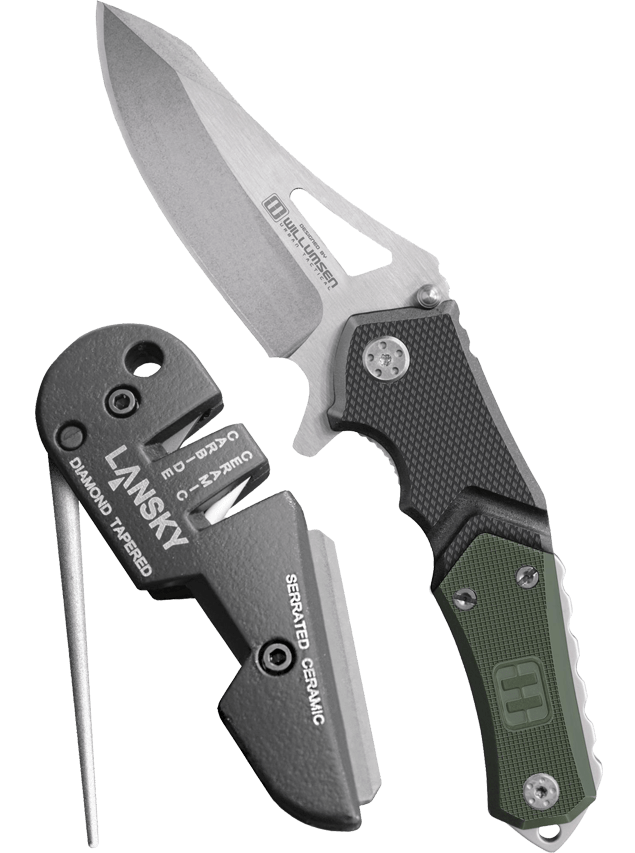
The buying action above this assessment is for standalone PSMED01, not the UTR7 combo. If the extra knife is part of your intended package, verify the exact UTR7 SKU and terms separately rather than assuming the standalone listing contains it.
Key specifications
Key details at a glance
| Power | Manual |
|---|---|
| Sharpening format | Manual 4-in-1 pocket sharpener with fixed pull-through slots and separate sharpening elements |
| Lowest angle setting | 22.5° |
| Highest angle setting | 22.5° |
| Angle-guide positions | 22.5° |
Use the exact model’s instructions for operating limits, supplied equipment and version differences.
Sources for this review
Sources for this assessment
- Knife Sharpeners — Lansky US catalogue, page 1
- Portable Sharpeners — Lansky US category listing
- Blademedic® Pocket Sharpener — exact Lansky product page and user guide
- Blademedic® PSMED01 — exact first-gallery manufacturer image
- Responder Blademedic Combo Pack, exact US SKU UTR7 product record
- UTR7 exact first-enabled manufacturer combo image


Check the requirements that matter to you
Use the finder to compare documented sharpener formats and limits; an unknown capability is not treated as a match.