
Your needs, this model
Does it fit your priorities?
Which marked knife settings does the QSHARP have?
Lansky lists four fixed carbide slots marked 17°, 20°, 25° and 30°. They are discrete choices, not a continuously adjustable range. Its QSHARP page does not explain whether those labels are per-side or inclusive angles, so compare the exact knife's bevel convention and instructions before using a slot.
Explore this need in the finder →Should I use the QSHARP carbide for every maintenance session?
No. Lansky calls the carbide aggressive and reserves it for quick correction or a very dull edge. The integrated 800-grit tapered ceramic element is the product's less aggressive maintenance surface; follow its separate instructions and clean the ceramic when metal transfers build up.
Explore this need in the finder →Does the QuadSharp have a serration method?
Yes. Lansky describes sharpening one serration at a time with the tapered ceramic element. That is a distinct, nonnumeric operation; the four carbide slot marks are not a serration angle or proof that the grooves fit a particular scallop.
Explore this need in the finder →This is a research-based assessment of the current U.S. Lansky QSHARP record and its instructions. It is not based on hands-on use or performance testing.
What the QuadSharp combines
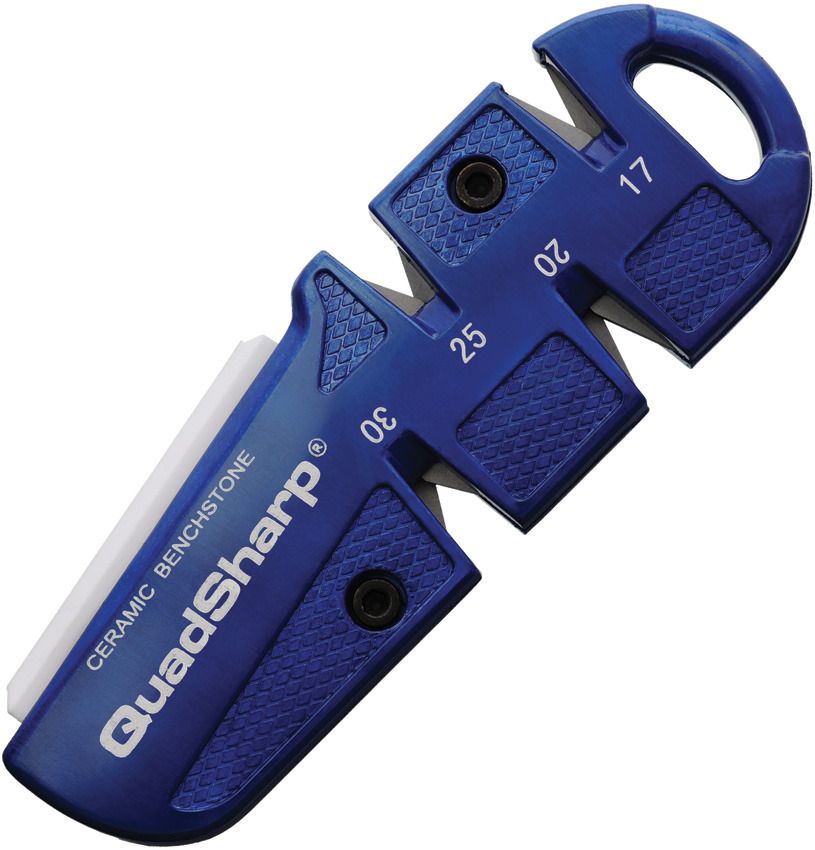
The QuadSharp® Carbide is a compact manual pocket sharpener built around two different jobs: four carbide pull-through slots at marked settings and a tapered ceramic benchstone along its body. Lansky lists it both as a stand-alone sharpener and as a field companion to its controlled-angle kits. The product page identifies SKU QSHARP, a rugged metal case and a body measuring 4.3 by 1.4 by 0.5 inches. Those dimensions describe the tool, not working clearance for every blade or hand.
Its angle marks are 17°, 20°, 25° and 30°. They are four discrete slots, not a continuously adjustable range. Lansky says they correspond to its controlled-angle kit positions, but the QSHARP page does not explain whether those numbers use the same side-versus-inclusive convention as a knife maker’s bevel specification. Treat the marks as the sharpener’s labelled capabilities, not a recommendation to reprofile any particular edge. Check the knife’s existing bevel and the full instructions before choosing a slot.
Carbide is the fast, aggressive path
The four carbide slots are intended for quick work on a very dull edge or when a fast touch-up is needed. Lansky’s instructions describe a few draws with moderate pressure, followed by rinsing the blade. That is maker guidance, not a measured result. The same instructions caution that carbide removes metal aggressively and should not become the routine for ordinary edge maintenance. For a knife that only needs upkeep, repeatedly pulling it through a carbide slot may remove more material than the task calls for.
This distinction is the QuadSharp’s defining tradeoff. Unlike an all-ceramic angle tool, it offers a more forceful setting step, but the page does not provide a graduated coarse-to-fine series of replaceable stones. There is no powered motor, clamp, or guided-rod frame. If the job is a larger repair or a careful, repeatable bevel change, the four slot marks and one integrated finishing element are a smaller toolset than a full controlled-angle kit.
Use the ceramic for maintenance and serrations
The attached ceramic benchstone is the gentler everyday element. Lansky rates it at 800 grit and describes using it against the edge in a benchstone-like or rod-like fashion. It is tapered, and the manufacturer gives a separate procedure for working one serration at a time with the ceramic corner. That makes it more versatile than the plain-edge carbide slots alone, but the serration routine is not an extension of the four labelled knife-angle slots: the product page gives no numeric angle for that task.
Dark streaks on the ceramic are described as steel transfer, not proof that the surface has worn out. Lansky recommends cleaning it with its Eraser Block. Keep the operations distinct: use a marked pull-through slot only for the corresponding plain-edge task, and use the ceramic’s own instructions for edge maintenance or serration work. Do not infer that a single angle entry in a finder result certifies every operation the tool can perform.
How it differs from the similar Lansky tools
The official QuadSharp/C-Sharp comparison is useful because these two tools share the same four marked angles, metal form, tapered 800-grit ceramic benchstone and compatibility with Lansky controlled-angle systems and Turn Boxes. The principal abrasive difference is in their slots: QSHARP uses carbide, while CSHARP uses 600-grit ceramic. Lansky positions the former as the more aggressive quick-sharpening choice and the latter as a gentler, slower option. The D-Sharp is another distinct SKU: its angle slots use 400-grit diamond, while it retains a ceramic finishing element. They are not colors or bundles of one interchangeable product.
These small tools can stand alone, but their connection to Lansky’s clamp kits is especially relevant when a blade already has a known bevel: the four fixed marks can serve as field touch-up references. Compatibility does not mean that QSHARP includes a clamp, rods, a case, oil, or a full progression; the exact QSHARP page does not list those as included accessories. Verify the exact SKU and seller package if any such item is essential.
Who should consider it—and what to check
QSHARP makes the most sense for someone who wants a compact, manually controlled field tool, needs one of its four fixed angle marks, and values a carbide slot for occasional rapid correction plus a ceramic surface for less aggressive maintenance. It is less compelling for someone who wants to minimize metal removal in every session, needs intermediate or adjustable angles, or expects a complete multi-stone repair system in a pocket-sized body.
Before using it, check whether the knife’s edge geometry and intended use align with the selected marked slot, whether the blade can be drawn through it safely, and whether ceramic-only maintenance would be the better routine. The maker’s warning about aggressive carbide matters more than a broad “field sharpener” label. For a ceramic-only option compare the C-Sharp review; for a diamond-slot alternative see the D-Sharp review. None of the three product pages supplies a general promise of compatibility with every steel, blade shape, bevel, or serration.
Assessment: The QuadSharp’s useful idea is the separation of a fast carbide correction from a built-in ceramic maintenance and serration surface. Its limitations are equally specific: four fixed labelled settings, no guided clamp, no numeric serration setting, and no disclosed full repair progression. Choose it for that narrow combination rather than assuming the four marks and “stand-alone” description settle fit for a particular knife.
Key specifications
Key details at a glance
| Power | Manual |
|---|---|
| Sharpening format | Portable manual four-angle carbide pull-through sharpener with an integrated tapered ceramic benchstone |
| Lowest angle setting | 17° |
| Highest angle setting | 30° |
| Included abrasive surfaces | Four carbide pull-through slots at fixed 17°, 20°, 25° and 30° labels; carbide grit is not stated / Integrated tapered 800-grit ceramic benchstone |
| Benchtop base included | No |
| Angle-guide positions | 17 / 20 / 25 / 30° |
Use the exact model’s instructions for operating limits, supplied equipment and version differences.
Sources for this review
Sources for this assessment
- Knife Sharpeners — Lansky US catalogue, page 1
- Portable Sharpeners — Lansky US category, page 1
- QuadSharp® Carbide, SKU QSHARP — exact Lansky product record and instructions
- Should I use the QuadSharp or the C-Sharp? — Lansky official comparison
- QuadSharp® Carbide QSHARP — exact first-gallery Lansky product image

Check the requirements that matter to you
Use the finder to compare documented sharpener formats and limits; an unknown capability is not treated as a match.