
Your needs, this model
Does it fit your priorities?
Can the Benchstone guide a kitchen knife at the maker's 20° position?
Yes. Its exact box list includes 20° and 25° guides, and the user guide identifies 20° for kitchen knives and 25° for outdoor knives. Those are discrete positions, not evidence of a continuous 20°–25° adjustment range; the numeric finder leaves angle unspecified for this model.
Explore this need in the finder →Does the Benchstone use a different angle guide for outdoor knives?
The manufacturer guide assigns the included 25° guide to outdoor knives and 20° to kitchen knives. The user still makes the strokes and should check the knife maker's guidance before changing its existing edge geometry.
Explore this need in the finder →Can it sharpen scissors, and do I need to add a ceramic surface?
Work Sharp identifies scissors as a supported use. The standard package already lists a fine ceramic surface along with 320- and 600-grit diamond plates, so no separate ceramic surface is needed for the documented package. Follow the exact guide for safe scissor handling.
Explore this need in the finder →The Work Sharp Benchstone Knife Sharpener (SKU WSBCHBSS) is a manual, dry bench system that combines a three-sided abrasive with two angle guides and a base that can pivot or lock. The exact package is documented on the manufacturer's product page and in its user guide. This review is source-based, not a hands-on account or a claim of sharpening tests.
What the exact WSBCHBSS box contains
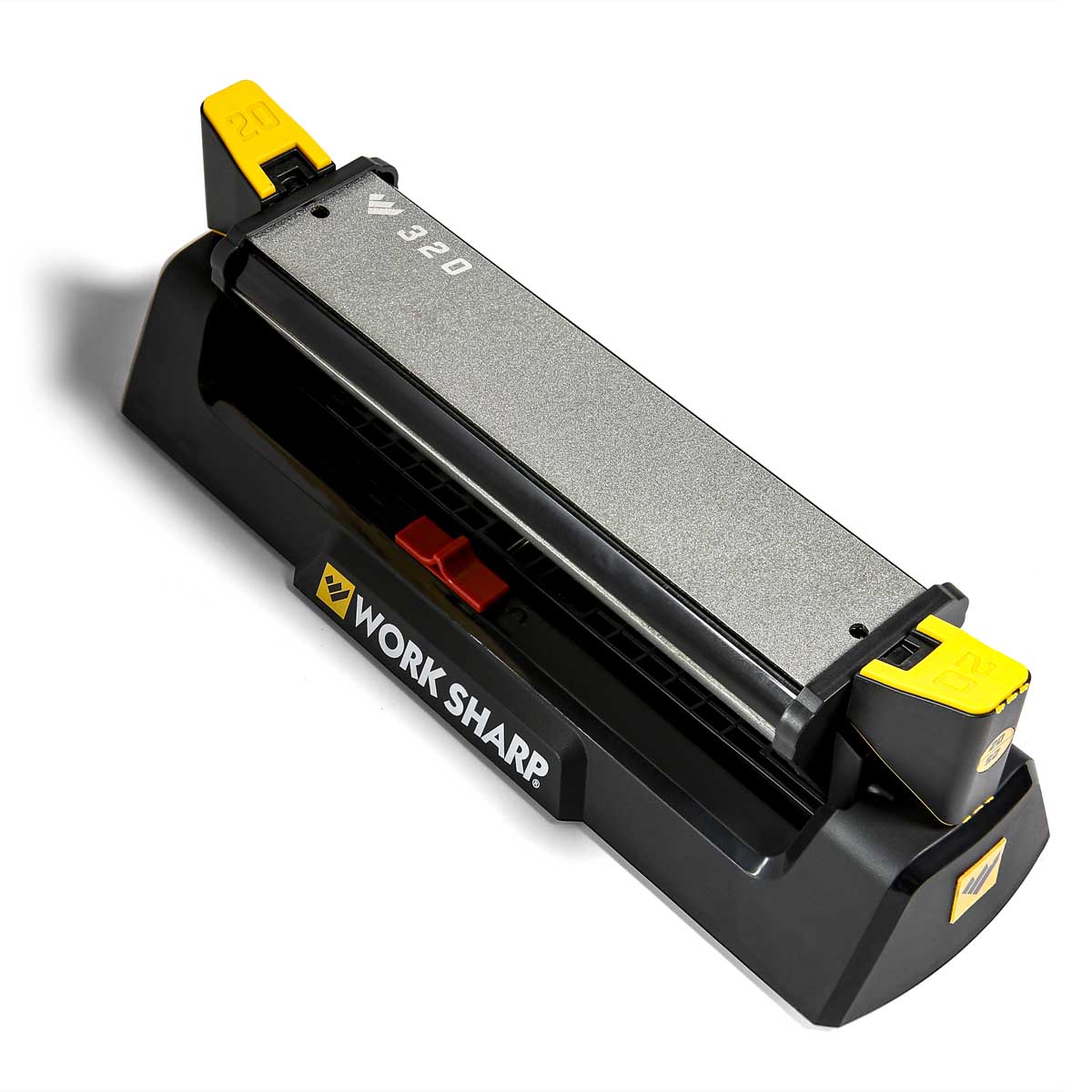
Work Sharp lists a Tri-Brasive rotating benchstone, 320- and 600-grit diamond faces, a fine ceramic face, a Pivot-Response anti-skid base and 20°/25° guides. It weighs 1.2 lb according to the product page and carries the maker's stated three-year warranty. The inclusion of three surfaces is a meaningful distinction from simple pull-through sharpeners and from the company's waterstone model: the first two faces are diamond, while the ceramic face is for honing. Replacement 320- and 600-grit plates are listed separately, so a worn plate need not mean replacing the entire system. Do not confuse the Benchstone with a separate replacement plate or with another Work Sharp guided system. Check for SKU WSBCHBSS and the full box list. The package is a manually moved abrasive; it is not an electric sharpener and does not clamp the knife in a fixture. The user holds and moves the knife across the abrasive guide, which means hand control and safe positioning still matter.Two guide positions and a pivoting surface
The manual assigns the 20° guide to kitchen knives and the 25° guide to outdoor knives. These are discrete positions; they are not a continuously adjustable 20°–25° scale. The base's Pivot-Response mechanism has two modes. Unlocked, the stone can follow the curve of the blade; locked, it provides a rigid surface and the manual calls for a sweeping motion to follow the edge. The guide also says the sharpening guides can be removed for freehand use. That combination offers more choice in hand feel than a fixed-angle slot, but it does not make angle selection automatic. The user must choose a guide, set the pivot mode, keep the knife on the guide and use light pressure. The supplied instructions say to stop the knife tip on the abrasive rather than running it off the edge, to avoid rounding the tip. A finder that asks for an exact numerical setting cannot express this product's discrete guide list without implying a continuous range, so this review leaves that numeric match unclaimed. Use the maker's listed positions and the knife manufacturer's own guidance when deciding whether either angle fits an existing edge.Dry sharpening, with a straightforward progression
Work Sharp explicitly says not to use oil or water on this system. The user guide recommends brushing the sharpening guides and stone clean after each session. That makes the Benchstone comparatively easy to keep dry, but it is not a maintenance-free device: filings and grit still need to be cleared, and the user needs a dry workspace and a safe place to handle the blade. The intended abrasive progression is coarse diamond for restoring an edge, fine diamond to refine it, and ceramic for honing. The manual recommends establishing the edge on the coarse side before moving to refinement and then alternating light strokes on ceramic until the burr is removed. No fixed number of strokes can be promised for every blade. The condition, steel, geometry and existing bevel all affect the work, and the guide's method depends on the user's ability to maintain contact and pressure across the curved edge.Knife use and limitations
The maker identifies kitchen, pocket, hunting and outdoor knives as uses, and its product page also names scissors. It does not list a serration attachment or a specific serrated-edge procedure in the standard box material reviewed here, so a buyer whose main need is maintaining serrations should verify another exact tool and its instructions. The WSBCHBSS package does not list a leather strop, digital angle indicator or carrying case. Those omissions do not mean the abrasive sequence cannot refine an ordinary edge; they mean those particular accessories are not part of this verified configuration. The triangular benchstone rotates to expose each abrasive face, and the Pivot-Response base is there to support those manual strokes rather than replace skill. The system is more structured than a bare stone because it supplies the guides and pivoting support, yet it still requires the user to understand which surface is facing up, which guide is appropriate and when to move to the next abrasive. If your priority is a large stone that can also hold other stones, the OD55 base serves a different purpose. If you specifically want water-based stone sharpening, the Whetstone uses a soaked 1000/6000 corundum stone instead.Who should consider it
The Benchstone is a plausible match for someone who wants a compact, manual system for both kitchen and outdoor knives, values three dry abrasive faces and wants the base to either follow a curve or stay rigid. It is less suitable if you want a motor to do the strokes, a continuous angle dial, no cleanup at all, or a verified serration-specific attachment. Before buying, confirm SKU WSBCHBSS, the included 320/600 diamond and ceramic faces, and both guides. Treat the stated angles as two choices, not a promise that every angle between them is supported, and use the manual's safety and care instructions for the exact package.Key specifications
Key details at a glance
| Power | Manual |
|---|---|
| Sharpening format | Pivoting three-surface benchstone |
| Included abrasive surfaces | 320-grit coarse diamond plate / 600-grit fine diamond plate / fine ceramic stone |
| Benchtop base included | Yes |
| Strop included | No |
| Use dry (no oil or water) | Yes |
| Angle-guide positions | 20 / 25° |
Use the exact model’s instructions for operating limits, supplied equipment and version differences.
Sources for this review
Sources for this assessment
Check the requirements that matter to you
Use the finder to compare documented sharpener formats and limits; an unknown capability is not treated as a match.