
Your needs, this model
Does it fit your priorities?
Can the Combo sharpen a serrated knife?
Work Sharp's user guide separates this from the belt process: turn the motor off and use the tapered ceramic rod for serrations. The guide says not to put serrations on the abrasive belt. Short, light strokes fit the individual scallops better than treating the edge like a plain blade.
Explore this need in the finder →Does the powered guide support a 25° kitchen-knife setup?
The product page and the included-box list both specify a 25° guide. It is a fixed guide position, not a range or dial. Check the knife maker's intended bevel before using any fixed-angle system to reprofile an edge.
Explore this need in the finder →Is the Combo a scissor sharpener or a stropping kit?
Neither capability is established for the exact WSCMB package. Its published contents list the sharpener, a 25° guide, a tapered ceramic honing rod and three P120 belts; they do not list a scissor cassette or leather strop.
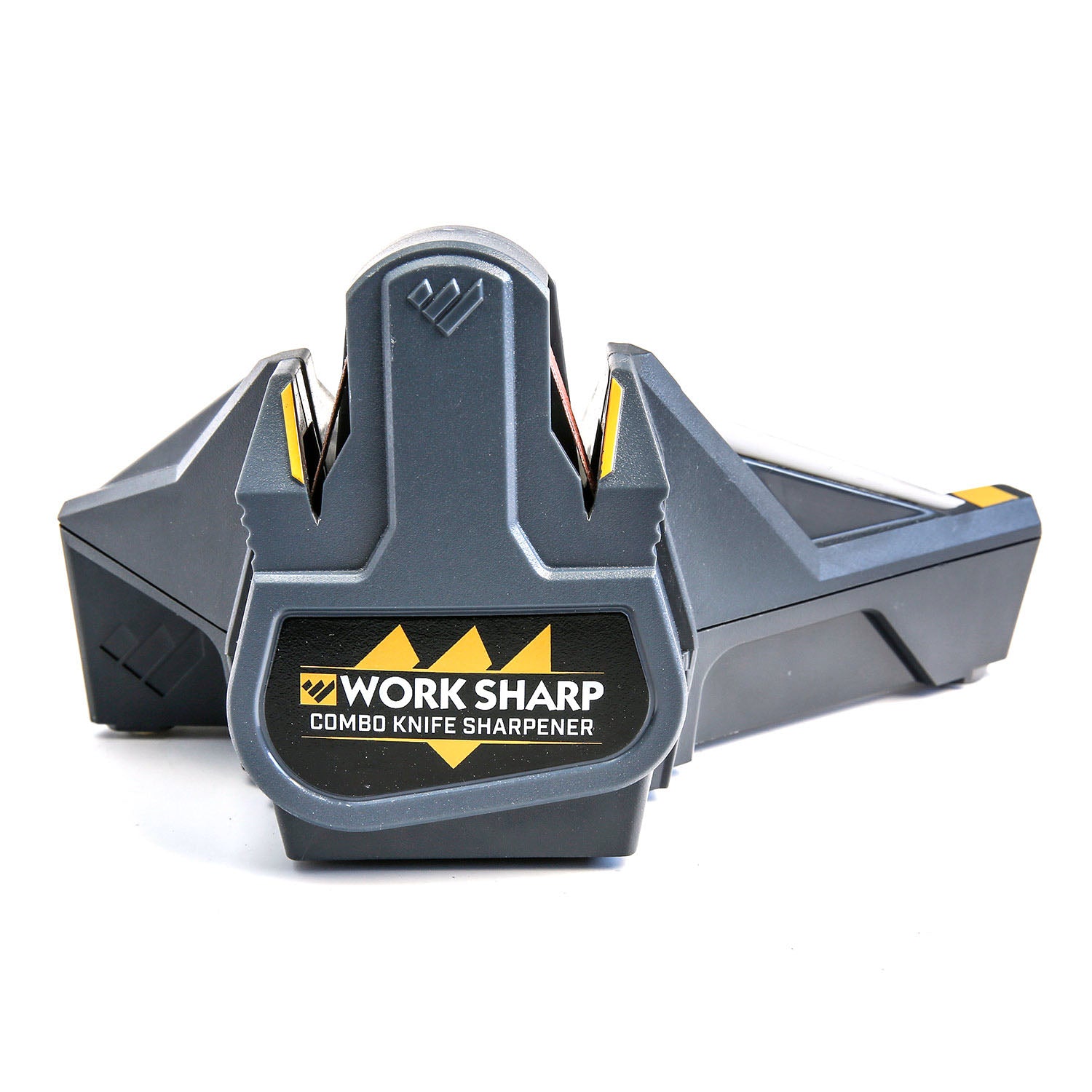
Explore this need in the finder →The Work Sharp Combo Knife Sharpener (SKU WSCMB) is a small powered belt machine with a second, manual sharpening surface built into the same package: a tapered ceramic rod. That split matters more than the word “combo.” Its belt is the powered edge-shaping route; the ceramic rod is an unpowered maintenance and serration route. This is an assessment of the manufacturer’s US product page and user guide, not a hands-on test.
What the WSCMB package actually includes
The standard box list is concise: the sharpener, one 25-degree knife guide, a tapered ceramic honing rod, and three P120 medium belts. The three belts are spares of the same stated grit, not three progressively finer stages. The product page lists a weight of 23.2 ounces, but does not publish a broad range of electrical, capacity, or blade-dimension specifications. Do not infer a more complete abrasive set from the word “Combo.”
For straight-edge work, the belt rides between fixed guides that hold a 25-degree presentation. That can make the stroke more repeatable than freehanding a belt, but the guide is not a dial: there is no documented range or alternate angle position. A single fixed bevel is a fit only when it is appropriate for the knife. Check the knife maker’s guidance first, particularly before changing an established edge.
The rod is a separate operation, not a second powered stage
Work Sharp’s guide says to switch the machine off for rod honing. It describes light, alternating passes using the rod’s guides to keep the blade angle steady. In other words, the WSCMB does not offer a three-grit powered progression: the belt is P120, while the ceramic rod is used manually to hone or refresh an edge. The ceramic is also the package’s serration method. The user guide explicitly says not to sharpen serrations on the belt; it directs the user to the tapered rod and describes treating the scalloped edge lightly, then drawing the flat side across the rod.
That distinction makes the model more purposeful than a simple powered pull-through, but it narrows its fit. A buyer who expects the motor to sharpen serrations, or wants an included powered scissor guide, should not assume either from the broad “knife sharpener” label. The exact WSCMB box list does not identify a scissor cassette or scissor procedure.
What the operating instructions ask of you
The belt routine still involves feeding a knife through the guide at a controlled pace and keeping it aligned with the guide reference. The manual’s sample pacing is about an inch per second; it warns that lingering can overwork the heel. It also recommends light pressure, even strokes, and stopping to assess the edge rather than making an arbitrary large number of passes. Those instructions are useful to read before using a powered abrasive: the machine guides the angle, but does not remove the need to control the knife.
The guide calls this a dry system and says not to add water or lubricant. It also gives simple care directions: brush debris from the sharpener and clean the ceramic rod with a pencil eraser. Belt replacement is part of ownership; Work Sharp identifies replacement P120 belts, rather than a menu of WSCMB-specific grit upgrades. Treat the current page’s 25-degree statement as the specification and the manual as the operating authority for technique.
How it differs from nearby choices
The Combo is simpler than Work Sharp’s Knife & Tool Sharpener Mk.2. The Mk.2 has two discrete knife-guide positions, coarse, medium, and fine belts, plus separate cassette methods for serrations and scissors. The Combo instead pairs a single P120 belt type with a manual ceramic rod. It may suit a buyer who wants that small set of routines, but its simplicity is not a substitute for the Mk.2’s distinct accessory modes.
Compared with a clamp-and-rod system such as the Precision Adjust, the WSCMB puts power at the belt rather than asking the user to move an abrasive rod along a clamped blade. Neither format is automatically safer or more precise for every knife; the deciding question is whether the fixed 25-degree path and powered belt routine suit the blade and the user’s preferred technique.
Checks before choosing the exact package
Verify that a listing is the standard WSCMB and includes the tapered ceramic rod, fixed 25-degree guide, and P120 belts. Do not count a belt as a fine finishing stage or a ceramic rod as a leather strop. Confirm that its plug and electrical rating suit the intended US outlet because the reviewed current product page does not state the rating. There is also a documentation mismatch worth resolving: the current product page advertises a three-year warranty, while the linked manual still says one year. Ask the seller or manufacturer for the warranty that applies to the exact unit rather than relying on either figure alone.
On the evidence available, the Combo is a plausible match for a household that wants a fixed-angle powered belt for ordinary edges and accepts a separate, manual rod step for touch-ups and serrations. It is a poor fit when an adjustable bevel, multiple powered grits, a scissor setup, or an included strop is essential.
Key specifications
Key details at a glance
| Power | Powered |
|---|---|
| Sharpening format | Powered belt with manual ceramic hone |
| Lowest angle setting | 25° |
| Highest angle setting | 25° |
| Included abrasive surfaces | P120 medium abrasive belt (three included) / Tapered ceramic honing rod |
| Strop included | No |
| Use dry (no oil or water) | Yes |
| Angle-guide positions | 25° |
Use the exact model’s instructions for operating limits, supplied equipment and version differences.
Sources for this review
Sources for this assessment
Check the requirements that matter to you
Use the finder to compare documented sharpener formats and limits; an unknown capability is not treated as a match.