
Your needs, this model
Does it fit your priorities?
Can the E3 power-sharpen a kitchen knife at 17°?
The CPE3 has fixed 17° guides for its powered belt routine. That documents the sharpener's guide setting, not proof that 17° matches every knife's original bevel. The E3 manual gives manual-click Sharpen and Refine stages rather than automatic timing, despite the current product page's timed-cycle wording.
Explore this need in the finder →Can the E3 maintain an edge without running its motor?
Yes, the CPE3 guide includes a dual-surface ceramic honing rod with 17° guide markers. Its coarse ribbed and fine smooth faces support a separate hand-guided maintenance routine. This does not document a manual belt-sharpening mode or replace the motorized stage when a knife needs significant reshaping.
Explore this need in the finder →Does the E3 support serrated knives or scissors?
The model guide documents a manual ceramic-rod routine for the flat side of serrated and bread knives but gives no numeric serration angle. It explicitly says not to sharpen scissors or other tools, so the E3's non-knife use is not treated as verified.
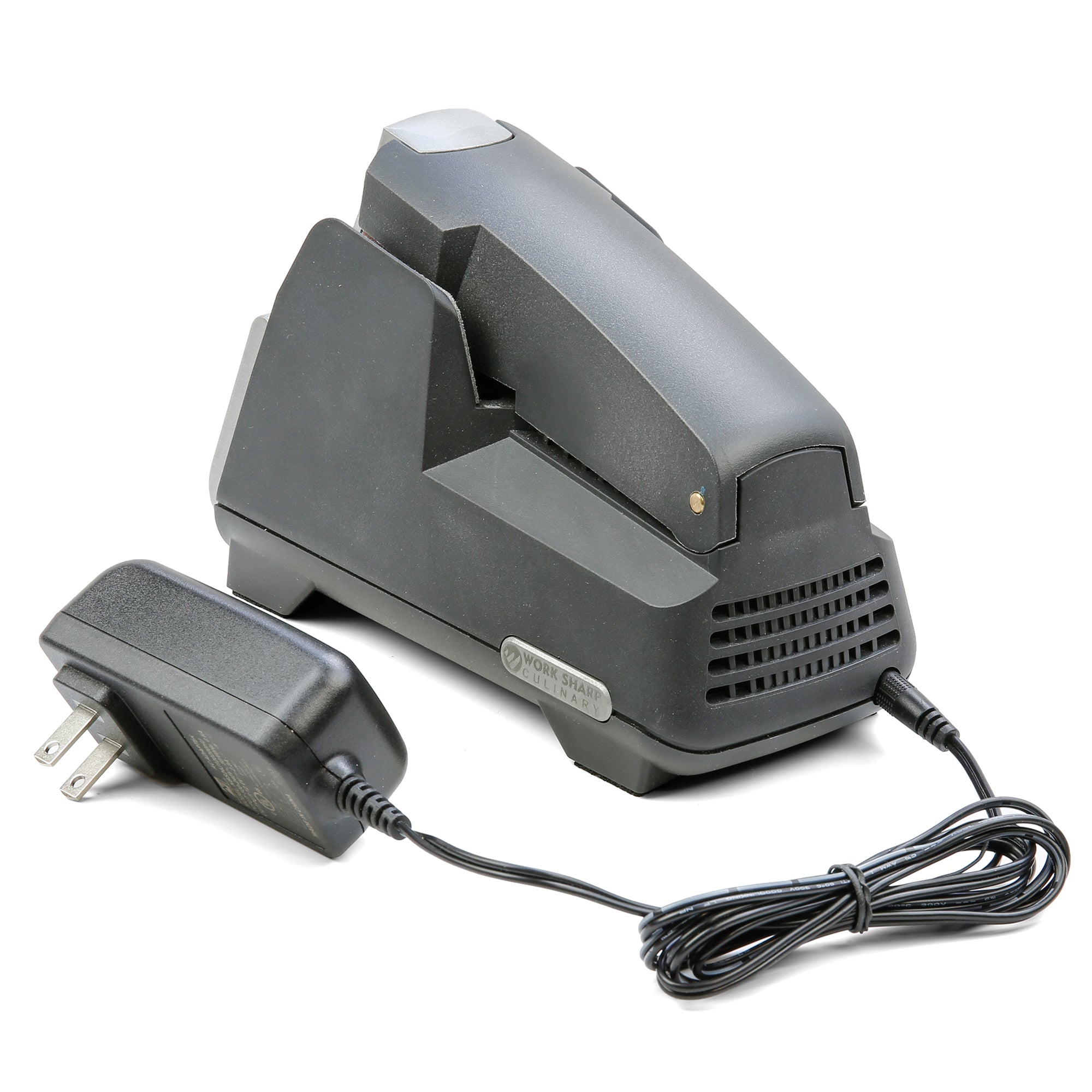
Explore this need in the finder →The Work Sharp E3 is a retired household electric kitchen sharpener, identified by the manufacturer as model CPE3. It is worth assessing separately from the later CPE2 and CPE5-NH: its exact page lists a fixed 17° guide and a red P120 belt, while its model guide documents a separate manual ceramic-rod routine. The two E3 arrangements share one package but do different work.
What the E3 actually offers
At the centre is a belt sharpener with left and right guides. The model guide describes a user-selected Sharpen stage at higher speed and a Refine stage at lower speed, both switched by a manual click. It also calls them untimed. That detail matters because the current CPE3 product page uses broader “timed sharpening cycles” language. I do not reconcile that discrepancy by borrowing operation details from the newer CPE5-NH: the model-matched E3 guide is the more specific source for its steps, so this assessment does not call the CPE3 automatic or claim that it shuts off after a timed programme.
The guides are fixed at the maker's stated 17°. In its plain-edge routine, the guide asks the user to keep a knife lightly against the lined guide and rollers, draw it slowly through the left slot, repeat on the right and alternate strokes. For an eight-inch knife, the guide gives eight seconds per side as its pace illustration; it describes ten slow strokes in the initial Sharpen stage, followed by ten in Refine. It has a separate shaping sequence for a knife that remains dull, based on checking for a burr and repeating small groups of strokes. Those are instructions, not results from a test of this unit. The manufacturer does not explain in the retrieved guide whether its 17° marking is per side or an included angle, so the number is only a filter for matching guide capability—not a prescription for your knife.
A separate hand-operated maintenance path
The CPE3 guide also identifies a dual-surface ceramic rod with an angle guide. The ribbed side is coarse and the smooth side fine; its instructions describe separate alternating strokes using each surface. This is manual edge maintenance, not a hand-powered version of the belt stage. It may suit someone who wants a bench appliance for sharpening plus a removable rod for lighter upkeep, but the included rod does not make the package a fully manual sharpening system. The manual's ceramic-rod serration procedure is narrower still: it works on the flat side with the fine face, and it gives no numerical angle for that operation. Keep the serrated method distinct from the 17° plain-edge guide.
Limits that narrow the fit
Work Sharp's guide restricts this appliance to clean knife blades that fit correctly in the slots. It warns against using it on scissors, axes or other tools, and says not to add water, oil or another lubricant or use the appliance outdoors. This is a household-use product, not an all-purpose benchtop grinder. The available materials do not establish a maximum blade length or a clearance limit for unusually tall handles, thick spines or asymmetric blades, so those cases need an exact manual and seller confirmation rather than a broad “all knives” promise.
The fixed angle is another real tradeoff. There is no adjustable setting on the CPE3 package. If your knife maker specifies another geometry, or you cannot determine how its bevel relates to the 17° Work Sharp guide, do not choose this model solely because the number looks close. A broad marketing description is not evidence that it can reproduce every factory edge. The separate rod's guide markers are useful for maintenance, but likewise do not establish that every blade should be honed at that angle.
Package and retirement checks
Work Sharp marks the CPE3 retired. Its current product page gives specifications but does not provide a complete in-box list. The manufacturer guide says the ceramic rod is included, and an archived retailer listing identifies a power supply, rod handle, dual-face rod and three red P120 belts. Treat that secondary list as a package cross-check, not proof that a used offer is complete. Before buying a retired unit, confirm that the exact CPE3/SKU and manual match, inspect the included power supply and guides, and ask whether the belts are present and serviceable. The model guide lists a replacement P120 belt kit, but that historical reference is not a guarantee of present supply.
The three-year warranty language in the manual is for consumer use and excludes abrasives; it should not be assumed to transfer to a secondhand purchase. Check the seller's return terms and the appliance's condition rather than treating an old warranty statement as current coverage. No prices, stock or seller quality are established here.
Who should consider it?
The CPE3 is a plausible match for a household user who specifically wants a powered, fixed-17° kitchen-belt routine and values the separate hand-guided rod for maintenance. It is a poor fit if you require an adjustable angle, a verified scissor or tool operation, outdoor use, or a clearly timed automatic cycle. It also needs more package verification than a current boxed model because its retired status makes listing completeness and condition central buying questions. Compare its documented operations with current kitchen sharpeners, but do not assume the newer models' controls, belts or refinements belong to the E3.
Key specifications
Key details at a glance
| Power | Powered |
|---|---|
| Sharpening format | Powered guided kitchen belt with manual ceramic rod |
| Lowest angle setting | 17° |
| Highest angle setting | 17° |
| Included abrasive surfaces | Red P120 ceramic abrasive belts / Dual-surface ceramic honing rod (coarse ribbed and fine smooth faces) |
| Angle-guide positions | 17° |
Use the exact model’s instructions for operating limits, supplied equipment and version differences.
Sources for this review
Sources for this assessment
- E3 Kitchen Knife Sharpener — Work Sharp
- Work Sharp E3 User’s Guide, 00121 Rev. 0 (manufacturer guide; KnifeCenter-hosted copy)
- Which Work Sharp Culinary Kitchen Knife Sharpener is Right for Me? — Work Sharp
- Work Sharp Culinary E3 Electric Kitchen Knife Sharpener — KnifeCenter archived model listing
- Sharpeners — Work Sharp US catalogue, page 4
Check the requirements that matter to you
Use the finder to compare documented sharpener formats and limits; an unknown capability is not treated as a match.