
Your needs, this model
Does it fit your priorities?
What angle range is supported by the included Blade Grinding Attachment?
The Elite page and its attachment manual document an adjustable 10°–35° knife-sharpening range for the 1 × 18 in Blade Grinding Attachment. The separate cassette uses a 15°–30° guide. The finder treats those as distinct plans; check which attachment and knife geometry the desired operation requires.
Explore this need in the finder →How does the Elite differ from the standard Ken Onion Mk.2?
The exact Elite package adds the Ken Onion Mk.2 Blade Grinding Attachment, a 1 × 18 in belt kit including a 12,000-grit belt, and the attachment’s three convex pulley profiles. It also retains the standard sharpening cassette, 65° scissor guide and 3/4 × 12 in belt kit. The base motor is related, but this is a materially larger supplied system.
Explore this need in the finder →Can its serration and scissor instructions be used on the Blade Grinding Attachment?
Do not assume so. Work Sharp’s user guide documents serrated and scissor operations for the standard cassette and its task-specific belts/guides; the supplied attachment is a separate 1 × 18 in freehand grinding arrangement. Follow the exact procedure for the attachment and task rather than carrying over the cassette instructions.
Explore this need in the finder →Can this be used for sustained commercial sharpening?
No. The linked guide states consumer use only, excludes industrial or commercial grinding and sharpening, and sets a 30-minutes-per-hour operating limit. Do not treat the Elite’s extra attachment or seven motor speeds as a commercial-duty rating.
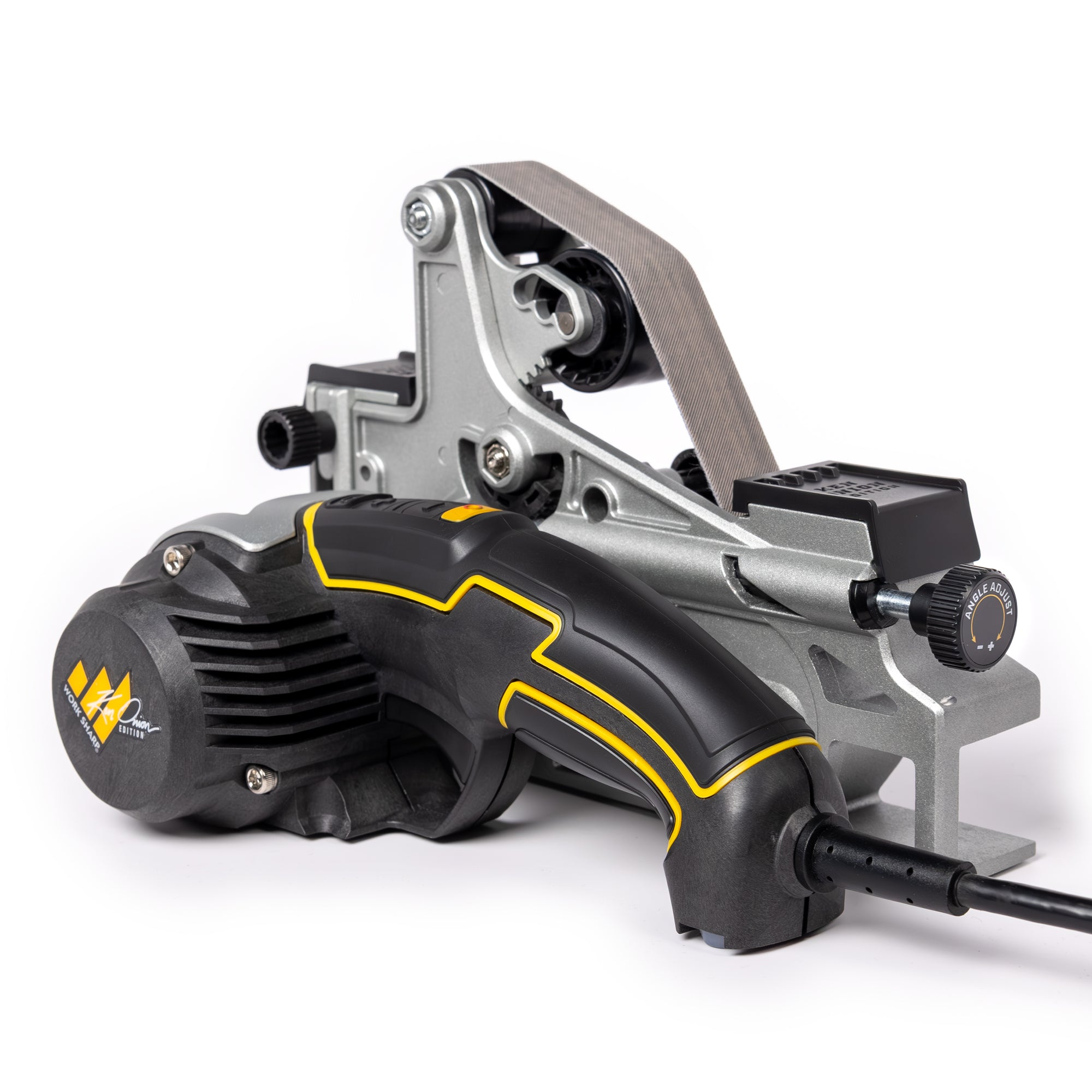
Explore this need in the finder →The WSKTS-KO2-ELT is Work Sharp's Ken Onion Edition ELITE Knife & Tool Sharpener Mk.2. It combines the Mk.2 motor and standard guided cassette with a separate 1 × 18-inch Blade Grinding Attachment, plus two belt formats. That is a materially different package from the WSKTS-KO2 base sharpener: one exact SKU supplies both guided-cassette and attachment workflows. The assessment below is based on the manufacturer's current listing and manuals, not personal use or a performance test.
Two knife setups, not one blended angle range
The standard cassette has a guided knife range of 15° to 30° per side. Its manual specifies half-degree increments and describes ordinary knife strokes through that guide. The included Blade Grinding Attachment is a separate 1 × 18-inch belt arrangement with its own angle control from 10° to 35°. The manual also shows three convex-pulley positions—high, medium and low—and gives different examples for outdoor, everyday-carry and kitchen blades.
Those ranges belong to different operating plans. It is reasonable to value the broader attachment range if it fits a specific knife task, but it would be misleading to describe every operation as a single 10°–35° guided cassette. The longer belt attachment asks for a freehand knife path against its reference plate, while the standard cassette uses its own blade guide. Angle marks and pulley choices do not identify the right bevel for a knife; check the knife maker's specification and confirm the angle convention before reprofiling an edge.
The package adds a second belt size and abrasive ladder
The box list includes one set of 3/4 × 12-inch belts for the standard cassette: P120, X65, X22, X4 and 6000 grit. It also lists a 1 × 18-inch set for the Blade Grinding Attachment: P120, X65, X22, X4 and 12000 grit. The longer attachment manual describes its coarse belts for repair and shaping, the middle grits for sharpening, X4 for honing, and 12000 for ultra-fine work such as serration polishing or stropping-like finishing. That last description refers to an abrasive belt; the exact package list does not include a leather strop.
The attachment's 1-inch belts and adjustable convex pulley are not substitutes for the standard cassette's narrower belts or guide. Belt width, grit and attachment change what is contacting the edge and how the blade is controlled. Replacement belts are available, but the sources reviewed do not give a reliable service-life count. Keep belts clean and dry as the manual instructs, and use only the attachment and abrasive types approved for this model.
Task guides stay with the standard cassette
The package retains a 65° scissor guide and a serrated-knife procedure in the standard cassette's manual. The serration instructions call for the 6000 belt and work on the flat side only; the scissor instructions use a separate guide and say to sharpen the beveled side. They are distinct from the freehand Blade Grinding Attachment plan. Do not infer that the longer belt assembly inherits the cassette's serration or scissor guide merely because both attach to the same motor.
For the attachment's plain-knife work, the instructions describe setting the desired angle, selecting among three convex profiles, mounting the appropriate belt and using very light pressure against the reference surface. The manual warns against excessive force and says to stop if pressure overloads the motor. Its tool-grinding section also tells the user to secure a workpiece. These setup demands matter: this package offers more modes, but a broad feature list does not remove the need to follow each procedure.
Who benefits from the Elite distinction?
The WSKTS-KO2-ELT is worth considering when both a repeatable cassette guide and a longer, adjustable belt attachment serve real jobs. The cassette provides a defined guided angle and its own scissor/serration arrangements; the Blade Grinding Attachment adds a 1 × 18-inch belt path and freehand angle control. If the cassette alone covers the routine, the base Ken Onion Mk.2 avoids the extra attachment. If you were comparing the standard WSKTS2 instead, note that it uses another motor platform, different two-position knife guides and its own belt/cassette package.
The ELITE product page describes this package as including the Mk.2 motor, both belt kits, seven-speed control and the two attachment systems. Work Sharp also lists a separate “Ken Onion Mk.2 Elite & Carry Case” bundle, SKU WSKTS-KO2-ELT-CASE, describing the same Elite system with a rugged carry case; it does not document a different sharpening attachment or operating method. This review covers the sharpener shared by both packages, while its primary SKU WSKTS-KO2-ELT is the no-case configuration. Confirm the exact code and box contents if an included case matters.
Operating limits and purchase checks
The shared user guide says the Ken Onion Mk.2 is for consumer use only, excludes industrial or commercial grinding and sharpening, and sets a limit of 30 minutes of use per hour. Additional attachments do not change that stated duty limit. The product page publishes a seven-pound weight and a three-year warranty, but the purchase check should still be made against the exact current offer and written warranty terms.
Before selecting the WSKTS-KO2-ELT, verify that the Elite package includes the 1 × 18-inch Blade Grinding Attachment, the standard cassette and both listed belt kits. Decide whether you need the attachment's 10°–35° range or the cassette's 15°–30° guide, then check your blade's shape, geometry and intended bevel. The Elite is best understood as a more complete powered workshop system, not as an automatic upgrade for every kitchen knife or as a substitute for task-specific practice and safety instructions.
Key specifications
Key details at a glance
| Power | Powered |
|---|---|
| Sharpening format | Powered guided cassette and freehand belt grinder |
| Lowest angle setting | 10° |
| Highest angle setting | 35° |
| Strop included | No |
| Angle-guide positions | ° |
Use the exact model’s instructions for operating limits, supplied equipment and version differences.
Sources for this review
Sources for this assessment
- Ken Onion Edition ELITE Knife & Tool Sharpener Mk.2 — Work Sharp
- Ken Onion Mk.2 Elite & Carry Case — Work Sharp (package-variant comparison)
- Ken Onion Edition Elite Knife & Tool Sharpener Mk.2 manuals and guides — Work Sharp
- Ken Onion Edition Elite Mk.2 User’s Guide — Work Sharp
- Sharpeners — Work Sharp US catalogue
Check the requirements that matter to you
Use the finder to compare documented sharpener formats and limits; an unknown capability is not treated as a match.