
Your needs, this model
Does it fit your priorities?
What angle range is included for knife sharpening?
Work Sharp lists an adjustable 15°–30° guide, and the Mk.2 manual specifies half-degree increments measured per side. That is a capability range for its standard guided cassette, not a recommendation for every knife. Check the blade maker’s intended bevel and angle convention first.
Explore this need in the finder →Does the package document serrated-knife work?
Yes. The exact Mk.2 manual provides a dedicated serrated-knife procedure: it says to use the 6000-grit belt, work only the flat side and keep the edge on the cassette side where the belt travels downward. It does not assign that serration operation the ordinary knife guide’s numeric angle range.
Explore this need in the finder →What comes with the scissor capability?
The exact package list includes a tool-sharpening cassette with a 65° scissor guide. Work Sharp’s manual gives a distinct scissor procedure and says to sharpen only the beveled side. This is not the same setup as the guided knife-angle cassette; check that the procedure fits the particular scissors.
Explore this need in the finder →Is this a commercial-duty belt machine?
No. The current user guide states consumer use only, excludes industrial or commercial sharpening and limits use to no more than 30 minutes in an hour. That is an important operating restriction for a shared workshop or service bench.
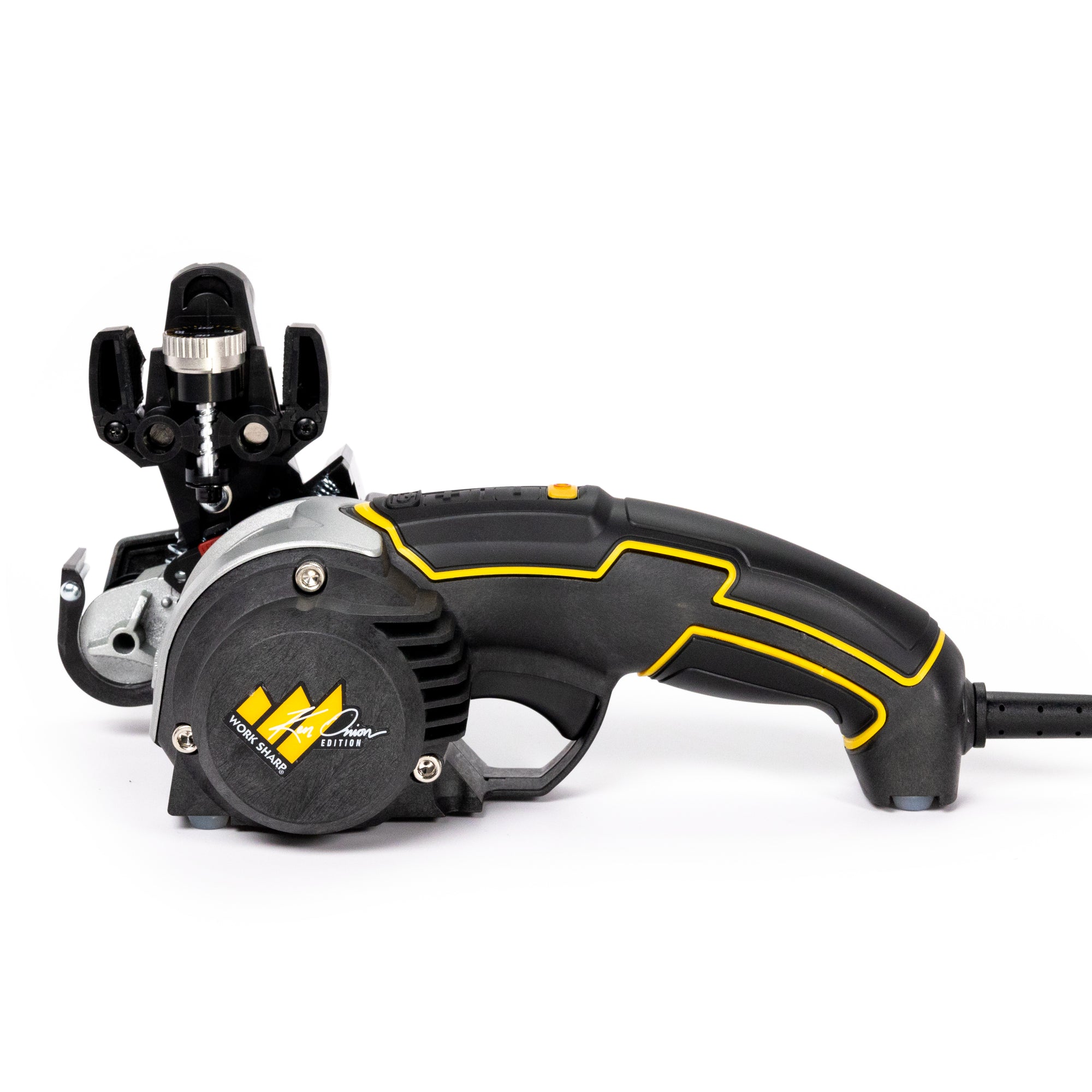
Explore this need in the finder →The WSKTS-KO2 is the Ken Onion Edition Knife & Tool Sharpener Mk.2, a powered belt system with an adjustable guided knife cassette. Its exact U.S. package has one each of five belt grits, a seven-speed motor control and a separate 65° scissor guide. The central decision is whether that guided, motor-driven belt routine fits your knives and your willingness to follow task-specific instructions. This is a source-based assessment of the listed package, not a hands-on test or a claim about results.
Guided belt work with a real adjustment range
The supplied knife cassette uses adjustable guides from 15° to 30°. Work Sharp's user guide says the setting moves in half-degree increments and is measured per side of the blade; an edge marked 20° per side is therefore 40° inclusive. That convention matters when comparing the sharpener with a knife maker's specifications, which may use another convention. The manufacturer gives example angles for different knife jobs, but these are not universal prescriptions. Check the original bevel, intended use and maker's guidance before deliberately changing it.
For ordinary guided sharpening, the operator positions the blade with the motor off, then powers the belt as the knife is drawn through the guide. The guide is a reference rather than a clamp that should be forced against the blade. The manual repeatedly stresses a light touch, following the edge's curve and stopping the belt before lifting the point away. That means this is not simply a push-through slot appliance: the user still controls blade path and timing while the motor supplies abrasive movement.
The dial is also not the whole system. Seven motor speed settings let the operator select a pace for the task, while the maker's procedure names different combinations of angles, speeds and abrasives for different knife types. A shopper wanting a repeatable guided route may value that structure; someone looking for a one-button appliance will face more setup and technique decisions.
Five belt grits, each with a different job
The box list names a P120 extra-coarse belt, X65 coarse, X22 medium, X4 fine and 6000 extra-fine belt. The first four use the standard 3/4 × 12-inch format; the 6000 belt is narrower. The user guide describes the coarse belts for shaping or repair, the middle grits for sharpening, and the fine belt for honing. It reserves the finest belt for its serration instructions. Those descriptions are more useful than treating the package as five interchangeable grades or assuming that every blade needs every belt.
The belts are consumables and Work Sharp lists replacement sets. Its manual says that belt discoloration alone is not a wear test and that belts should be kept clean and dry for best performance. It does not establish an expected number of knives or sharpening sessions per belt, so no service-life estimate belongs in this assessment. A leather strop is not listed in the standard WSKTS-KO2 package; the 6000-grit belt remains an abrasive belt, not an included leather finishing accessory.
Serrations and scissors are separate operations
The product page identifies serrated knives among the supported uses, and the manual supplies a distinct procedure. It directs the operator to use the 6000 belt, sharpen only the flat side and keep the serrated edge on the right side of the cassette so the belt travels downward. That is meaningful evidence of a serration method, but the chart marks its angle as unspecified. The 15°–30° range for the ordinary guided knife plan should not be transferred to this different task as a claimed scallop angle.
For scissors, the box list includes a dedicated 65° guide in the tool-sharpening cassette. Work Sharp's manual gives a separate scissor setup and says to sharpen only the beveled side. That is not the ordinary knife-angle guide; use the exact scissor instructions and check whether they suit the particular shears before starting. Unusual, damaged or asymmetrical scissors may require a different approach.
Know the difference from nearby Work Sharp models
The standard Knife & Tool Sharpener Mk.2, WSKTS2, is a different powered belt platform with discrete 20° and 25° guide positions, a different six-belt package and its own supplied task guides. The WSKTS-KO2 instead lists five wider-grit belt classes, a 15°–30° adjustable cassette and seven speed settings. Shared “Mk.2” wording does not make their controls, angle capability or consumables interchangeable.
The Ken Onion Elite Mk.2 is another distinct package: it includes the standard cassette plus a separate 1 × 18-inch Blade Grinding Attachment and an additional belt set. That longer attachment's angle controls and freehand workflow are not supplied with this base WSKTS-KO2. Compare the exact SKU and included attachments rather than assuming that a picture or a broad “Ken Onion” label describes the same kit.
Use limits and the final package check
The user guide describes the sharpener as a consumer tool, excludes industrial or commercial sharpening, and limits use to no more than 30 minutes in an hour. The motor, cassette and guides should be used only in the configurations described in the exact manual. No maximum blade length is confirmed in the sources reviewed here, so general compatibility labels should not be treated as proof that an unusually long blade clears the guides.
Before choosing the WSKTS-KO2, verify the exact model code, five listed belt grits, adjustable guided cassette and scissor guide in the offer. Check the knife maker's intended angle and whether per-side degrees match the figure you need. For serrations or scissors, read those separate instructions rather than applying the plain-edge routine. If that powered, guided format and its operating limits suit your routine, the model offers a clearly documented set of jobs; it is not a claim that every knife, tool or edge will fit without additional checks.
Key specifications
Key details at a glance
| Power | Powered |
|---|---|
| Sharpening format | Powered guided belt cassette |
| Lowest angle setting | 15° |
| Highest angle setting | 30° |
| Angle increment | 0.5° |
| Included abrasive surfaces | P120 extra-coarse 3/4 × 12 in belt / X65 coarse 3/4 × 12 in belt / X22 medium 3/4 × 12 in belt / X4 fine 3/4 × 12 in belt / 6000-grit extra-fine 1/2 × 12 in belt |
| Strop included | No |
| Angle-guide positions | ° |
Use the exact model’s instructions for operating limits, supplied equipment and version differences.
Sources for this review
Sources for this assessment
Check the requirements that matter to you
Use the finder to compare documented sharpener formats and limits; an unknown capability is not treated as a match.