
Your needs, this model
Does it fit your priorities?
How are the two slots used on a straight-edged kitchen knife?
The manual places the knife at the heel in slot 1 and calls for firm heel-to-tip pulls, repeating until sharp; once sharp, it uses slot 2 for firm back-and-forth strokes along the blade. It also says to keep the knife upright and clean it between stages and before food preparation.
Explore this need in the finder →Does the Kitchen Edge use its sharpening slot for serrations?
No. The exact guide says to use slot 2 only for serrated knives and gives them a separate back-and-forth procedure. Do not transfer that serration routine to slot 1 or treat the product page's fixed 20° knife-slot value as a scallop angle.
Explore this need in the finder →Can the same package sharpen scissors or pocket knives?
The product FAQ says the Kitchen Edge is for straight-edged kitchen knives, will not fit pocketknives correctly and is not shaped for scissors or other non-knife tools. Choose a package with an explicit method if either task is essential.
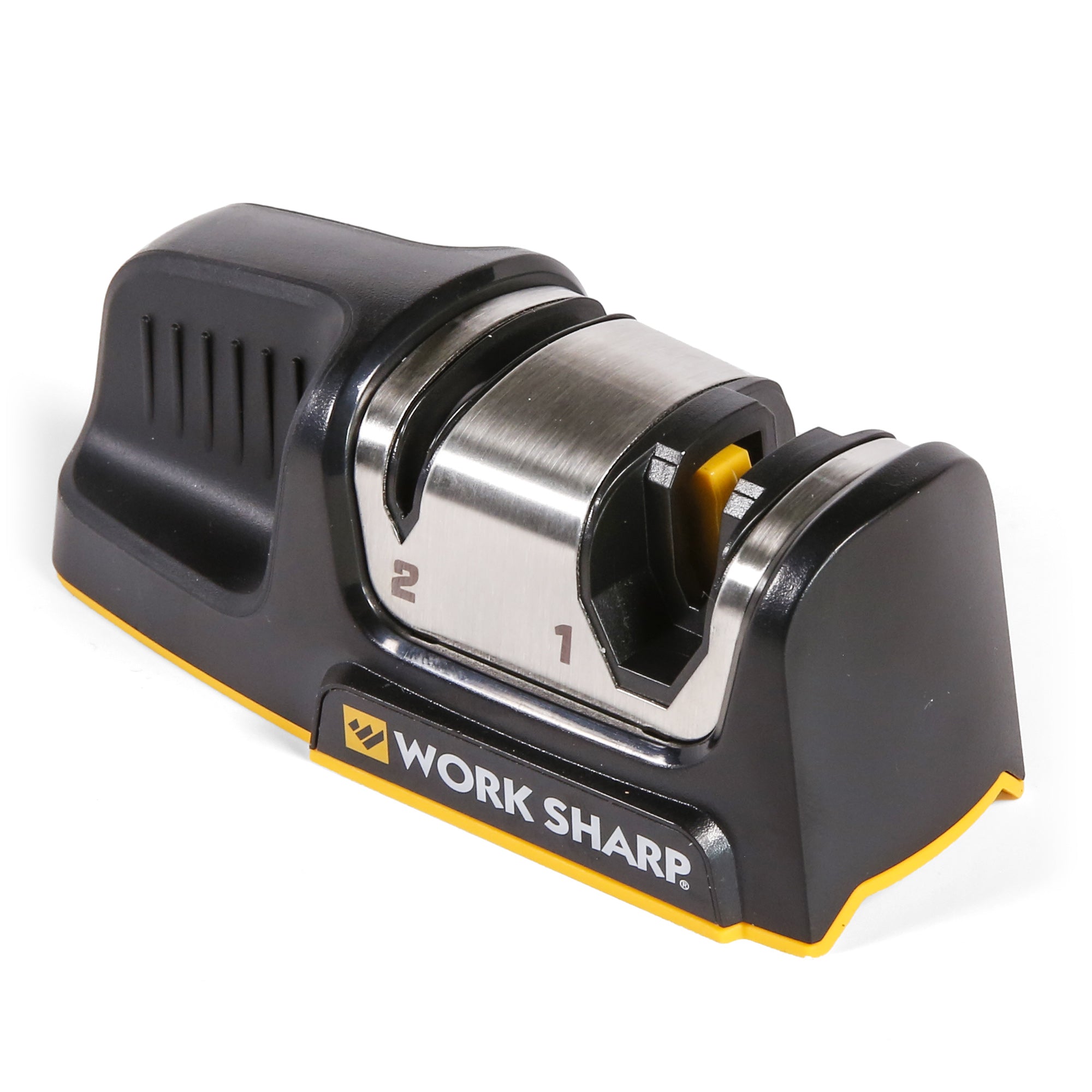
Explore this need in the finder →WSKTNKES is a small manual kitchen sharpener built around two different jobs: carbide sharpening in the first slot and ceramic honing in the second. Work Sharp lists a fixed 20° knife angle, a compact body, and use on kitchen cutlery. The important buying question is whether that narrow, guided routine suits your blades—not whether two slots sound like a universal sharpening system. This assessment is based on the maker’s product information and instructions; it is not a hands-on test.
What the exact package does
The Kitchen Edge box list names the sharpener, a Convex-Carbide sharpening stage, and a fine-grit ceramic honing wheel. The manufacturer’s product page specifies a 20° edge angle. No angle dial, replaceable abrasive set, scissor plate, or leather strop appears in the reviewed package list. This is a self-contained counter-side tool, not one of the company’s powered belt machines or guided-clamp systems.
The package also needs to be identified correctly. The product page and accompanying guide call out WSKTNKES, “Kitchen Edge.” Similar Work Sharp names can refer to a different model, and the guide’s slot-by-slot sequence matters: its first slot and second slot do not perform interchangeable work.
The instructions make the sequence clear
For a plain-edge kitchen knife, the manual places the sharpener over or at the edge of a counter so the blade has room to travel. It directs the user to start with the heel in slot 1, pull from heel to tip with firm pressure, and repeat until sharp. The next stage uses slot 2, with the knife moving back and forth over the full blade length. The maker says to follow the blade curve, keep the knife upright rather than tilting it sideways, and clean the blade between stages and before food preparation.
That procedure is more specific than the generic label “pull-through.” It asks for a different motion in each slot and room at the counter edge. A cramped workspace or a knife that cannot travel cleanly through the guides changes the practical fit. The instructions also warn that a severely dull or damaged edge may require additional strokes; they do not promise a set restoration time or specify how much material an individual knife will lose.
Separate the serration task from the plain edge
Work Sharp’s guide says to use slot 2 only for serrated knives. It gives a separate pull-and-push procedure rather than sending serrations through slot 1. The product page’s 20° number is a knife-slot specification, not a numeric scallop angle. If your priority is serrated bread knives, this documented second-slot route is relevant; if your priority is scissors, it is not. The maker’s FAQ explicitly says the Kitchen Edge is not shaped for scissors or other non-knife tools.
There is a similar boundary for pocket knives. The same FAQ says this design is for kitchen knives and will not fit pocketknives correctly. That model-specific limitation is more useful than a broad category card that simply says “knife sharpener.” For mixed kitchen-and-field use, compare a handheld tool such as Work Sharp’s Pivot Plus or Pocket Knife Sharpener instead, while checking their distinct fixed guides and abrasive routines.
Who should consider it—and who should pass
WSKTNKES is worth considering when the job is ordinary straight-edged kitchen cutlery, the listed fixed geometry is appropriate for the knife, and a simple two-slot manual sequence is preferable to choosing among stones or a powered belt. The product page presents it as beginner-friendly, but that does not remove the need to follow the instructions or verify the knife maker’s edge guidance. Its compact format may also suit a camp or secondary kitchen if the counter-edge setup can be made stable.
Look elsewhere if you require a selectable angle, want one tool for pocketknives and kitchen cutlery, need a scissor method, or expect an adjustable clamp to preserve a chosen bevel. A fixed number alone is not proof that 20° matches a knife’s existing edge. The manufacturer does not explain the angle convention in the reviewed sources, so do not assume whether the number is per side or an included angle.
Buying checks
Before choosing a listing, match the name and WSKTNKES identifier, verify that the two-slot body and both sharpening/honing surfaces are included, and read the exact guide for your intended edge. Confirm that the counter placement gives the blade clearance described by the maker. The reviewed package list does not name a strop, scissor accessory, or adjustable base; do not treat another model’s accessories as included here. If your knife is unusually long, flexible, asymmetric, or has a specialized edge, the broad “kitchen” use label is not a fit guarantee.
The useful distinction is simple: Kitchen Edge’s sharpening and honing slots are task-specific, its maker-documented use is kitchen-focused, and its fixed 20° guide is a compatibility filter rather than a bevel recommendation. Read the full instructions and confirm the exact package before buying.
Key specifications
Key details at a glance
| Power | Manual |
|---|---|
| Sharpening format | Fixed two slot convex carbide and ceramic |
| Lowest angle setting | 20° |
| Highest angle setting | 20° |
| Included abrasive surfaces | convex-carbide sharpening slot / fine-grit ceramic honing wheel |
| Strop included | No |
| Angle-guide positions | 20° |
Use the exact model’s instructions for operating limits, supplied equipment and version differences.
Sources for this review
Sources for this assessment
Check the requirements that matter to you
Use the finder to compare documented sharpener formats and limits; an unknown capability is not treated as a match.