
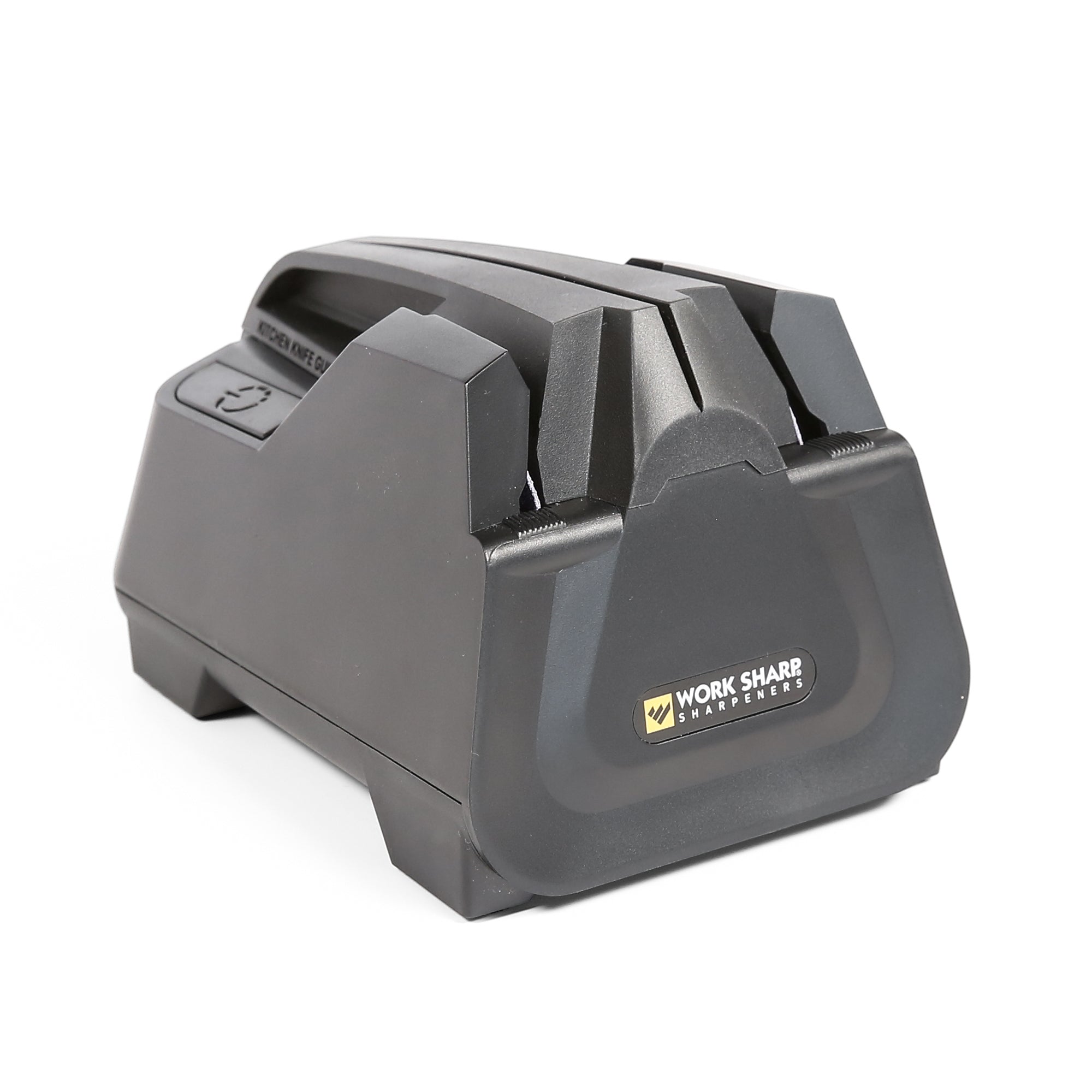
Your needs, this model
Does it fit your priorities?
What angle does the CPE2 use for ordinary kitchen knives?
The current Work Sharp product page specifies a 20° guide. It is one fixed setting, not an adjustable interval. Confirm the knife maker's intended bevel and whether its angle convention matches before using a fixed-angle sharpener to alter an edge.
Explore this need in the finder →Does the CPE2 have a documented serrated-knife method?
Yes: the current product page says the ceramic wheel hones serrations, and the linked one-page guide gives a separate serration-slot stroke procedure. That page does not specify motor state or a numeric scallop angle, so this assessment does not treat the serration routine as proven manual or powered work at a chosen angle.
Explore this need in the finder →What does scissor sharpening require on the CPE2?
The exact CPE2 package lists a scissor guide. Work Sharp's linked guide says to remove the angle guide, set the sharpener to its lowest speed, rest the blade on the scissor guide, and pull slowly two to five times per side. Check whether that procedure suits the specific scissors before starting.
Explore this need in the finder →The CPE2 is a small powered kitchen sharpener whose distinguishing feature is not a broad set of adjustments: Work Sharp lists one 20° guide, P120 ceramic abrasive discs, a fine ceramic honing wheel and a separate scissor guide. The useful question is whether those specific routines fit the knives and edge maintenance you actually need. This is a source-based assessment of the listed CPE2 package, not a hands-on test.
One fixed kitchen angle, with two different knife routines
The current product page specifies a 20° guide. That should be treated as a single supported position, not as a range that can be tuned to any knife. The linked one-page guide separates electric sharpening from manual sharpening: the powered instructions call for switching the machine on, placing the knife in the slot, drawing it through slowly, and alternating sides until the cycle stops. A separate manual section describes a hand-guided back-and-forth stroke with gentle pressure. The difference matters if you want a motor to do the abrasive movement or prefer to supply the strokes yourself.
Neither routine answers whether 20° is the right bevel for a particular blade. Check the knife maker's intended edge and angle convention before using a fixed-angle unit to change the edge. The captured sources do not provide a maximum blade length or thickness, so do not infer clearance for an unusually long, thick, flexible or shaped blade from the general kitchen-use designation.
Abrasive discs and a honing wheel are not a multi-grit progression
The supplied P120 ceramic discs are the sharpening abrasive identified in the box list. The separate fine ceramic wheel is described as a honing and maintenance surface. Those components serve different roles; their presence does not create a documented coarse-to-fine sequence comparable to a kit with several labeled grits. The manual says the abrasives are reversible, and the manufacturer lists replacement abrasives for the E2 family. That is useful ownership information, but it does not establish a service-life estimate for a particular home routine.
The package does not list a leather strop. A honing wheel should not be counted as one: the finder treats an included strop as a separate, explicit package requirement. The guide also advises wiping grinding dust from the inside and outside with a dry cloth after use. That cleaning step is not enough to establish a general no-water or no-lubricant operating rule, so check the full instructions for the exact unit rather than extrapolating one.
Scissors and serrations need separate checks
Scissors have their own included guide and a specific manual procedure. Work Sharp instructs the user to remove the angle guide, set the sharpener to its lowest speed, rest the scissor blade on the scissor guide, and pull slowly two to five times per side. This is a distinct, powered arrangement—not proof that every scissor shape or blade is compatible. Read the exact guide and confirm fit for the scissors at hand.
The product page also identifies serration support, and its feature description associates serrations with the ceramic honing wheel. The linked guide illustrates a separate serration-slot procedure using repeated back-and-forth strokes. It does not state whether the motor should be running for that task or give a numeric scallop angle. The broad serrated-use label is therefore supported, but this assessment does not assign that routine to a required manual or powered method, nor to the 20° knife setting. If one of those conditions is essential, treat it as unverified until the manufacturer clarifies the exact operation.
Where it sits among other formats
Within Work Sharp's reviewed set, the CPE2 trades angle flexibility and a larger abrasive ladder for a compact kitchen-focused arrangement. The Combo is another powered option, but its knife guide is fixed at 25° and its P120 belt is paired with a separate manual ceramic rod; it is not the same disc-and-honing-wheel design. The Knife & Tool Sharpener Mk.2 has its own 20° and 25° positions and dedicated task cassettes. Although the Mk.2 shares a 20° figure, its belt workflow and included tool guides are different. These comparisons describe documented configurations, not a performance ranking.
What to verify before choosing
Check that the exact offer says CPE2, includes the scissor guide if you need that operation, and uses the supplied package rather than a retailer bundle or another generation. Confirm the unit's electrical label for your market; the product page and linked guide inspected here do not establish a precise voltage or frequency. The manufacturer currently lists a 1.2 lb weight and a three-year warranty, but confirm the current written terms for the actual purchase. No price, stock condition or seller claim is part of this assessment.
For a kitchen routine built around a fixed 20° guide, P120 ceramic discs and a separate honing surface, the CPE2 has a clearly stated job. Its limitations are equally clear: no adjustable interval, no listed strop, no confirmed pocket-knife package, and incomplete operating detail for the serration motor state. Match those facts to your knife and your preferred routine before treating this compact format as a fit.
Key specifications
Key details at a glance
| Power | Powered |
|---|---|
| Sharpening format | Powered kitchen disc and ceramic honing wheel |
| Lowest angle setting | 20° |
| Highest angle setting | 20° |
| Included abrasive surfaces | P120 ceramic abrasive sharpening discs / Fine-grit ceramic honing wheel |
| Strop included | No |
| Angle-guide positions | 20° |
Use the exact model’s instructions for operating limits, supplied equipment and version differences.
Sources for this review
Sources for this assessment
Check the requirements that matter to you
Use the finder to compare documented sharpener formats and limits; an unknown capability is not treated as a match.