
Your needs, this model
Does it fit your priorities?
Does the standard Mk.2 package include a way to sharpen scissors?
Yes. The exact box list includes a tool-sharpening cassette with a 65° scissor guide. The user guide gives a separate scissor procedure and calls for sharpening only the beveled side. This is a different setup from the knife angle guide.
Explore this need in the finder →Can the Mk.2 work on serrated knives?
The included cassette has a dedicated serrated-knife guide and the manual provides a separate procedure. Do not transfer the plain-edge knife sequence blindly: use the serration-specific instructions and the exact belt and cassette setup they specify.
Explore this need in the finder →Can the 20° and 25° guides be treated as any setting between those values?
No. The manufacturer's manual describes two positions, 20° and 25°, rather than an adjustable range. The site's numeric matching field deliberately stays unpopulated for this plan because its current rule engine cannot express a short list of exact angles without also suggesting unsupported values in between.
Explore this need in the finder →Is this suitable for continuous shop or commercial sharpening?
The Mk.2 user guide states consumer use only, excludes industrial or commercial sharpening, and says not to exceed 30 minutes of use in one hour. It is not a substitute for a machine rated for sustained production work.
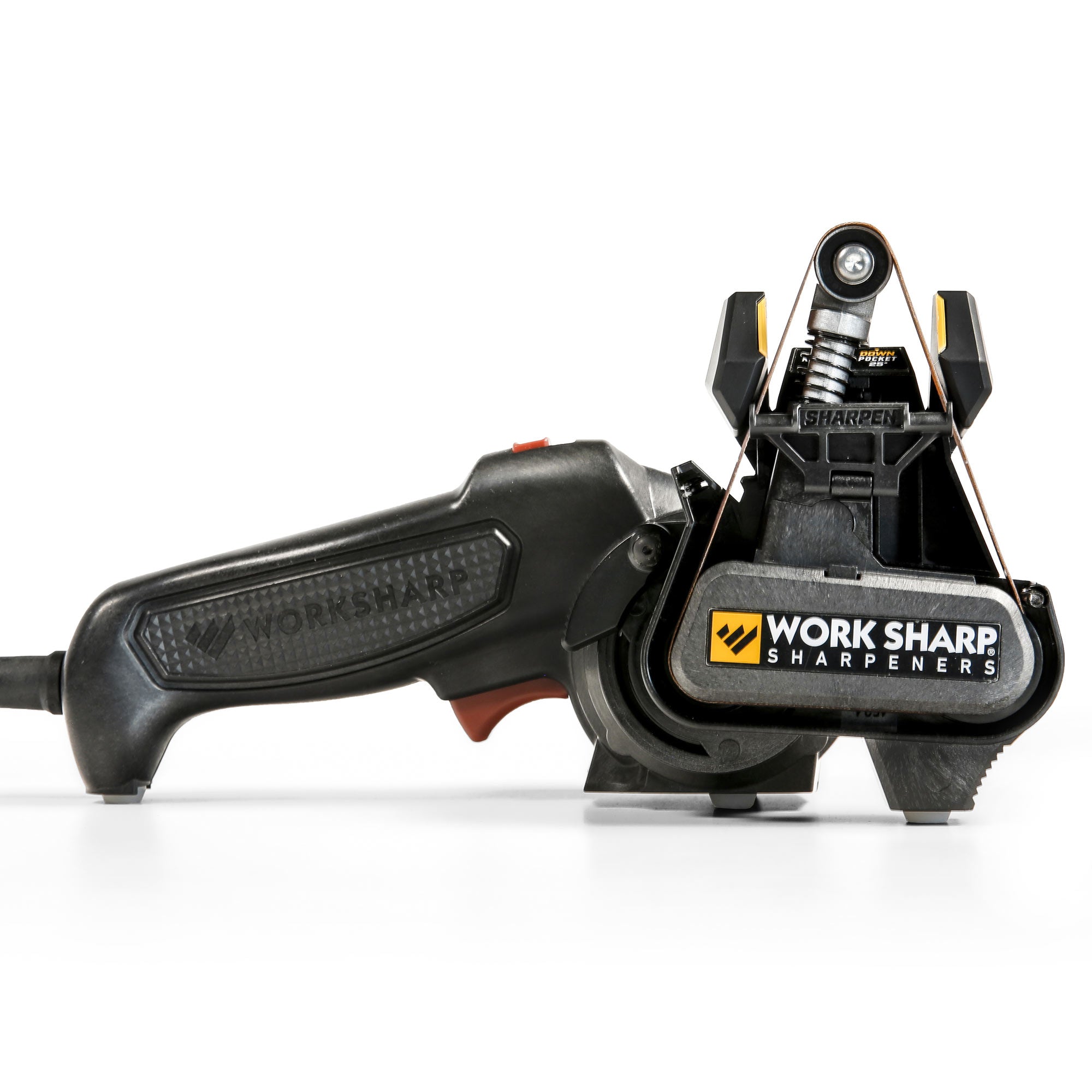
Explore this need in the finder →The Work Sharp Knife & Tool Sharpener Mk.2 (SKU WSKTS2) is not just the Combo Knife Sharpener with a different name. It is a 120-volt powered belt system whose included cassette changes the work it can do: ordinary knives use one guide arrangement, serrations have a separate guide, scissors have a dedicated 65-degree guide, and several shop or outdoor tools use a grinding setup. This is a source-based assessment of the US model page and its manual, not a hands-on test.
The standard Mk.2 is a specific kit
The manufacturer lists a 20- and 25-degree knife guide, the tool-sharpening cassette with a scissor guide, and two belts each in P80 coarse, P220 medium, and 6000 fine. The manual specifies half-inch by 12-inch belts. Those are six supplied belts across three grit classes, not six different finishes. Work Sharp lists the machine at three pounds and describes a two-speed motor: normal speed for sharpening and high speed for grinding.
The two knife-guide settings are discrete positions. They are not the endpoints of an adjustable 20-to-25-degree range, so settings such as 22 or 23 degrees are not supported by the reviewed guide. The site’s numerical angle filter deliberately does not translate this short list into a continuous range; leaving the angle blank is more accurate than presenting a false match. The correct bevel remains specific to the knife and its maker’s instructions.
Think in setups, not one universal pass
For ordinary kitchen or outdoor knives, the manual describes holding the blade against the angle guide and edge guide while drawing it across the belt. It calls for light pressure, even work on both sides, and stopping while the tip remains supported by the belt to reduce the chance of rounding it. A separate serration guide and procedure address serrated blades; that route should not be confused with the standard plain-edge guide.
Scissors require a different cassette position and their own guide. The manual says to sharpen only the beveled side and identifies a dedicated setup rather than inviting the user to run scissors through the knife guide. The same basic separation applies to tool work: the manual directs the user to remove the knife angle guide, lower the edge guide, and select the higher grinding speed for certain tools. Keeping these modes distinct is a real advantage of the package, but it also makes the manual part of the required setup rather than optional reading.
More grit options, more responsibility
P80 is identified for coarse grinding and many tools, P220 for knife and scissor sharpening, and 6000 for honing knives. The package therefore offers more progression than the Combo’s single P120 belt type. But the result depends on selecting the right belt and cassette position, keeping the belt centered, and following the instructions for the particular blade. A higher grit is not automatically needed for every touch-up, and the coarse belt should not be treated as the default knife stage.
The manual also puts a meaningful boundary on the machine: it is for consumer use, not industrial or commercial sharpening, and use should not exceed 30 minutes in an hour. That limit matters more than the broad “knife and tool” name if the intended work is repeated production sharpening. The manual contains standard power-tool safety instructions, including eye protection and attention to airborne dust and noise; users should check the full warnings and their own working conditions.
Where it sits beside the Combo and manual systems
The WSCMB pairs a fixed 25-degree belt guide with a manual ceramic rod, and its guide directs serrations to that rod with the motor off. The Mk.2 supplies P80/P220/6000 belts, two fixed knife-guide settings, a powered serration method, and a scissor cassette. Those are different feature sets, not merely a basic and deluxe version of the same standard package.
A manual guided sharpener such as the Precision Adjust solves another problem: the user supplies the stroke, while a clamp and rod support a range of settings. The Mk.2 moves the belt for you and offers multiple purpose-built cassette arrangements. That can simplify repetitive strokes, yet it also uses a powered abrasive and requires the user to manage pace, pressure, belt direction, and the tip. Someone who needs a non-powered routine or a continuously selectable angle should compare other formats instead.
Buying checks for WSKTS2
Confirm the exact SKU WSKTS2, the complete cassette, 20/25-degree guide, and all three belt grits in the offer; do not mistake the related Ken Onion editions or the retired original WSKTS for this kit. Check the 120 V, 60 Hz rating against the intended outlet, and make sure the work pattern stays within the manual’s duty limit. The standard contents do not list a leather strop. Also check replacement-belt supply and the cost of ongoing consumables for the sharpening routine you actually expect to use.
For a home user who wants more than a straight-edge kitchen guide, the Mk.2 has documented paths for knives, serrations, scissors, and several tools. Its tradeoff is that every path has its own setup and limits. It is not a single-angle, universal-slot appliance; buyers should be comfortable matching the cassette, belt, speed, and technique to the task before switching it on.
Key specifications
Key details at a glance
| Power | Powered |
|---|---|
| Sharpening format | Powered belt cassette system |
| Included abrasive surfaces | P80 coarse abrasive belt (two included) / P220 medium abrasive belt (two included) / 6000 fine abrasive belt (two included) |
| Strop included | No |
| Angle-guide positions | 20 / 25° |
Use the exact model’s instructions for operating limits, supplied equipment and version differences.
Sources for this review
Sources for this assessment
Check the requirements that matter to you
Use the finder to compare documented sharpener formats and limits; an unknown capability is not treated as a match.