
Your needs, this model
Does it fit your priorities?
What sharpening method does the Micro's maker describe?
Work Sharp's EDC article describes a hand-guided pass on the diamond rod, followed by alternating passes on the ceramic rod. That supports a manual maintenance routine; it is not a powered setup or a promise of repair performance.
Explore this need in the finder →Does the documented guide establish an exact numeric angle range?
The maker's EDC article identifies one 25° guide position where the plastic meets the diamond rod. It does not publish a continuous adjustable range or explain an angle convention, so this reference should not be treated as meeting an arbitrary numeric-angle requirement.
Explore this need in the finder →Can the current package be checked for a strop or exact accessories?
Not from the accessible current manufacturer pages. The exact product route returned a not-found page, while the Micro manuals route exposed video players but no box list. Confirm the complete model and contents from an identity-bearing current offer; strop inclusion remains unknown here.
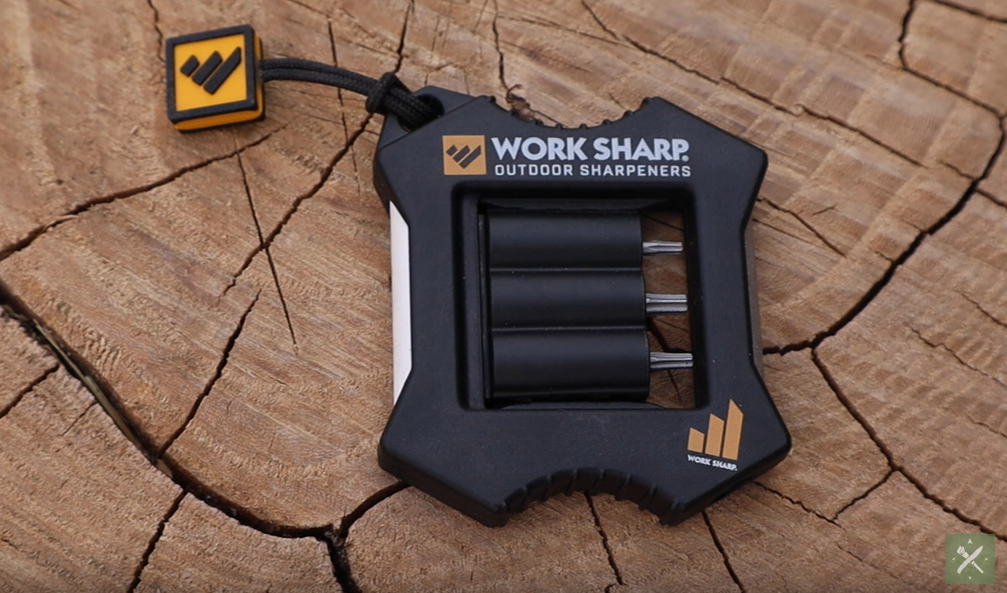
Explore this need in the finder →Work Sharp's EDC instructions identify the Micro Sharpener & Knife Tool as a small, manually used edge-maintenance tool for a carried knife. The published routine uses a guided diamond rod first and a ceramic rod second. This assessment is based on those manufacturer instructions, not hands-on use. The exact product page is no longer available as a live listing, so this is a model reference rather than a current purchase recommendation.
What the documented routine includes
The manufacturer's field directions describe holding the sharpener with the diamond surface facing up, placing the blade heel against the plastic guide, then drawing the edge from heel to tip while alternating sides. The article says the guide is 25° at the point where the plastic meets the diamond rod. It then switches to the ceramic side for a second set of alternating heel-to-tip passes. The order is useful to understand: the diamond surface is the maker's first sharpening step, while the ceramic surface follows as a honing step. The source suggests a paper cut as a check, but that is an instruction in the article, not a test performed for this review.
The guide supplies one angle position, not an adjustable interval. It does not explain whether 25° is expressed per side or as a total included angle. A numerical range matcher therefore cannot safely translate this single mark into a universal bevel claim. If the angle matters, compare the actual knife bevel with the manufacturer's current instructions before using a guide position; a fixed mark does not prove that it is right for every blade.
Why the format suits a carried-knife task
The instructions are explicitly framed around everyday-carry knives used in a pocket or pack, including field use. That is a narrower task than maintaining an entire kitchen block or setting a repeatable bevel on many knives. The hand-guided rod format avoids a motor or a bench setup, but the user still controls the knife, stroke, pressure and edge presentation. Work Sharp describes the tool as maintenance-oriented, so it is safer to treat the published routine as a touch-up workflow rather than assume it can correct a badly damaged edge or remove a large amount of steel.
The article also describes a built-in Torx driver for basic knife-hardware work, naming T6, T8 and T10 screws and mentioning pocket clips and pivots. That makes the model a combined knife-maintenance tool in the maker's description, not just an abrasive. However, the current product page and box contents could not be confirmed; the archived article alone does not establish which loose bits or accessories are included in an offer today.
Limits that matter before choosing one
The current manufacturer product URL returned a not-found page when checked, and the Micro manuals page did not expose an exact box list or a downloadable text guide. Those observations do not prove that the model is retired, unavailable from every seller, or unchanged from its earlier configuration. They do mean a shopper should not assume that an old photograph or archived procedure describes a seller's present package. Check the full model name, the included abrasives and the exact hardware accessories in any offer; do not substitute a sibling Work Sharp sharpener just because its name is similar.
The maker's archived instructions establish the diamond-and-ceramic sequence and the 25° guide position, but they do not establish serrated-edge support, a strop, knife-length limits, or current package contents. Those fields remain unknown here rather than being inferred from a neighboring field sharpener. This record is also excluded from the current finder matches until an exact present-day buying configuration can be established. A match for another manual pocket-knife sharpener is not evidence that the Micro itself is currently offered or that the two packages are interchangeable.
Assessment
The Micro's documented strengths are a compact manual diamond-to-ceramic routine and a built-in knife-hardware driver in one tool. Its evidence is strongest for straightforward EDC maintenance, not for a broad all-purpose kitchen, serration or precision-angle claim. Because the live product listing and box contents are not confirmed, keep this assessment for identification and comparison only; use the current finder to compare documented alternatives and verify the exact offer before buying.
Key specifications
Key details at a glance
| Power | Manual |
|---|---|
| Sharpening format | Manual portable guided diamond ceramic rods |
| Included abrasive surfaces | diamond rod / ceramic rod |
| Angle-guide positions | 25° |
Use the exact model’s instructions for operating limits, supplied equipment and version differences.
Sources for this review
Sources for this assessment
Check the requirements that matter to you
Use the finder to compare documented sharpener formats and limits; an unknown capability is not treated as a match.