
Your needs, this model
Does it fit your priorities?
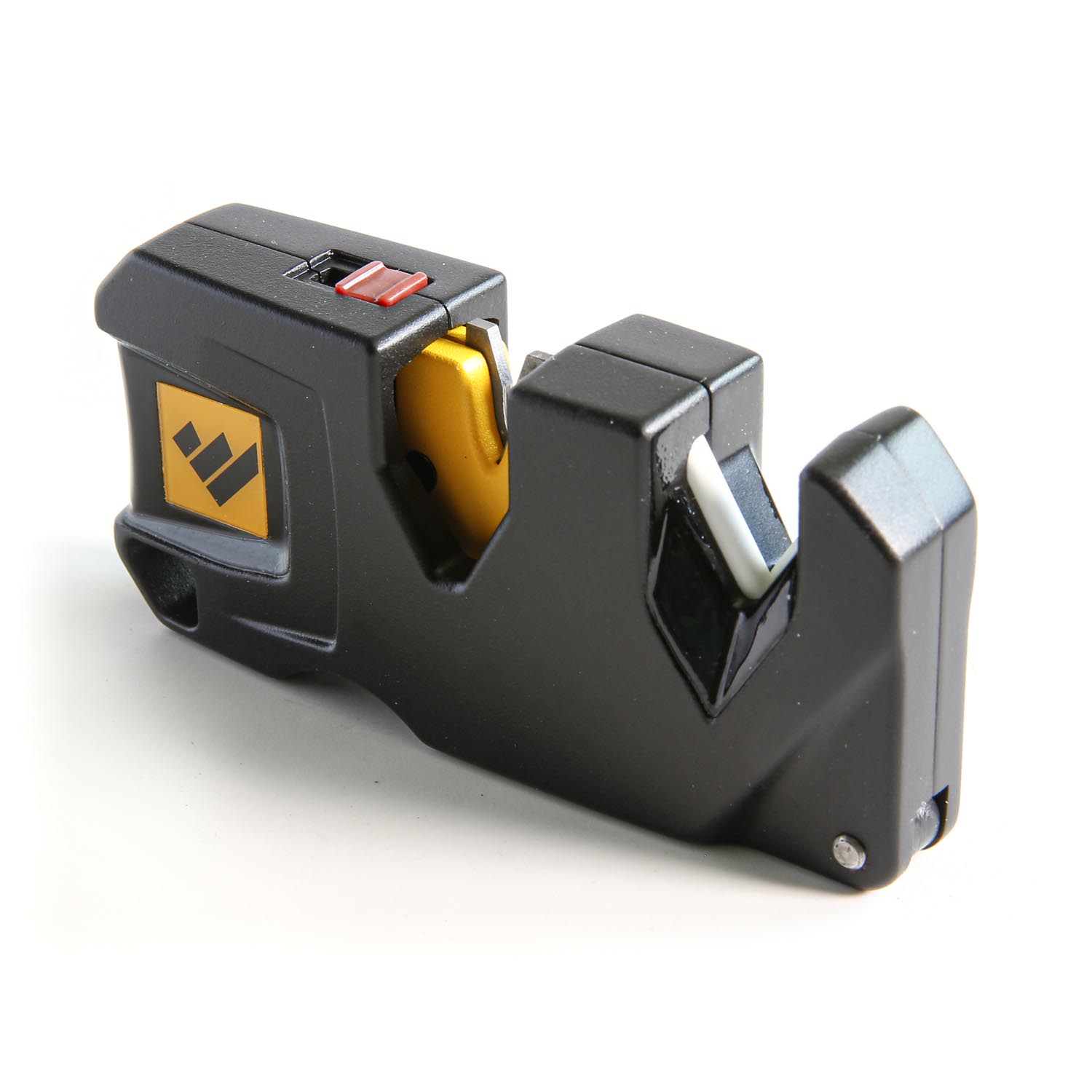
What does the red Pivot Response switch change?
The manual says one position lets the convex-carbide mechanism follow the blade curve and remove more material for heavier sharpening; locking it out reduces material removal for lighter work. It is a mechanical mode, not a motor or angle control.
Explore this need in the finder →Does Pivot Plus have a documented serration method?
Yes. The manual describes the tapered diamond rod for serrations and also a very-light-pressure ceramic deburring method. Those are separate from the convex-carbide plain-edge slot, and neither inherits that slot's stated 25° angle.
Explore this need in the finder →How does this differ from the standard Pivot?
The exact Pivot Plus box list includes a tapered diamond rod; standard Pivot WSEDCPVT instead lists a flat diamond plate with a hook groove. The manufacturer describes the tapered rod for serrations and fine-edge hand tools, while the flat plate's manual emphasizes hooks, hand tools and more material removal. The models have distinct SKUs and are not interchangeable packages.
Explore this need in the finder →Can it sharpen scissors?
The reviewed exact package and manual document knife, serration and fine-edge hand-tool work, but do not describe a scissor sharpening routine. If scissors are essential, prefer an exact package with an explicit scissor guide rather than inferring that capability from a general hand-tool claim.
Explore this need in the finder →Work Sharp’s Pivot Plus (WSEDCPVP) is a manual handheld sharpener that combines a convex-carbide knife slot, a ceramic hone, and a tapered diamond rod. Its most consequential distinction from the standard Pivot is not the word “Plus” on the housing: the plus model supplies a tapered rod for serrations and fine-edge hand tools, while standard Pivot WSEDCPVT lists a flat diamond plate with a hook groove. Both have their own documented procedures and a fixed 25° carbide knife slot. This assessment follows the exact product page and one-page user guide rather than assuming that similarly named packages are the same.
Three working surfaces, separate jobs
The product page identifies the knife-slot angle as 25° and describes a compact tool for kitchen, pocket, and serrated blades. The box list names the carbide sharpener, ceramic hone, tapered diamond rod, and the Pivot Plus body. No leather strop or scissors fixture appears in that list. The taper rod is a meaningful piece of the configuration: it reaches serrations and fine-edge hand tools in a way the standard Pivot’s flat plate is not presented as doing.
The manufacturer’s guide starts plain-edge sharpening at the heel in the carbide slot and calls for a pull-through stroke with medium pressure. A red button changes the carbide mechanism. In one position, the convex carbide follows the blade curve and removes more material for heavier sharpening; locked out, it remains still and removes less material for lighter applications. That Pivot Response feature is mechanical, not powered, and it does not turn the tool into an adjustable-angle sharpener.
Use the ceramic and tapered rod deliberately
For refinement, the guide switches to the ceramic hone and says to follow the same basic stroke; its tip is to use the ceramic hone for re-sharpening. The serration work is separate. The manual says the tapered diamond rod can sharpen serrations, and it also describes a light-pressure ceramic touch-up on the flat side to deburr them. For fine-edge hand tools such as garden pruners, the maker’s instructions call for light pressure along the beveled side. These are not reasons to press the 25° carbide slot into a different task.
Work Sharp presents the tool for kitchen and pocket knives, while the guide describes the manual operations. That makes it a more task-flexible portable option than a kitchen-only fixed-slot unit, but it does not establish fit for every blade length, handle, serration pitch, or edge geometry. No scissor method is documented in the reviewed exact package materials. If scissors are essential, compare models with an explicit scissor fixture and instructions rather than extrapolating from the phrase “fine-edge hand tools.”
Where it fits in a manual kit
The most persuasive use case is a compact manual kit that needs both an everyday carbide slot and a specifically documented way to reach serrations. The product is designed around guided passes rather than freehand angle control, so it is easier to understand than a system that asks the user to set a custom bevel—but the angle is also less adaptable. Work Sharp gives 25° for the carbide knife slot; the reviewed sources do not say whether that figure is per side or included. Compare it with the knife maker’s guidance before changing an established edge.
The standard Pivot makes a different trade. It has a flat diamond plate with a hook groove, which Work Sharp describes for fishhooks, hand tools, and knife edges that need more material removal. Pivot Plus instead lists a tapered rod and gives it a serration role. The two packages are not interchangeable, and neither model inherits the other’s abrasive merely because both have Pivot in the name.
Limitations and purchase checks
There is no adjustable angle range, dedicated scissors fixture, or included strop in the reviewed box list. The carbide slot’s fixed geometry may be unsuitable for a knife whose maker specifies a different edge. The ceramic hone is a maintenance surface, not a second precise angle control, and the guide’s “medium” and “light” pressure instructions require attention rather than a powered feed. This review does not claim measured edge quality, speed, or abrasive life.
Check that the listing is the exact WSEDCPVP Pivot Plus, with the tapered diamond rod, ceramic hone, and carbide body. Do not substitute WSEDCPVT standard Pivot or assume that a bundled listing includes additional attachments. Read the guide for the exact intended task, verify that the blade geometry reaches the surface safely, and treat the maker’s category labels as starting points rather than guarantees for a particular knife.
Key specifications
Key details at a glance
| Power | Manual |
|---|---|
| Sharpening format | Handheld convex carbide ceramic and tapered diamond |
| Lowest angle setting | 25° |
| Highest angle setting | 25° |
| Included abrasive surfaces | convex-carbide knife slot / ceramic hone / tapered diamond rod |
| Strop included | No |
| Angle-guide positions | 25° |
Use the exact model’s instructions for operating limits, supplied equipment and version differences.
Sources for this review
Sources for this assessment
Check the requirements that matter to you
Use the finder to compare documented sharpener formats and limits; an unknown capability is not treated as a match.