
Your needs, this model
Does it fit your priorities?
What is the standard Pivot's stated knife-slot angle?
Work Sharp lists a fixed 25° edge angle for the carbide knife slot. The product page and manual do not explain the convention or offer an adjustment dial, so compare with the knife maker's own edge specification rather than assuming a per-side value.
Explore this need in the finder →What is Pivot Response for?
The manual says the unlocked mechanism follows the blade curve and increases material removal for heavy sharpening; locked, it stays stationary and removes less material for lighter use. The switch does not alter the 25° knife-slot geometry.
Explore this need in the finder →Does standard Pivot have a serration routine?
Yes. The manual describes light-pressure ceramic work along the flat side of the serrations and an alternative short up-and-down method nesting the scallop on the ceramic rod. It is a separate honing procedure, not the carbide slot's 25° plain-edge plan.
Explore this need in the finder →What does standard Pivot include that Pivot Plus does not?
The standard Pivot box lists a flat diamond plate with a hook groove; Pivot Plus lists a tapered diamond rod instead. The standard manual describes the plate for fishhooks, hand tools and knife edges needing more removal. Do not treat the similarly named SKUs as one package.
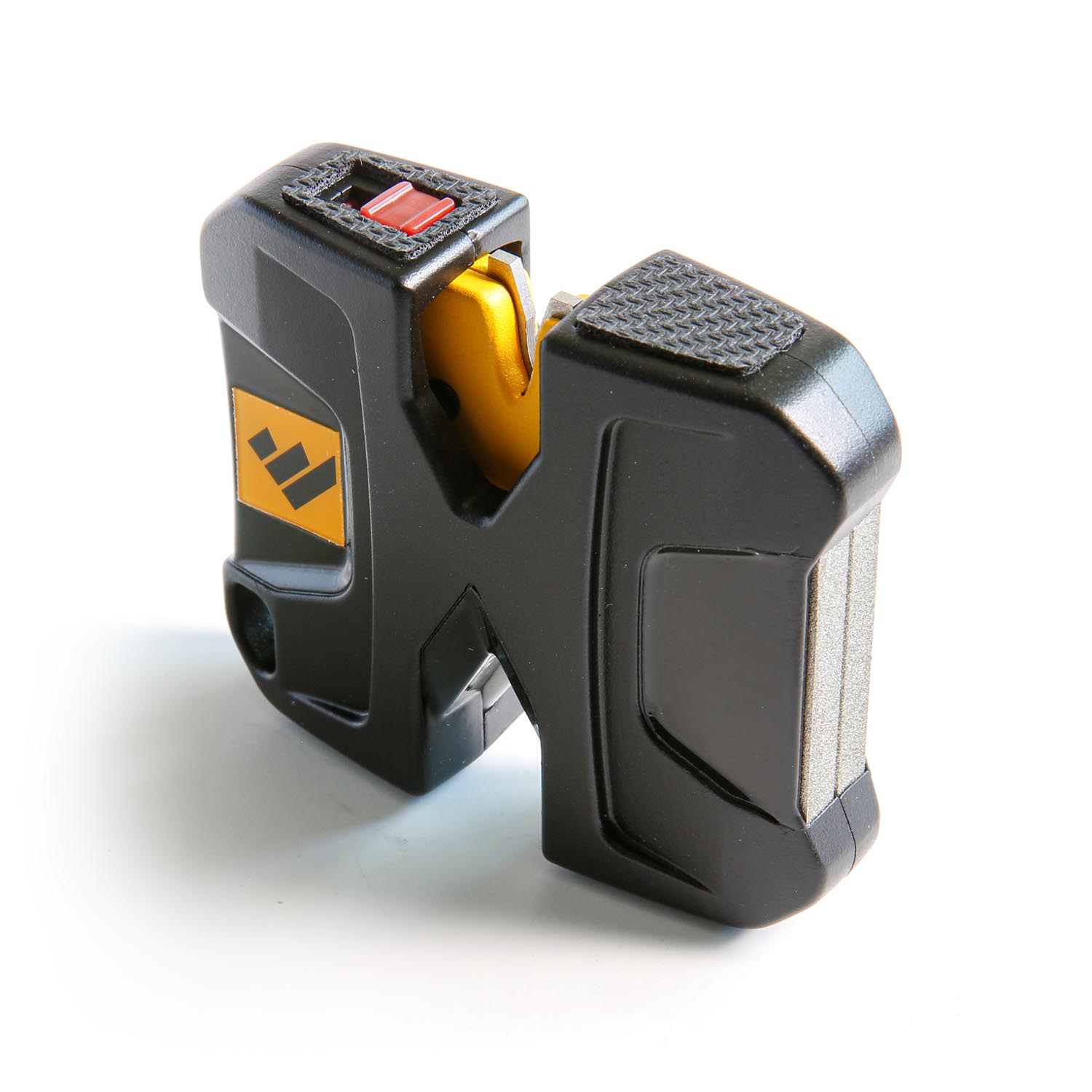
Explore this need in the finder →Standard Work Sharp Pivot (WSEDCPVT) is a small manual tool with a convex-carbide knife slot, ceramic hone, and flat diamond plate that includes a hook groove. Work Sharp lists a fixed 25° edge angle for the carbide slot. The movable abrasive feature called Pivot Response follows a curved blade when activated or stays locked for lighter work; it is not an angle adjustment. Those distinctions matter because the separately sold Pivot Plus (WSEDCPVP) replaces the flat plate with a tapered diamond rod and documents a different set of tasks.
What the standard package includes
The exact product page and manual list the carbide sharpening slot, ceramic hone, flat diamond plate with fishhook groove, and lanyard hole. The maker labels the intended use as pocket and hunting knives and describes small-tool use. No scissors attachment or leather strop appears in the reviewed box list. Standard Pivot is therefore best read as a portable field sharpener rather than a universal kitchen system or a clamp that holds a selected bevel.
The published 25° value applies to the carbide knife slot. The source does not explain the angle convention or document a dial, so this is a fixed capability, not a promise that every knife should be sharpened there. If your knife has an unusual factory bevel, a narrow asymmetric profile, or a specification from its maker, compare that guidance before using the slot.
Pivot Response changes material contact
Work Sharp’s one-page guide begins with the blade heel in the carbide slot and a medium-pressure pull-through. Moving the red switch activates Pivot Response so the convex carbide follows the knife’s curve and removes more material during heavier sharpening. Locking it out holds the abrasive still and reduces removal for lighter work. The choice is about how the sharpening element moves, not a way to choose 20°, 25°, or another edge setting.
The next operation moves to the ceramic hone. Work Sharp says to use that surface for re-sharpening. The manual gives it a different role on serrations: touch the flat side to the ceramic with very light pressure, or nest the scallop on the ceramic rod and use short up-and-down motions. That method is separate from the plain-edge carbide pass, so the carbide slot’s numeric angle should not be transferred to a serrated edge.
The flat plate is the defining difference from Pivot Plus
The flat diamond plate gives standard Pivot a distinct tool-facing surface. Work Sharp describes it for fishhooks, hand tools, and knife sharpening that calls for more material removal. The hook groove is part of the plate’s visible package identity. Pivot Plus instead includes a tapered diamond rod, which its manual names for serrations and fine-edge hand tools. Both retain the familiar Pivot Response body and a fixed carbide slot, but their diamond components are not the same and should not be treated as package variants without checking the SKU.
For a pocket or hunting kit that needs an edge touch-up tool and a flat surface for hooks or general small-tool work, standard Pivot has a clearer use case than a model selected only by a low price or broad marketing claim. If serrations or small beveled tools are the priority, compare the Plus’s tapered rod instructions. If kitchen-only two-stage sharpening is the job, evaluate dedicated kitchen models rather than assuming this field design provides kitchen clearance.
Limits to keep in view
The product does not document a selectable angle range, a scissor routine, or a leather strop in the exact package. It asks the user to guide the knife and select the Pivot Response position, so there is still a manual technique component. Its use labels do not prove that a particular handle, blade curvature, steel, or edge profile will fit. The manual’s short format is useful for basic operation, but it is not a substitute for knife-specific guidance when the edge is specialized.
There is no independent speed or sharpness measurement here, and no claim that the tool removes material at a particular rate. Work Sharp itself describes Pivot Response as a heavier-versus-lighter removal option, which is enough to signal a meaningful handling difference without translating it into an unsupported performance ranking.
Buying checks
Verify the exact WSEDCPVT name and confirm the flat diamond plate with its hook groove, ceramic hone, and carbide slot. Do not assume that the tapered rod pictured or listed for Pivot Plus is included. Ask whether the fixed 25° knife slot is compatible with your knife’s documented bevel convention, and check whether the desired use is pocket or hunting maintenance rather than scissors or an unsupported large kitchen blade. The small package is most useful when its specific field tasks align with your routine.
Key specifications
Key details at a glance
| Power | Manual |
|---|---|
| Sharpening format | Handheld convex carbide ceramic and flat diamond |
| Lowest angle setting | 25° |
| Highest angle setting | 25° |
| Included abrasive surfaces | convex-carbide knife slot / ceramic hone / flat diamond plate with hook groove |
| Strop included | No |
| Angle-guide positions | 25° |
Use the exact model’s instructions for operating limits, supplied equipment and version differences.
Sources for this review
Sources for this assessment
Check the requirements that matter to you
Use the finder to compare documented sharpener formats and limits; an unknown capability is not treated as a match.