
Your needs, this model
Does it fit your priorities?
What guide angle does the pocket sharpener provide?
Work Sharp identifies 25° guides on both the diamond and ceramic stages. That is a fixed guide position, not an angle dial, and the reviewed instructions do not specify whether the number is per-side or included.
Explore this need in the finder →How does the diamond-to-ceramic sequence work?
The guide describes light-pressure strokes with the blade side resting on the angle guide, followed by alternating diamond strokes and ceramic honing strokes; the opposite guide is used on the other side. Use the instructions for the exact blade and handle the finished edge carefully.
Explore this need in the finder →Is it limited to folding pocket knives?
The manufacturer says it can also work with small fixed-blade knives, kitchen paring knives and other compact blades, but is best suited to smaller knives rather than large outdoor tools. That does not verify clearance for every blade or handle.
Explore this need in the finder →Does WSGPS-W include a leather strop?
No. Its exact box list includes the 320-grit diamond and fine ceramic rod, and the product FAQ explicitly says no leather strop is included. The product page's title and specification sections disagree about weight, so this review does not rely on either weight figure.
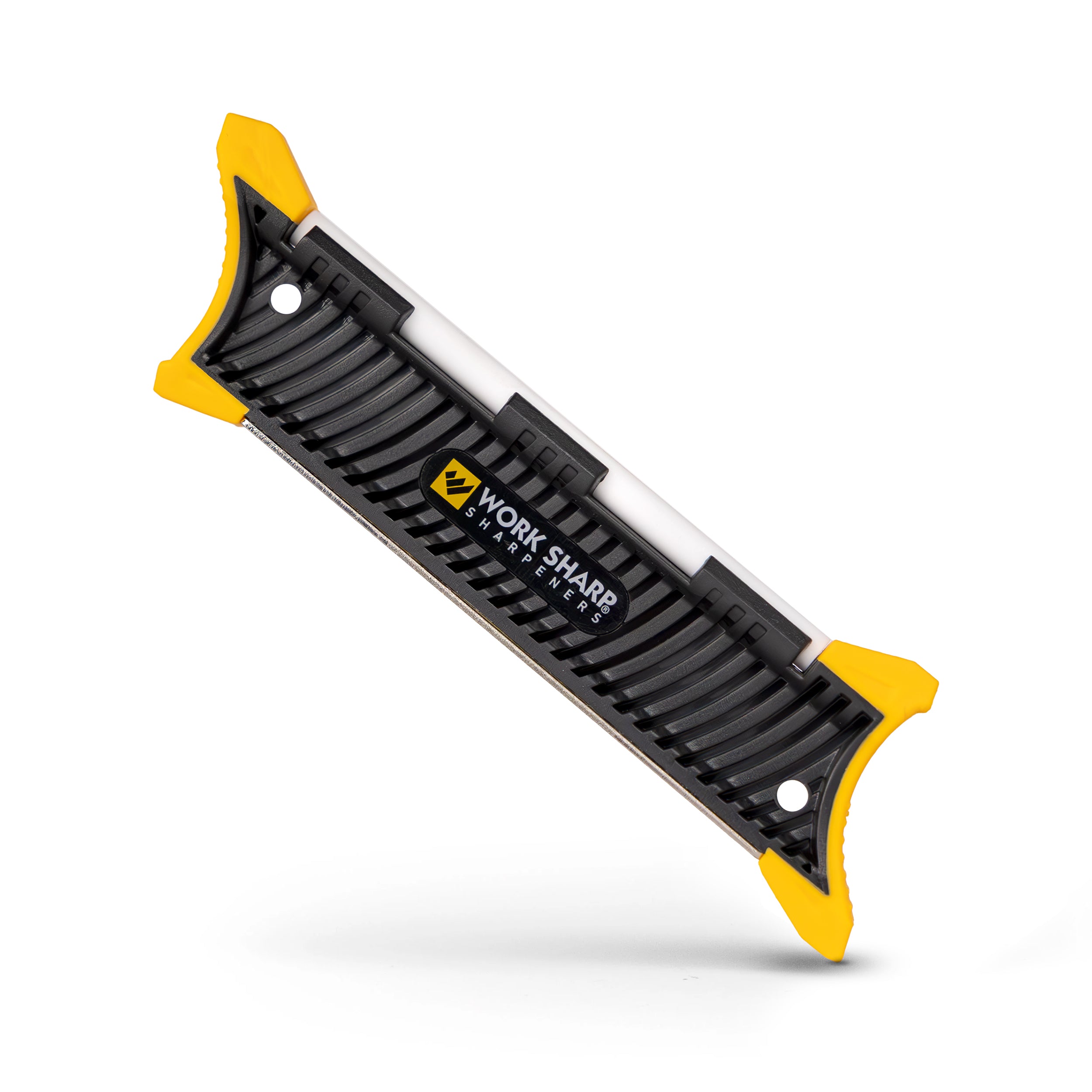
Explore this need in the finder →Work Sharp Pocket Knife Sharpener WSGPS-W is a manual plate-and-rod tool for pocket knives and other compact blades. Its box lists a medium 320-grit diamond surface and a fine ceramic rod, with 25° guides for the sharpening and honing stages. The format is portable and simple, but the fixed guides and maker’s small-blade emphasis are important boundaries: this is not an adjustable kitchen system, and it is not documented for every edge or tool.
What the package does—and does not do
The diamond plate provides the coarser sharpening surface; the ceramic rod is for honing. The exact product page says the guide keeps the angle consistent and identifies 25° positions. Work Sharp also says the sharpener can serve small fixed-blade knives, paring knives, and other compact blades, while noting that it is best suited to smaller knives rather than large outdoor tools. That gives it a useful pocket-to-paring-knife range, but not a blanket kitchen endorsement for every chef’s knife or large blade.
The product page’s weight copy is inconsistent: a marketing heading gives one figure while the specification section gives another. This assessment leaves weight out instead of choosing between them. The same exact page says there is no leather strop included; the box list also contains no scissor fixture or accessory. Similar-looking portable sharpeners can differ in abrasives, angle guides, and included components, so verify the WSGPS-W identifier rather than relying on a generic product title.
How its guide works
The manufacturer’s guide instructs the user to rest the side of the blade on the angle guide and sweep the blade across the abrasive with light pressure while maintaining the angle. It shows alternating strokes on the diamond plate followed by alternating strokes on the ceramic. The other side is sharpened using the opposite guide. The finished edge requires careful handling; the manual calls attention to the sharpness created by the tool.
This is controlled hand movement, not a clamp or motorized pass. The guides support consistency but do not set a custom angle, and the maker’s 25° statement does not specify whether it is per-side or included. A knife maker’s edge instructions and the blade’s existing geometry still matter. The little tool makes less sense when you need a specialized bevel, a wide range of adjustments, or a system that holds a long blade firmly while you work.
How it compares with the Pivot family
Work Sharp’s Pocket Knife Sharpener uses a diamond plate and ceramic rod with 25° guides; Pivot and Pivot Plus use a fixed carbide slot, ceramic, and different diamond attachments. The standard Pivot has a flat diamond plate and hook groove, while Pivot Plus has a tapered diamond rod and documents serration work. WSGPS-W is a simpler plate-and-rod arrangement with angle guides; the other two add a carbide sharpening slot and the Pivot Response mechanism. Similar portability does not erase these differences.
The reviewed Pocket Knife Sharpener manual documents straight blade work on diamond and ceramic, not a serration or scissor procedure. Its FAQ’s hard-steel examples are maker claims, not a test we performed. If a serrated edge or scissors are required, choose a package with a clearly documented task-specific method. For a compact plain-edge blade where a 25° guide suits the knife, WSGPS-W has a straightforward manual sequence without extra fixtures.
Who may prefer this format
Consider it for a pack, camp, glovebox, or small-tool kit when the work is a compact plain-edge blade and you want both a diamond sharpening stage and a ceramic hone in one hand-operated package. The maker’s support for paring knives extends the use beyond folding knives, but the small-blade caveat still matters. Check blade length, handle clearance, and whether the guide can contact the edge as the manual shows. The product name is not proof that every folding knife shape fits well.
Pass if you need a continuously adjustable bevel, a dedicated serration tool, an included strop, scissor sharpening, or a heavy-duty surface for broad tools. Work Sharp’s package list gives no replaceable abrasive information in the sources reviewed here, so replacement availability is not asserted. No hands-on sharpness, durability, time, or edge-retention claim is made.
Before buying
Confirm the exact WSGPS-W model, the medium diamond and fine ceramic surfaces, and both angle guides in the offered package. Check that the maker’s fixed 25° capability is compatible with your knife’s own instructions, that a compact blade is the intended job, and that you do not expect a strop, scissor attachment, or serration method. Read the current manual before use and handle the edge safely after sharpening. Its value lies in a specific portable two-surface routine, not in doing every sharpening task.
Key specifications
Key details at a glance
| Power | Manual |
|---|---|
| Sharpening format | Portable guided diamond plate and ceramic rod |
| Lowest angle setting | 25° |
| Highest angle setting | 25° |
| Included abrasive surfaces | medium 320-grit diamond plate / fine ceramic rod |
| Strop included | No |
| Angle-guide positions | 25° |
Use the exact model’s instructions for operating limits, supplied equipment and version differences.
Sources for this review
Sources for this assessment
Check the requirements that matter to you
Use the finder to compare documented sharpener formats and limits; an unknown capability is not treated as a match.