
Your needs, this model
Does it fit your priorities?
Will the standard Precision Adjust package let me set a kitchen-knife angle around 20°?
Yes, 20° is inside the manufacturer-documented 15°–30° adjustment span. The manual also gives 20° as its example for Western-style kitchen knives and 15° for Eastern-style knives; use the knife maker's guidance where available and do not treat one setting as universal.
Explore this need in the finder →Can I use this for a pocket or hunting knife and choose a more durable bevel?
The manufacturer identifies the model for pocket and hunting knives. Its guide suggests 25° for heavy-use pocket or hunting knives and 20° for lighter use, while emphasizing technique and edge durability tradeoffs. That is guidance, not a promise that every blade's existing geometry should be changed to those angles.
Explore this need in the finder →Does the standard package include the special parts for serrated knives or a strop?
Neither is listed in the standard package's box contents. Work Sharp lists the included 320 and 600 diamond surfaces and fine ceramic hone; the replacement leather strop is presented separately as a compatible accessory. Serrated sharpening is not established for this exact three-surface package, so do not treat the model as a verified serrated solution without confirming the exact tool and instructions.
Explore this need in the finder →The Work Sharp Precision Adjust (SKU WSBCHPAJ) is a manual, guided sharpener: the knife sits in a V-block clamp while the user moves a three-sided abrasive along the edge on a guided rod. The maker lists kitchen, pocket and hunting knives as intended uses, and specifies a 15°–30° adjustment range. This is a document-based assessment of the exact standard package, not a hands-on test or a report of owned equipment. The manufacturer's product page and its user guide are the sources for the package and instructions.
What is in the standard package
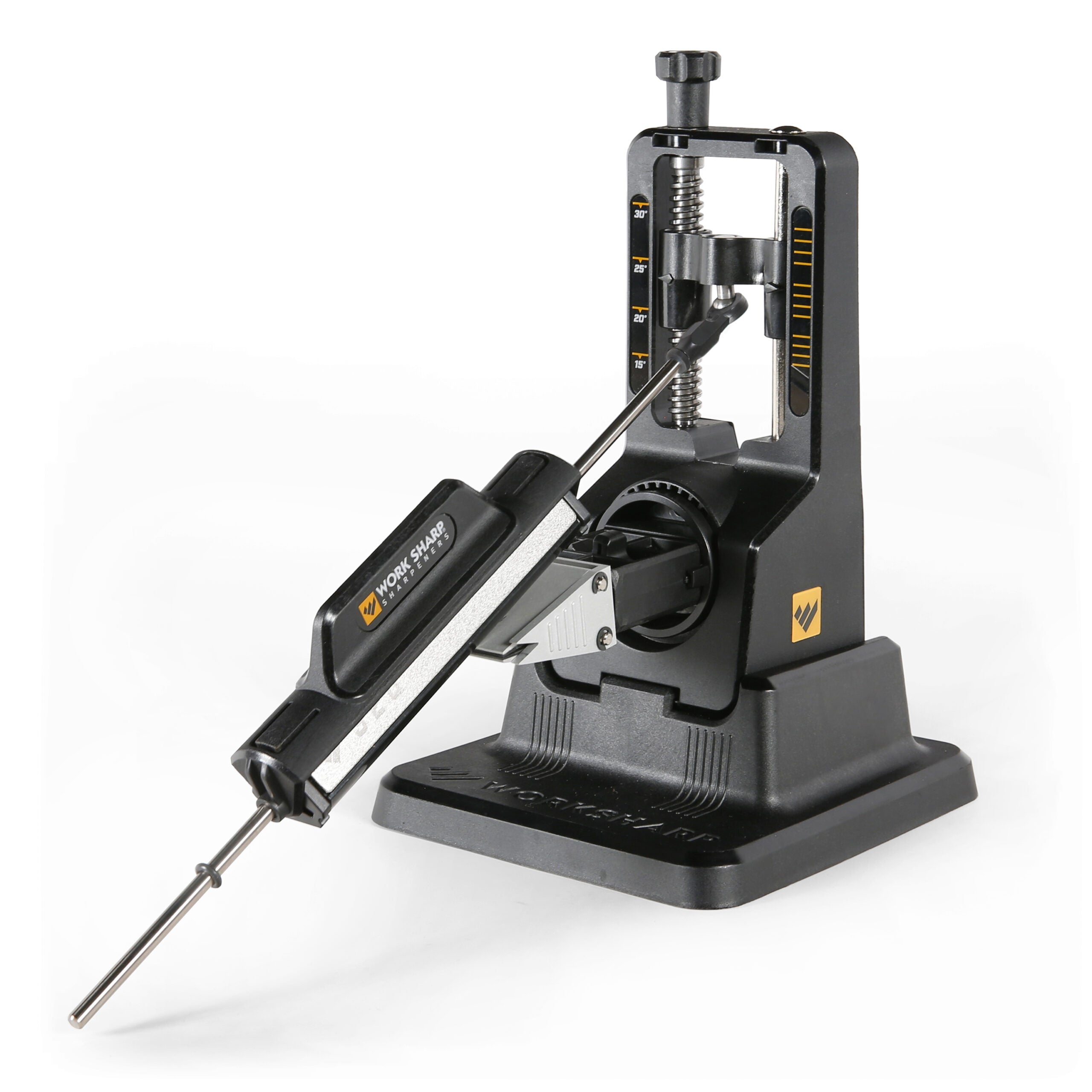
Work Sharp lists a benchtop base, adjustable sharpening chassis, V-block clamp, slide rod with O-ring stops, and a rotating Tri-Brasive handle. Its three surfaces are a 320-grit coarse diamond plate, a 600-grit fine diamond plate and a fine ceramic stone. That is a compact, easy-to-understand progression: the manual assigns the coarse plate to shaping, the fine diamond to sharpening and the ceramic to honing. The product page also says the abrasives can be replaced individually. Do not mistake the standard kit for the more elaborate versions with similar names. The company describes this model as its basic three-abrasive setup; the Precision Adjust Elite adds more abrasives, a leather strop and a carrying case. Accessories and packages change, so check the exact WSBCHPAJ listing and its box contents rather than relying on a family name alone. The standard package does not list a strop, a serration attachment or a digital angle indicator.How the guided arrangement changes the job
The clamp and rod address one of the hard parts of freehand sharpening: holding a repeatable relationship between blade and abrasive. In the maker's setup, the chassis attaches to the base, the rod engages the angle selector and the knife is secured in the removable clamp. The guide has a macro scale and a one-degree micro scale. It recommends centering the blade in the jaws, aligning the edge parallel with the jaws where the knife allows, then turning the clamp to work on the opposite side. Its step-by-step process starts with light pressure at the heel, moves toward the tip, and asks the user to establish and remove a burr instead of relying on a fixed stroke count. That is more controlled than an un-guided stone, but it is not automatic. You still set the angle, choose an abrasive, maintain light and even strokes, watch the edge and flip the clamp. The company says the chassis can be bench-mounted or used by hand; the included base makes the benchtop setup the straightforward starting point. The user guide cautions that some folding-knife blade and handle designs may not clamp safely. It also says never to leave a knife mounted when the sharpener is not in use. Keep the manufacturer's safety instructions beside the work rather than treating the mechanism as a guard against careless handling.Angle range is a capability, not a prescription
The dial covers 15° through 30°, with one-degree increments. The manufacturer's guide gives example settings, including 20° for Western-style kitchen knives and 15° for Eastern-style kitchen knives; for pocket and hunting use it gives 20° for light use and 25° for heavy use. It also describes lower settings as potentially sharper but less durable, and higher settings as more durable. These are general starting points from the maker, not a diagnosis of an individual knife. Before changing an existing bevel, check the knife maker's guidance, the edge condition and the work the knife will do. If you need a setting outside this documented span, this model is not a fit on angle range alone.Where the package may fall short
The standard kit is a sensible candidate when the buyer wants a manual clamp-and-guide format and the three listed abrasive surfaces meet the intended work. It is less compelling if the required routine is powered and quick, if the buyer expects a strop or broader finishing set in the box, or if serrated edges are a central task. The standard box list and manual do not establish a dedicated serration method for this package; that is a reason to verify another exact system, not proof that every serrated blade is impossible to touch up with it. The official material reviewed here does not state a maximum blade length or maximum blade thickness for SKU WSBCHPAJ, so this assessment does not promise clearance for a particular long, thick or unusually shaped knife. Clamp compatibility can turn on handle clearance, spine shape and where the knife can be secured. If those dimensions matter, ask the maker about the exact knife before buying rather than borrowing a limit from an Elite or Professional model.Use, care and replacement
This is a dry sharpening system. Work Sharp's guide explicitly says not to use oil or water while sharpening. It says abrasives are individually replaceable and advises using light pressure; the product page's care guidance also recommends brushing filings from the abrasives and storing the sharpener dry. Keep the knife and clamp secure, keep fingers clear of the edge, and avoid dragging the abrasive across the blade face, which the guide warns can scratch it. Replacement parts are useful for long-term ownership, but they are consumables rather than a reason to apply extra pressure or continue with a worn surface.Who should shortlist it
Consider the Precision Adjust if the priority is a manual, repeatable guide for supported kitchen or pocket/hunting knives, the desired setting is within 15°–30°, and you are willing to work through the maker's three-surface sequence. The fixed clamp and guided rod are the defining convenience; the limited standard kit and hands-on strokes are the counterweight. Compare the SKU, included surfaces, accessory needs and blade clearance before choosing a seller. If those checks do not fit, leave it off the shortlist rather than reading general product-family claims as guarantees for your knife.Key specifications
Key details at a glance
| Power | Manual |
|---|---|
| Sharpening format | V-block clamp and guided rod |
| Lowest angle setting | 15° |
| Highest angle setting | 30° |
| Angle increment | 1° |
| Included abrasive surfaces | 320-grit coarse diamond plate / 600-grit fine diamond plate / fine ceramic stone |
| Benchtop base included | Yes |
| Strop included | No |
| Use dry (no oil or water) | Yes |
Use the exact model’s instructions for operating limits, supplied equipment and version differences.
Sources for this review
Sources for this assessment
Check the requirements that matter to you
Use the finder to compare documented sharpener formats and limits; an unknown capability is not treated as a match.