
Your needs, this model
Does it fit your priorities?
Are the RKS angle marks a continuous range?
No. The product page and manual identify four guide positions: 15°, 17°, 20° and 25°. The finder represents these as separate supported arrangements, so a match at 20° does not claim support for 18° or every point between the outer marks. The maker's instructions also do not state the angle convention in the reviewed short guide; compare its markings with the knife maker's specification before changing a bevel.
Explore this need in the finder →Will a narrow or unusually wide blade sit securely on the RKS?
Work Sharp's FAQ cautions that blades narrower than 0.5 inch may have trouble staying on the magnet and aligning with the guide. It says blades up to about 2.25 inches wide can be sharpened effectively. Those are maker-published fit cues, not a measurement of your knife; check how its profile and handle sit on the exact magnetic block and riser.
Explore this need in the finder →Does this package include a strop, serration attachment, or scissor guide?
The exact WSKTNRKS-W box list names a magnetic angle block, 320- and 600-grit diamond discs, a fine ceramic disc and storage packaging; it does not list a leather strop or scissor guide. I found no RKS-specific serration procedure in the short official guide or product page, so this assessment does not count it as a verified serration method. A separately sold RKS disc does not turn the device into another model's attachment system.
Explore this need in the finder →Can I use replacement discs from another Work Sharp sharpener?
No. Work Sharp says the RKS is its only model using round sharpening discs and that replacement parts from its other systems are not compatible. Check that a replacement is specifically named for the Rolling Knife Sharpener; its FAQ lists separate RKS 320-grit, 600-grit and ceramic discs.
Explore this need in the finder →The Work Sharp RKS is a manual rolling sharpener, not a motorized slot machine or an adjustable-angle rod kit. Its distinctive buying question is whether your knife sits safely on the magnetic block and whether one of the four marked angles is the setting you actually need. This assessment is based on Work Sharp's exact WSKTNRKS-W product page and short guide; it is not a hands-on test, and it makes no independent performance claim.
What the WSKTNRKS-W package includes
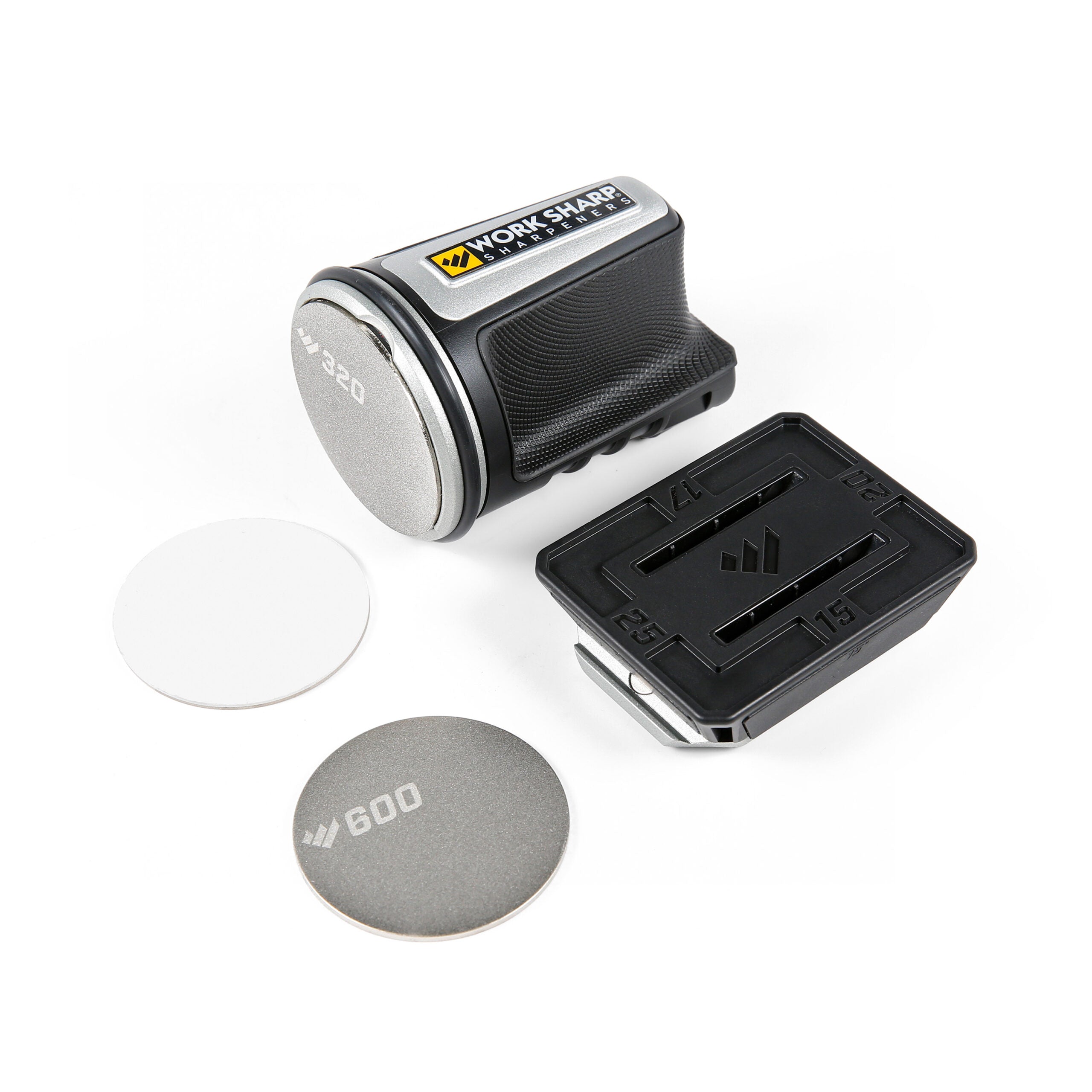
Work Sharp identifies the RKS as SKU WSKTNRKS-W. The stated box contents are the rolling sharpener, a magnetic angle block marked 15°, 17°, 20° and 25°, diamond discs marked 320 and 600 grit, and a fine ceramic disc. The maker says the retail packaging can also be used as a drawer organizer. It lists the device at 2 lb and gives it a three-year warranty; the short guide says the consumer warranty excludes abrasives. None of that should be assumed for a used or incomplete offer without checking what is actually in the box.
The abrasive details have a small but meaningful wording wrinkle. The included-items list describes 320 grit as coarse, while a feature callout on the same product page calls it medium. Rather than treating those adjectives as a reliable comparison with another brand's scale, this assessment records the printed 320 and 600 grit values and the fine ceramic hone. The page presents the discs as replaceable and sells RKS-specific replacements. It also says round discs are unique to this model and are not interchangeable with other Work Sharp systems' replacement parts.
Four positions, not a continuous 15°–25° range
The RKS's magnetic block presents four discrete settings: 15°, 17°, 20° and 25°. The instruction sheet maps those marks to broad knife categories—Eastern, Western, pocket/folder and outdoor—but that is manufacturer guidance, not a substitute for a knife maker's specification or an answer for every blade. The RKS does not document 16°, 18° or every other integer between the outer positions. For that reason, this site's numeric matching treats each RKS angle as its own operating arrangement: a 20° result means the 20° mark only.
The guide's short diagram does not state whether its angles are measured per side or as an included angle. Work Sharp's other sharpening products sometimes specify conventions in their own manuals, but those facts cannot be transferred to the RKS. If a knife maker gives you a required edge angle, confirm both the RKS marking convention and the knife's existing bevel before you remove material. The available marks are a compatibility filter, not a recommendation to reprofile a blade.
Magnetic hold and blade fit deserve a real check
Rolling is a simple motion only after the knife is seated, aligned and held with care. Work Sharp describes a blade riser for folding knives, but its FAQ also warns that blades narrower than 0.5 inch may have trouble staying on the magnet and lining up with the guide. It says blades up to about 2.25 inches wide can be sharpened effectively. Those are useful manufacturer-published cues, not a guarantee for your particular profile. Compare the blade's width and shape with the block and consider whether its handle, ricasso or taper will obstruct the path.
Safety is not incidental to a magnetic fixture. The RKS guide warns users to keep fingers away from the edge, keep the knife securely positioned on the block while actively sharpening, avoid excessive pressure and never leave a knife attached when not in use. It also calls attention to strong magnets that may interfere with cards, pacemakers, phones, computers and other electronics. The tool is hand-operated, but a guided arrangement does not make the exposed edge harmless.
How its workflow differs from a powered or freehand system
The RKS avoids a motor, a belt tracking mechanism and a powered knife slot. Instead, the user chooses the guide block position, controls the rolling movement and changes between the included discs and ceramic surface. Work Sharp's product copy describes a coarse-to-finer sequence followed by ceramic honing, but the short instruction sheet is primarily diagrams and safety information rather than a long blade-specific procedure. Do not infer a universal number of strokes, pressure, service life or result from the product's simplicity language.
That makes the RKS a different proposition from a Work Sharp Combo, which combines a powered belt procedure with a separate motor-off ceramic-rod plan, or a clamped guided system where an abrasive is moved across a fixed knife. The RKS is a dedicated manual roller. Its package supplies the four angle marks and the RKS's own round abrasives; it does not add a scissor guide, a serration attachment or a leather strop. The product page and reviewed quick guide do not document a serration or scissor method, so this assessment does not mark those tasks as supported.
Who should shortlist it—and what to verify
This is a plausible format to investigate if you want a compact, hand-powered guided rolling routine for a kitchen or pocket knife, and one of the four fixed guide marks matches your documented need. It is a poor fit when the requirement is an arbitrary in-between angle, when a particularly narrow blade may not stay aligned, or when a serration, scissor or other tool procedure must be verified. The standard package includes no leather strop; buying a strop separately does not make it part of this exact SKU.
Before choosing a particular offer, check the WSKTNRKS-W model identifier, the complete magnetic block and four marked positions, all three abrasive surfaces, and the condition and compatibility of any included discs. Confirm whether your knife's width and profile can be positioned safely, which angle convention the maker intends, and whether the intended work is covered by RKS-specific instructions. If your task depends on a different angle or edge type, compare the documented alternatives in the angle guide and the full finder rather than stretching the RKS's listed positions into a range.
Key specifications
Key details at a glance
| Power | Manual |
|---|---|
| Sharpening format | Rolling manual guide |
| Included abrasive surfaces | 320-grit diamond disc / 600-grit diamond disc / fine ceramic disc |
| Strop included | No |
| Angle-guide positions | 15 / 17 / 20 / 25° |
Use the exact model’s instructions for operating limits, supplied equipment and version differences.
Sources for this review
Sources for this assessment
Check the requirements that matter to you
Use the finder to compare documented sharpener formats and limits; an unknown capability is not treated as a match.