
Your needs, this model
Does it fit your priorities?
What is involved before using the Whetstone?
The user guide says to submerge the stone for 5–10 minutes or until air bubbles stop, then keep it wet while sharpening. The current product FAQ says at least 10 minutes or until bubbles stop, so these official instructions differ slightly; check the current guide supplied with the exact offer. The guide calls for water only, not oil or dry sharpening.
Explore this need in the finder →Does the Whetstone include a guide position for a folding knife?
Its two removable guides are 15° and 17°. The user guide gives 17° as its example for kitchen or folding knives and 15° for Eastern kitchen knives. These are discrete guidance points, not a continuous adjustment span.
Explore this need in the finder →Is this a dry sharpener that can be rinsed only after the job?
No. Work Sharp's instructions require water: soak the stone, keep it wet during sharpening, use water to rinse it when changing from coarse to fine, then clean the base and guides and store the system clean and dry. The 6000-grit side refines an edge after the 1000-grit work.
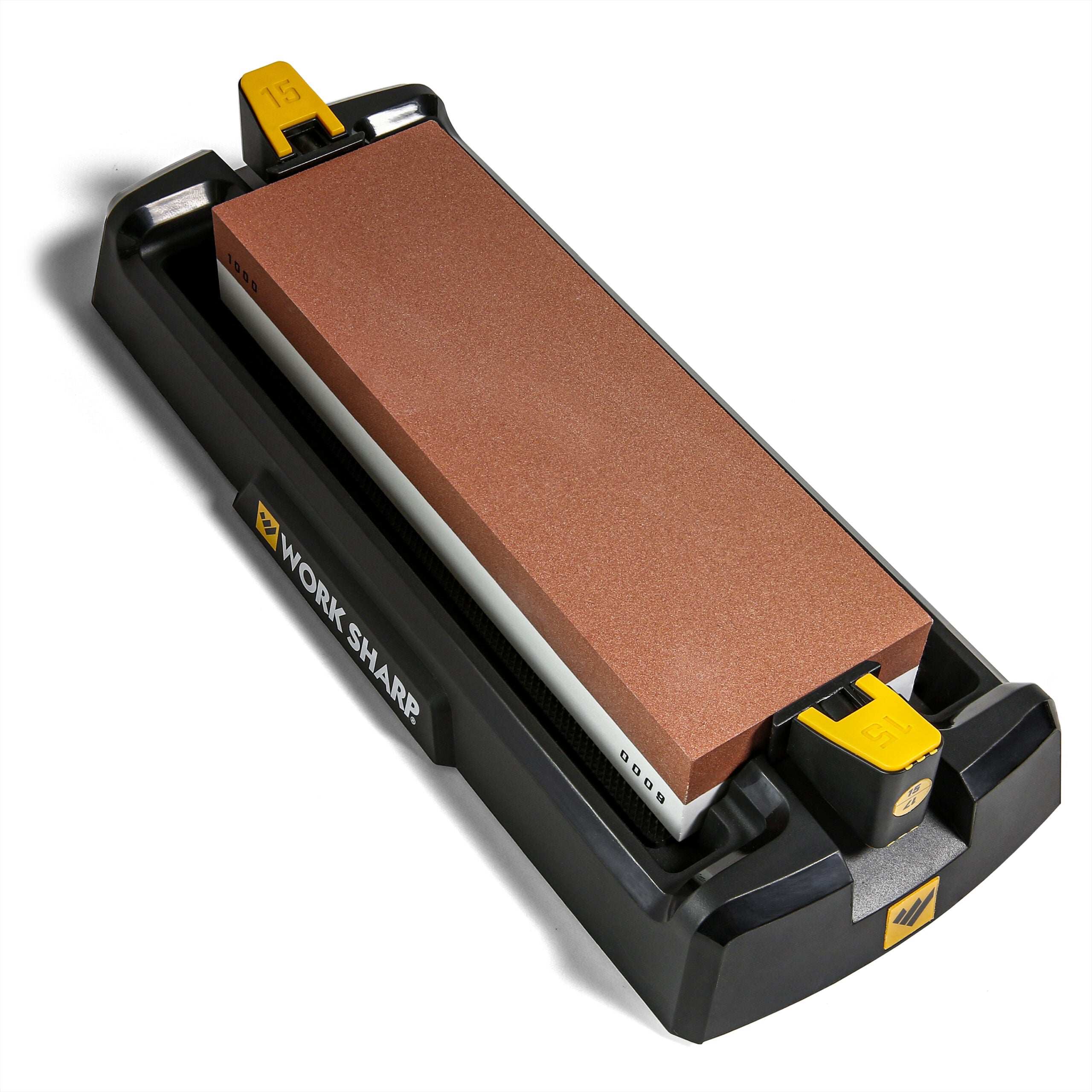
Explore this need in the finder →The Work Sharp Whetstone Knife Sharpener (SKU WSBCHWHT) is a manual water-stone setup: a reversible 1000/6000-grit corundum stone sits in a water-control base, with removable guides marked 15° and 17°. Its manufacturer product page and the model's user guide describe how the package differs from a dry bench sharpener. This assessment relies on those documents rather than personal use or performance testing.
What the WSBCHWHT package is for
The box list includes the dual-grit water stone, a base with anti-skid feet and 15°/17° guides. Work Sharp identifies corundum (aluminum oxide) as the abrasive material and lists the complete sharpener at 2 lb with a three-year warranty. The 1000 side is used for sharpening and edge recovery; the 6000 side refines the edge and removes the burr. A compatible replacement 1000/6000 stone is separately listed, as are alternate guide sets, but the standard model itself includes the two listed positions. Its central purchase difference is the wet process. The supplied guide says to soak the stone before starting, keep it wet as you sharpen, and rinse the stone and base when changing from coarse to fine. It says to use water only—not oil or dry sharpening—and to clean the stone, guides and base after each session, then store the system clean and dry. The water-control base is intended to reduce mess and keep the stone stable, but it does not eliminate the need for a cup of water, a cloth and cleanup space.Angle examples are not a universal bevel prescription
The guide labels 15° as an example for Eastern kitchen knives and 17° for kitchen knives or folding knives. The manufacturer's page describes these as removable angle guides, not a continuous adjustment mechanism. An angle mentioned by a guide does not establish the correct bevel for every knife in that broad class: factory edges vary, and the right geometry depends on the knife maker's instructions and intended use. If you need a specific angle, check that guidance before changing an existing edge. The finder on this site asks buyers for a numerical angle range. Since WSBCHWHT documents two discrete guide positions, not every numerical angle between them, its fact record does not claim a continuous lower and upper setting. Leaving the numeric range unknown is intentional: it avoids making an 16° or another unsupported position appear mechanically selectable. The review and official manual remain the right places to check the listed guide positions.What the water-stone workflow asks of you
The basic sequence is simple to explain but still requires practice. The coarse 1000 side faces up first. The user moves the knife along the stone with light pressure, follows its curve and works until the edge has been sharpened consistently. The fine 6000 side then refines the edge. Work Sharp instructs users to rinse away coarse grit and slurry before the transition, keep the stone wet, and alternate light finishing strokes to remove the burr. The guide cautions against rounding the tip by stopping the blade on the abrasive rather than running it off the end. One small instruction conflict matters during setup. The current downloadable guide says to soak for 5–10 minutes or until bubbles stop; the product page FAQ says at least 10 minutes or until bubbles stop. Because these are both official sources, this assessment records the difference rather than pretending there is one unambiguous time. Check the guide supplied with the exact package or ask Work Sharp if this point matters to you. The core instructions agree that the stone must be soaked and kept wet while sharpening.Fit and tradeoffs
Work Sharp lists pocket and kitchen knife use, and the guide specifically includes folding knives as an example for the 17° guide. This is a manual learning tool rather than a push-through slot or motorized device. Unlike the Benchstone, it has a water stone and does not document a pivoting base. Unlike the OD55, it arrives with its own water-control base and one two-sided stone; it is not designed around a larger compatible-stone platform. The choice is less about which one is universally superior and more about which routine you are willing to maintain. The WSBCHWHT package does not list a leather strop or serration attachment, and the reviewed manual does not provide a dedicated serrated-blade method. Treat those as unverified requirements rather than assuming that a general knife-use label covers every edge. Cleaning after each session and keeping the stone wet during use are part of the intended process, not optional accessories. If you want a dry, quicker setup with minimal water handling, a dry manual or powered format may be a better fit. Shortlist this exact model if water-stone sharpening is the method you want, its 1000/6000 progression is appropriate, and the two documented guide positions suit your needs. Confirm SKU WSBCHWHT, the supplied stone and base, the guide set and the current soak instructions. The stone still asks for steady manual technique, and the published 15°/17° marks should not be treated as a recommendation to alter a knife's factory bevel without checking its own requirements.Key specifications
Key details at a glance
| Power | Manual |
|---|---|
| Sharpening format | Water stone with removable guides |
| Included abrasive surfaces | 1000-grit corundum (aluminum oxide) / 6000-grit corundum (aluminum oxide) |
| Benchtop base included | Yes |
| Strop included | No |
| Use dry (no oil or water) | No |
| Angle-guide positions | 15 / 17° |
Use the exact model’s instructions for operating limits, supplied equipment and version differences.
Sources for this review
Sources for this assessment
Check the requirements that matter to you
Use the finder to compare documented sharpener formats and limits; an unknown capability is not treated as a match.