
Your needs, this model
Does it fit your priorities?
What kind of work does the WS2000 manual document?
The maker's manual describes a powered tool grinder for chisels and plane blades up to 1 5/8 inches wide, small carving and lathe tools, screwdrivers, putty knives, scrapers, axes, hatchets and other flat-blade tools. It does not provide a consumer kitchen- or pocket-knife procedure, so those uses should not be inferred from the broad catalogue label.
Explore this need in the finder →Does the WS2000's fixed 25° port establish a knife angle?
No. The original manual assigns the fixed 25° chisel port to chisels and plane blades; it does not identify that figure as a kitchen or pocket knife bevel. The knife finder angle field is therefore not applied to this reference, and the product remains outside its matches.
Explore this need in the finder →Is the retired WS2000 a current knife-buying recommendation?
No. Work Sharp currently marks the exact WS2000 retired and discontinued, while its model-specific manual describes tool grinding rather than consumer cutlery sharpening. Treat this page as an identification and capability reference only; it does not verify a seller's current package or establish knife suitability.
Explore this need in the finder →The Work Sharp WS2000 Tool Sharpener & Grinder is a retired powered workshop tool, not a verified consumer cutlery sharpener. Work Sharp's exact product page identifies SKU WS2000 and marks it retired and discontinued. The original model guide documents tool grinding, including chisels, plane blades, carving and lathe tools, screwdrivers, scrapers, axes and hatchets; it does not give a kitchen- or pocket-knife sharpening procedure. This assessment is based on the maker's product record and guide, not hands-on use. It is kept as an identification reference, not a knife-buying recommendation.
A powered wheel system for shop tools
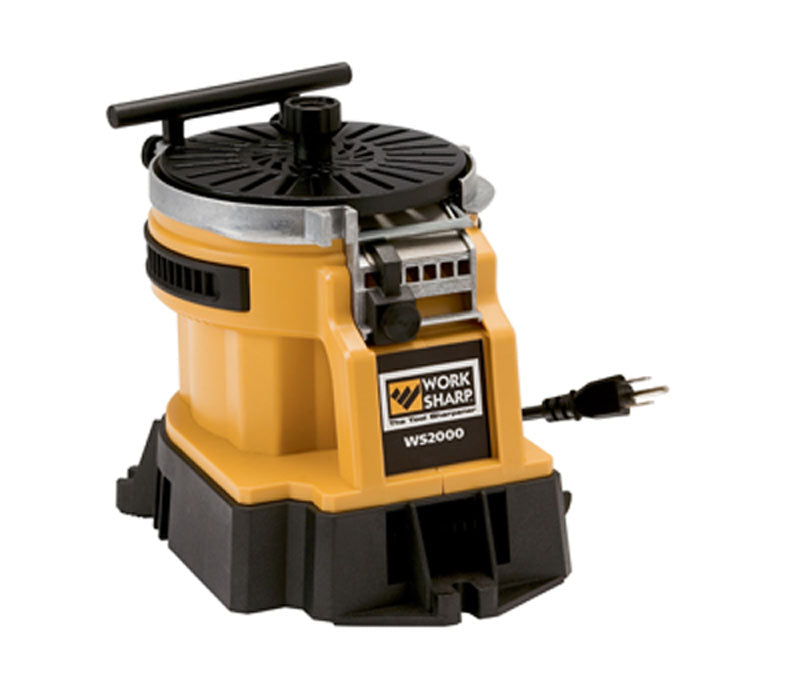
The WS2000 centers on an Edge-Vision slotted wheel driven by a 1/5-horsepower induction motor, with a stated maximum wheel speed of 1,750 rpm. The wheel accepts slotted or solid abrasive media, and the guide describes 150 mm (6-inch) adhesive-backed abrasives. A top tool rest supports top-side work, while an underside port lets the operator see the work surface through the wheel during some smaller-tool operations. That arrangement is a different proposition from a narrow consumer knife sharpener: its setup, workpiece support and abrasives are described around workshop tools.
The manual assigns the underside port to small carving and lathe tools, screwdrivers and general grinding. For larger work, it describes top-side use with the rest optional, naming putty knives, scrapers, axes, hatchets and other flat-blade tools. Those are useful, concrete boundaries for identifying what the machine was made to do. The phrase “other flat-blade tools” is not an exact-model kitchen-knife instruction, so it should not be stretched into a promise about kitchen, pocket, hunting or serrated edges.
The fixed port is specifically for chisels and plane blades
The WS2000's most controlled setup is a chisel port with a fixed 25-degree angle and a stated maximum width of 1 5/8 inches. A hold-down, alignment fence and diamond-plated heat sink help position a chisel or plane blade for the guide's bevel-grinding sequence. The manual also gives distinct procedures for flattening a tool back, changing the abrasive orientation and grinding the bevel; it is not simply a pass-through slot intended for arbitrary blades.
The 25-degree figure belongs to this tool port and its named tool work. It is not evidence of a 25-degree knife guide or a useful knife-angle range. The manual does not identify the angle convention for consumer cutlery, nor does it document a repeatable way to clamp or draw a kitchen knife through that port. Anyone comparing knife sharpeners should therefore leave the WS2000 out of angle-based knife choices rather than treating one number from a chisel setup as a knife specification.
Setup, abrasives and safety take workshop space
The guide's original package list names the WS2000 unit, the Edge-Vision slotted wheel, a top tool rest, standard and slotted adhesive-backed abrasives and the user guide. That describes the package covered by the manual; it does not verify the contents of a present-day used or third-party offer. The manufacturer now labels the exact model discontinued, and this research does not establish current replacement-abrasive, repair or service availability. The manual says the wheel can use standard 6-inch pressure-sensitive adhesive abrasives, but an owner should verify the correct media and fit for the actual machine and wheel rather than assume any replacement kit is compatible.
This is a bench machine that needs a stable work surface and a properly grounded outlet. Work Sharp's manual calls for safety glasses and hearing protection, notes that noise can exceed 85 dB(A) under some loads, and warns that grinding debris can be hot enough to create a fire hazard if it accumulates. Those are practical ownership requirements, not minor details: the unit needs a clean work area, appropriate protective equipment and careful setup. The same guide specifically warns that the tempered-glass wheel is not intended for the WS2000 and says to use only its Edge-Vision wheel, so the installed assembly and replacement parts matter.
Where it belongs in a knife-sharpener search
Work Sharp's broad collection places the WS2000 within a “Manual and Electric Knife Sharpeners” browsing context, while its exact product name and detailed user guide emphasize a tool sharpener and grinder. Both observations are worth preserving: the listing explains why the model appears in the historical catalogue, and the model-specific manual is the stronger source for its documented operating tasks. Neither source supplies the missing consumer-cutlery procedure.
For a buyer whose actual need is maintaining kitchen, pocket or serrated knives, the evidence here does not support choosing this model or assuming that the tool ports are appropriate. A purpose-built knife sharpener with an exact-model knife workflow is a more defensible comparison. For someone identifying an existing WS2000 for woodworking or general tool tasks, the guide provides useful operating and safety detail, but the current condition, installed wheel, replacement consumables and any seller's package must be checked separately.
Assessment
The WS2000 is an interesting retired tool grinder with a distinctive see-through wheel, a dedicated fixed-angle chisel port and a broad set of documented shop-tool tasks. Its strengths are specific to those tasks; they do not establish a dependable consumer knife-sharpening setup. Keeping the model visible as a historical reference preserves the manufacturer's catalogue record without turning the category label or generic flat-blade wording into an unsupported cutlery recommendation.
Primary references: Work Sharp's exact WS2000 product page; the original Work Sharp WS2000 user's guide, hosted by Northern Tool; and Work Sharp's collection page.
Key specifications
Key details at a glance
| Power | Powered |
|---|---|
| Sharpening format | Powered edge-vision wheel and fixed-angle chisel port for tool grinding |
| Included abrasive surfaces | Edge-Vision slotted wheel / standard adhesive-backed abrasives / slotted adhesive-backed abrasives |
Use the exact model’s instructions for operating limits, supplied equipment and version differences.
Sources for this review
Sources for this assessment
Check the requirements that matter to you
Use the finder to compare documented sharpener formats and limits; an unknown capability is not treated as a match.