
Your needs, this model
Does it fit your priorities?
How do the Model 1520's 15° and 20° routes differ?
The 2024 and 2017 Model 1520 manuals describe a 15°-per-side primary facet for the Asian-style route: use Stage 1, then Stage 3; the instructions describe Stage 2 as an optional intermediate bevel for a stronger edge. The 20°-per-side American/European route uses Stage 2 and then Stage 3. Those are distinct paths, not a continuous adjustment range. Match a setting to the knife maker's edge instructions rather than treating a style label as a universal rule.
Explore this need in the finder →What does the Model 1520 manual say to do with serrations?
The manual says serrated blades use Stage 3 only for ordinary sharpening, generally five to ten alternating pairs of pulls. If a serrated edge is severely damaged, it permits one quick pull in each Stage 2 slot before returning to Stage 3, while warning that excessive Stage 2 use removes unnecessary metal from the teeth. This is a separate procedure, not a numerical version of either plain-edge angle route.
Explore this need in the finder →Are the Stage 3 disks a leather strop, and can the Model 1520 sharpen scissors?
No. Stage 3 uses built-in abrasive stropping/polishing disks; the manufacturer does not identify these as a separate included leather strop. The manual specifically says not to use the sharpener for scissors or axes and not to put any blade into a slot unless it fits freely. Do not substitute a powered label or finishing disk for a required leather strop or tool-specific scissor method.
Explore this need in the finder →How should I plan for Model 1520 setup and care?
The instructions specify household use on a stable countertop, clean blades before sharpening, and no honing oil, water or other lubricant. The Model 1520 has a manual cleaning/dressing lever for its Stage 3 disks; the instructions warn that overusing this tool removes abrasive material and can wear the disks prematurely. Follow the exact booklet supplied with the finish SKU rather than assuming every offer includes the same documents or condition.
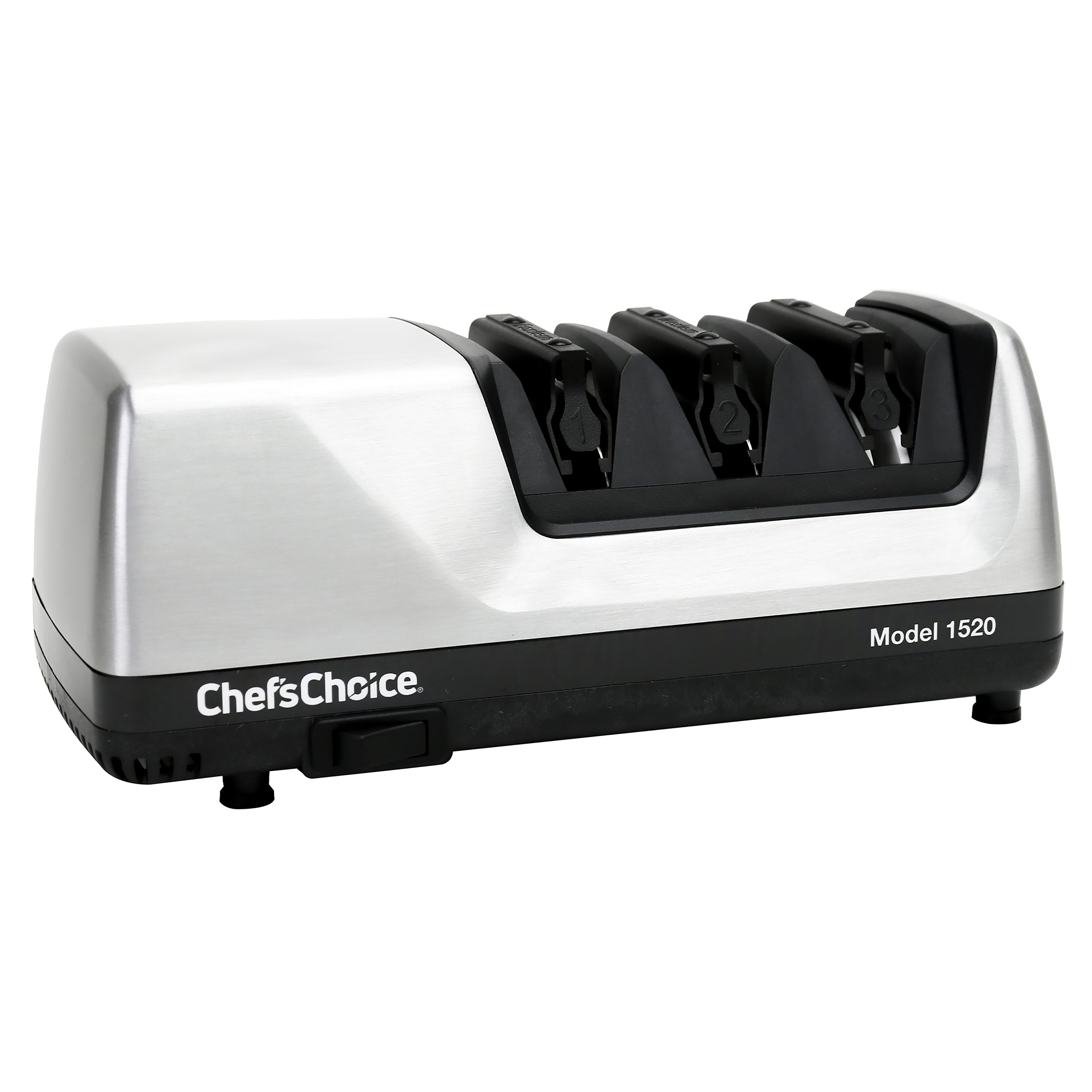
Explore this need in the finder →This review covers Chef'sChoice's current US AngleSelect Model 1520 in three finish SKUs: brushed-metal 0115207, black 0115201, and white 0115200. The pictured review identity is 0115207. The product pages and manuals describe the same three-stage design; no functional difference is documented for the other finishes. Confirm the SKU and package rather than trusting a photo.
Two plain-edge routes, not one variable wheel
Stage 1 and Stage 2 have different jobs. The manual describes Stage 1 for a 15-degree-per-side Asian-style primary facet, followed by Stage 3. Stage 2 is the 20-degree-per-side route for American and European style knives, also followed by Stage 3. It describes an optional Stage 2 sequence for adding a small intermediate bevel to a 15-degree edge. These are discrete paths, not continuous angle adjustment.
That division can be useful in a kitchen with knives intended for more than one edge geometry, but it does not identify the correct path for an individual knife. Both product pages and the manuals use the terms 15 and 20 degrees; the manuals specify these as facet angles per side, or 30 and 40 degrees total. Knife makers may use different conventions or recommend another edge. Read the knife's own guidance before choosing a route, especially before converting an existing bevel. The 1520's separate angle paths distinguish it from the Chef'sChoice 15XV, whose current product page describes a fixed 15-degree-class plain-edge capability.
Stage 3 is a shared finishing system
The same Stage 3 polishing/stropping disks finish either plain-edge route. A 20-degree edge ordinarily skips Stage 1; a 15-degree edge begins in Stage 1 and may use Stage 2 for the optional intermediate bevel. These built-in abrasive disks are not a separate leather strop. The reviewed product pages do not verify a leather strop in the exact package, so do not treat this model as meeting that requirement without checking a specific offer.
The manuals describe a manually operated cleaning/dressing lever for the Stage 3 disks. They caution that using it removes abrasive material and should be reserved for disks that are seriously darkened or no longer polishing well. This is a maintenance procedure, not a reason to dress the surfaces on a schedule regardless of condition. The manuals also say to clean food and foreign material from blades before sharpening and not to use oil, water, or another lubricant on the abrasive stages.
Serrations have their own instructions
The manufacturer lists serrated knives as supported, but a serration is not treated as a plain edge at either numerical setting. The Model 1520 manual directs ordinary serration work to Stage 3, typically five to ten alternating pairs of pulls. For a severely damaged serrated edge, it permits one quick pull in each Stage 2 slot before finishing in Stage 3, and warns that overusing Stage 2 removes more metal from the teeth than necessary. The instructions acknowledge that teeth will not appear as sharp as a plain edge. Because the manual provides a separate route rather than a serration angle, the plain-edge 15- and 20-degree figures should not be applied to the scallops.
Fit limits matter more than the broad category icons
The maker's knife guide marks chef's, Santoku, bread, hunting, filet, and pocket knives, but those labels are not a guarantee for every blade. The manual warns against scissors, axes, ceramic knives, and any blade that does not fit freely in a slot. Traditional single-bevel Japanese knives need a side-specific procedure. It also rules out older, thick European cleavers while describing smaller Asian cleavers as a different case.
The device is a countertop electric machine, not a portable field tool. Its manual requires use on a stable counter or table, says not to use it outdoors, and limits it to household use. It also warns that correctly sharpened knives may be sharper than expected. Users still control the blade movement and must keep it moving smoothly through the guides, use light pressure, and follow the sequence for the particular edge. The maker's claims about speed or results are not independent performance testing, and this review makes no hands-on claim.
What the finish variants establish
The US pages identify 0115207 as brushed metal, 0115201 as black, and 0115200 as white. The black page links a 2017 booklet; white and brushed-metal pages link a 2024 booklet. Both describe the same Model 1520 stage roles and core angle routes, though safety and housekeeping text differs; use the exact supplied manual. Manufacturer evidence documents finish differences, not a different sharpening capability, so the black and white SKUs are covered as variants here.
Buying checks
Confirm that an offer is a complete US Model 1520 and note its SKU: 0115207 (brushed metal), 0115201 (black), or 0115200 (white). Do not confuse it with the Model 15/15XV or infer finish, condition, or box contents from a stock photo. Check the package, market-specific plug/electrical rating, supplied manual, and warranty terms; no individual seller offer was checked.
Then compare your knife's recommended bevel with the Model 1520's two documented primary-facet routes. If a leather strop, scissors, axes, ceramic knives, or a non-fitting blade is essential, its documentation does not establish a match for that task. This is a source-based assessment of stated design, instructions, and constraints—not a sharpness test, speed measurement, durability trial, owner report, price check, or claim that every blade in a broad knife category is compatible.
Key specifications
Key details at a glance
| Power | Powered |
|---|---|
| Sharpening format | Powered three-stage diamond and polishing-disk sharpener |
| Lowest angle setting | 15° |
| Highest angle setting | 20° |
| Included abrasive surfaces | Diamond abrasive disks in Stage 1 and Stage 2 / Ultrafine stropping/polishing disks in Stage 3 |
| Use dry (no oil or water) | Yes |
| Angle-guide positions | 15 / 20° |
Use the exact model’s instructions for operating limits, supplied equipment and version differences.
Sources for this review
Sources for this assessment
- Chef'sChoice AngleSelect Model 1520 Professional Electric Knife Sharpener, Brushed Metal (SKU 0115207)
- Chef'sChoice Model 1520 Professional Electric Knife Sharpener, Black (SKU 0115201)
- Chef'sChoice Model 1520 Professional Electric Knife Sharpener, White (SKU 0115200)
- Chef'sChoice Model 1520 Electric Knife Sharpener Instructions (2024 edition)
- Chef'sChoice AngleSelect Model 1520 Instructions (2017 edition)
- Electric Knife Sharpeners — Chef'sChoice by EdgeCraft
- Chef'sChoice Warranty & Manuals
Check the requirements that matter to you
Use the finder to compare documented sharpener formats and limits; an unknown capability is not treated as a match.