
Your needs, this model
Does it fit your priorities?
Does Model 478 document a manual kitchen-knife route at 20 degrees?
The current manufacturer page marks the 20-degree edge icon red for Model 478 and identifies a two-stage manual sharpener. Its linked instructions describe Stage 1 making a first bevel and Stage 2 honing a micro-bevel, but do not say whether the page's 20-degree label is per side or included angle. Treat it as a capability point, not advice to reprofile a specific knife; follow the knife maker's guidance and check fit.
Explore this need in the finder →Can the Model 478 be used for a serrated edge or scissors?
The exact product page's capability grid marks its serrated icon red, so the maker indicates serrated use; however, the linked two-page manual gives no serration-specific stroke sequence. Do not transfer its 20-degree plain-edge point to serrations. The page title includes scissors, but the manual expressly says 'Not for scissors,' and the scissors icon is not highlighted as a supported feature. If either edge or tool is essential, confirm the correct Model 478 procedure with the manufacturer before use; the checker does not treat it as scissor-capable.
Explore this need in the finder →Do Model 478's two stages mean that a separate leather strop is included?
No. The manufacturer describes a Stage 1 sharpening surface and Stage 2 honing surface, with diamond abrasives in both; neither the product page nor the linked manual lists a separate leather strop or a complete seller-box inventory. Because the package evidence is unknown, it does not match a request that makes an included strop essential.
Explore this need in the finder →What setup and care directions are actually in Model 478's manual?
The manual asks for a level surface around waist height, a clean blade, light pressure in Stage 1 and little or no downward pressure in Stage 2; left-handed users turn the sharpener around. It says to keep fingers clear, clean the exterior with a damp soft cloth, and use no oil or other lubricating liquids because they are unnecessary. The manual's one-year limited warranty is for normal household use and excludes industrial or commercial use. These are maker directions, not hands-on test results.
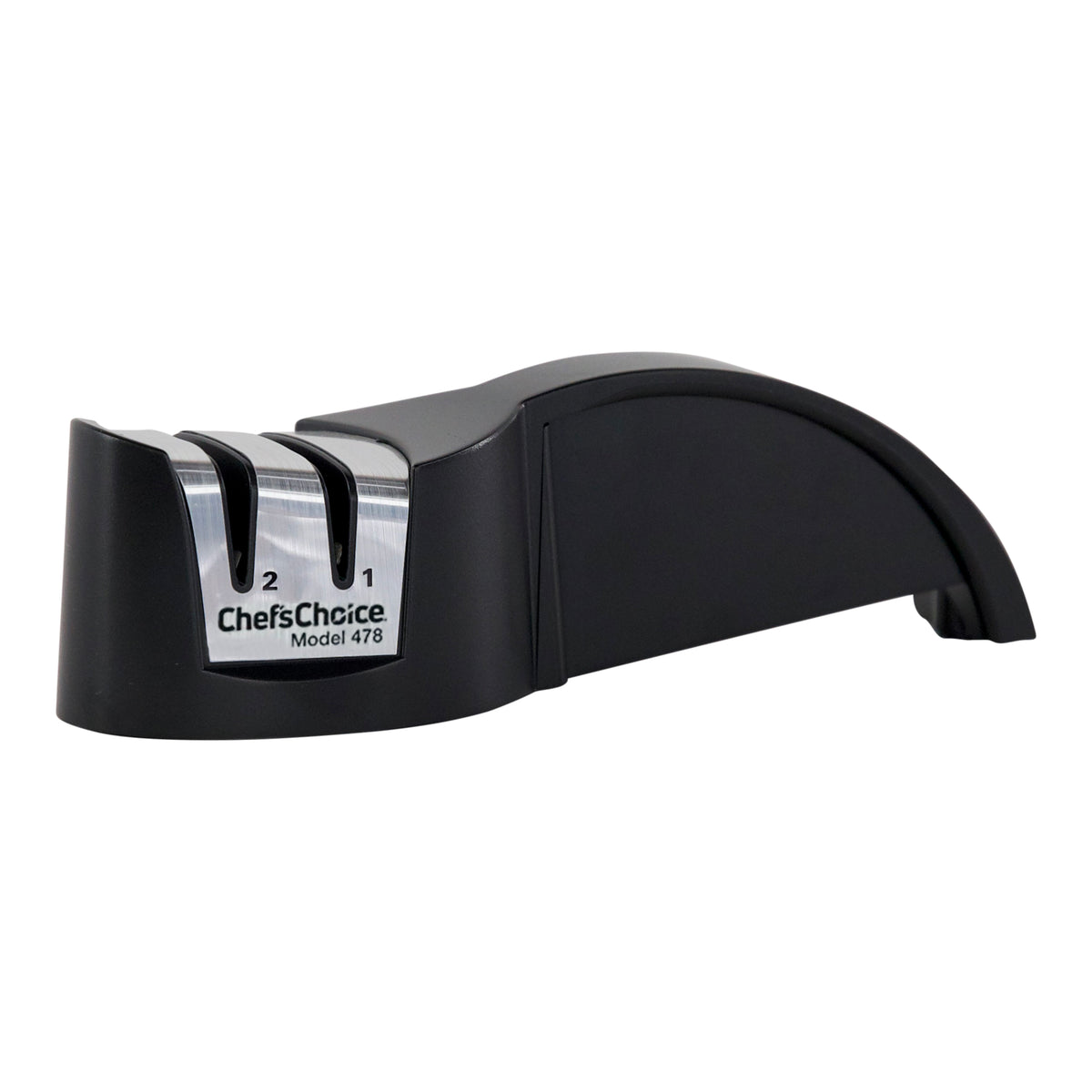
Explore this need in the finder →The Chef'sChoice Model 478 is a hand-operated, two-stage Diamond Hone sharpener sold on the manufacturer's current US site as SKU 4780100. This assessment uses the exact product page, its linked two-page Model 478 instructions and the current manufacturer manual-category records. No physical unit was used, no sharpening test or measurement was performed, and no price, stock or customer experience is assessed.
Two fixed stages rather than an adjustment system
The operating sequence is simple on paper but still asks you to guide the knife. The manual calls Stage 1 sharpening: the centered blade travels back and forth along its length, under light downward pressure, until the edge is ready for the second step. Stage 2 hones the edge by forming a micro-bevel; the instructions call for little or no downward pressure there. Chef'sChoice describes both stages as using diamond abrasives. It is a fixed-slot arrangement, not a dial whose angle can be changed for different knives.
The current product page marks its “20 Degree Edge” feature red, while its 15-degree and combined 15/20-degree icons are grey. That supports a single maker-marked 20-degree-class capability for a straight edge, not a continuous adjustment range. The linked manual does not define whether the page's angle convention is per side or an included angle. It therefore cannot tell you whether 20 is right for a particular blade or whether changing the bevel is appropriate. Check the knife maker's specification before removing material.
The manual gives example stroke counts—fewer than 25 full back-and-forth strokes in Stage 1 for a knife that is not very dull and fewer than 10 in Stage 2 if Stage 1 was adequate. Those are maker instructions, not an independent estimate of time or a performance result. The number of strokes can vary with edge condition; the instructions tell users to stop and assess the knife rather than follow a universal count.
Knife guidance—and a name that needs a caveat
The maker's feature grid highlights chef's, Santoku, bread, hunting, filet and pocket knives for this model. The manual's scope is less specific: it provides a generic knife sequence, advises that the blade be centered, and says the user should verify that it fits the slots. No maximum blade length, clearance dimensions or fit guarantee for a particular bolster, handle or blade shape is documented in the sources reviewed here.
One notable mismatch deserves more weight than the product title. The page calls this a “Knife and Scissors Sharpener,” but the linked Model 478 manual says, “Not for scissors,” and the scissor icon in the maker's red/grey capability grid is not highlighted. Do not use the title as scissor approval. The exact page also highlights its serrated icon; however, the linked manual supplies no distinct serration procedure. That is enough to report the maker's capability indication, but not enough to invent special strokes or carry the straight-edge 20-degree label over to serrations. Ask the manufacturer for the correct serration method before relying on that feature.
Setup, handedness and care
The instructions ask the user to place the unit on a level surface around waist height, make sure the knife is clean, keep fingers clear and hold the handle securely. Stage labels appear on both sides. A left-handed user turns the sharpener around and swaps hands; the manual also suggests that, for thick blades, a few careful Stage 2 strokes from the other side may sometimes be useful. These directions make clear that this is not a hands-free process: the person remains responsible for centering the blade, controlling the strokes and handling the edge safely.
For care, Chef'sChoice says the exterior can be wiped with a damp, soft cloth and that oils or other lubricating liquids are unnecessary. The source does not establish a full package list, a separate leather strop, replaceable-abrasive availability, a special cleaning tool or a sharpening-fluid prohibition. The product page and manual state a one-year limited warranty; the manual restricts its warranty to normal household use and excludes industrial or commercial use. Confirm applicable terms for the exact seller offer and condition.
Where it fits in the reviewed field
Compared with a whetstone, clamp-and-rod system or freehand benchstone, the Model 478 puts a blade into two fixed slots rather than asking the user to set a clamp or hold a freehand angle. That narrows the setup decision but also limits flexibility: there is no documented angle dial, and the machine cannot be treated as a substitute for a more adjustable system when a knife requires another setting. Manual sharpening also means repeated hand motion; this is not the powered, motor-driven route chosen by Chef'sChoice's Model 312.
The internal Stage 2 honing surface is not evidence of a separate leather strop in the box. Before buying, verify the listing's exact Model 478/SKU 4780100, confirm the package and warranty terms, and compare your intended knives with the instructions. If a numeric 20-degree-class point is essential, the product page supports that capability only for the maker-marked edge type; if scissors are essential, the manual explicitly rules this model out. The same manual's lack of a separate serration routine is a reason to request clarification, not to improvise a procedure.
Key specifications
Key details at a glance
| Power | Manual |
|---|---|
| Sharpening format | Manual two stage fixed slot diamond hone |
| Lowest angle setting | 20° |
| Highest angle setting | 20° |
| Included abrasive surfaces | Stage 1 sharpening surface; manufacturer identifies 100% diamond abrasives in both stages / Stage 2 honing surface; manufacturer identifies 100% diamond abrasives in both stages |
| Angle-guide positions | 20° |
Use the exact model’s instructions for operating limits, supplied equipment and version differences.
Sources for this review
Sources for this assessment
Check the requirements that matter to you
Use the finder to compare documented sharpener formats and limits; an unknown capability is not treated as a match.