
Your needs, this model
Does it fit your priorities?
Does the exact DB1260 set a bevel angle for me?
No numeric angle or marked guide appears in the exact instructions. They ask the user to observe and match the blade's existing bevel, so this is manual freehand work rather than a documented 20° or 25° system.
Explore this need in the finder →Which DB1260 face does the maker assign to repair versus routine upkeep?
The exact current page labels one side coarse and assigns it to serious repair or reconditioning, while the fine side is for honing, polishing or maintenance. Its listed coarse value conflicts with Lansky's 2022 catalog for the same DB-1260 code (200 versus 120); confirm the exact package if that number matters. The 600 fine value agrees in both sources.
Explore this need in the finder →What use does the exact DB1260 record document for kitchen knives?
The manufacturer details include a Kitchen Blade use label and also list filet and woodworking/chisels. That is a documented comparison, not a fit guarantee for every blade; no individual clearance chart is supplied.
Explore this need in the finder →Does DB1260 document serration sharpening or an included leather strop?
The exact page gives no scallop-by-scallop serration method and does not state whether a leather strop is included in the seller's package. Its micro-serrated-edge wording describes the edge the fine surface can leave, not a procedure for sharpening existing serrations.
Explore this need in the finder →This research-based assessment is for the exact Lansky Double-Sided Diamond Benchstone Coarse/Fine, SKU DB1260, listed in the maker's current Knife Sharpeners and Benchstones categories. It is a manual two-face benchstone, not a clamp kit or a powered sharpener. I have not used or tested it; this reading follows its exact manufacturer product record and a separately checked Lansky catalog. See Lansky's DB1260 page.
Two faces, with an important grit-source disagreement
Lansky's current DB1260 page identifies a coarse face and a fine face. The instructions reserve the coarse face for a very dull or damaged edge that needs reconditioning, then use the fine face to hone, polish or maintain an already-finished edge. Its product details call the pair 200 and 600 grit. That is the current exact-SKU page's claim—not a measurement made for this assessment.
There is a real conflict to keep visible: Lansky's 2022 catalog copy lists the exact DB-1260 model as 120/600 grit, while the current product page says 200/600. I found no maker explanation mapping those claims to a changed version or package. If the difference between coarse ratings matters to your choice, check the label and exact package with the seller or manufacturer rather than treating either number as independently verified. The 600 fine rating agrees across the two maker sources.
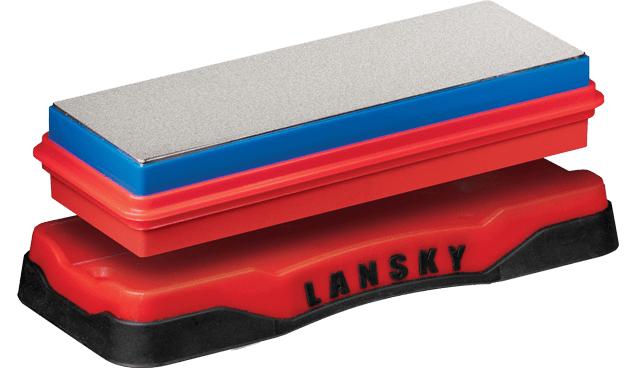
The current page's feature bullets identify the coarse side as red and fine as blue, but one later sentence calls the fine side red. The product photo shows separate red and blue edges; the prose's color slip is not a reliable selector. Match the exact SKU and side labels, not color alone.
Freehand strokes, not a preset bevel
Set the base on a stable, flat surface with the side you want facing up. Lansky asks the sharpener to observe the knife's existing bevel, bring the edge to that angle and make a light, continuous push as though slicing a thin layer from the stone. Its suggested routine starts with several strokes per side, then reduces the count and moves finer. That is a hand-controlled method: the user, not a clamp or marked slot, holds the bevel.
The record gives no degree mark, adjustment range, increment, blade-clearance chart or statement about a per-side versus inclusive angle convention. The six-inch product length and two-inch width describe the listed sharpening surface, not a maximum knife size or the full footprint of the base. A long, tall, flexible or unusually shaped knife still needs a real workspace and clearance check.
What its use list does—and does not—say
The exact product details name regular, filet, kitchen-blade and woodworking/chisel uses. Kitchen work is therefore documented for this model. The page does not specifically name pocket or hunting knives, and its general word “regular” is not used here as proof of that narrower use class. Nor does the product page give a scallop-by-scallop serration or scissor procedure.
The page says the 600-grit finish can produce a “micro-serrated working edge.” That describes the resulting edge, not an instruction for sharpening existing serrations. It should not be confused with a tapered rod or a dedicated serration method. If that is your essential task, compare an assessment that cites a model-specific serration procedure instead.
Dry use and a simple base
Lansky says not to use lubrication on either diamond surface and specifically warns against honing oil. It directs the user to wipe the diamond stone with a damp rag after use. That care instruction is about cleaning, not an invitation to add oil during sharpening. The product record identifies a non-slip base and screw holes for optional bench mounting; it does not provide the base's overall dimensions or say that permanent mounting is required.
The exact page does not inventory a seller-specific package or say whether a leather strop, oil, case or extra abrasive is included. Treat those as unconfirmed rather than absent. Check the SKU and contents of the actual offer before counting accessories.
Choosing DB1260 over a neighboring format
DB1260 is the Lansky double-sided diamond benchstone with a maker-labeled coarse/fine sequence. Its sibling, DB2860, is labeled medium/fine: its current page assigns its first face to maintaining an undamaged dull edge, while its own grit number also conflicts with Lansky's older catalog. The BSTR100 is a different complete bench unit with three surfaces—diamond, alumina oxide and ceramic—instead of DB1260's two diamond faces. Those packages are not equivalent just because each has a tabletop base.
DB1260 is a reasonable research-based shortlist candidate when you want manual kitchen-blade work, a coarse-to-fine two-face format and are comfortable controlling the bevel yourself. Its key cautions are the unresolved coarse-grit discrepancy, no numeric angle guide, no documented serration/scissor procedure, no individual knife-clearance promise and unconfirmed strop/package contents. This is an evidence review, not a performance test, price report or availability claim.
Key specifications
Key details at a glance
| Power | Manual |
|---|---|
| Sharpening format | Two-face diamond benchstone with an integrated non-slip base; select a face and guide the blade across it by hand while matching the existing bevel. |
| Included abrasive surfaces | Two manufacturer-described diamond faces: current exact page labels coarse/fine 200/600 grit; Lansky's 2022 catalog lists DB-1260 at 120/600 grit. The coarse value conflicts and is not treated as settled. / Maker assigns the coarse face to serious reconditioning of dull/damaged edges and the fine face to honing, polishing or routine maintenance. |
| Benchtop base included | Yes |
| Use dry (no oil or water) | Yes |
| Angle-guide positions | ° |
Use the exact model’s instructions for operating limits, supplied equipment and version differences.
Sources for this review
Sources for this assessment
- Lansky Double-Sided Diamond Benchstone Coarse/Fine, SKU DB1260 — exact manufacturer product record and instructions
- DB1260 manufacturer product page Details section, cross-checked against its exact record
- Lansky 2022 catalog copy, page 18 / printed page 17 — Double-Sided Diamond Benchstones
- Lansky DB1260 first enabled exact-model product-gallery image

Check the requirements that matter to you
Use the finder to compare documented sharpener formats and limits; an unknown capability is not treated as a match.