
Your needs, this model
Does it fit your priorities?
Does BSTR100 set a numeric bevel angle for me?
No numeric degree setting or marked guide appears in the exact instructions. They ask the user to observe the existing bevel and match it, so this is a hand-controlled-angle stone rather than a documented 20° or 25° system.
Explore this need in the finder →Which BSTR100 surface does the manufacturer assign to routine touch-ups versus major repair?
The exact page reserves the 200-grit diamond for serious repair or re-profiling and says it is not for every session. Its 280-grit alumina-oxide stone is the usual maintenance surface for an undamaged, slightly dull edge; the 1,000-grit ceramic is listed for honing and finishing. For an undamaged edge, the maker suggests beginning on the medium surface.
Explore this need in the finder →Should I apply oil while sharpening on the three surfaces?
No. Lansky says not to use lubrication while sharpening on any of the three stones and specifically warns against honing oil on the diamond. Its separate care directions say to clean the alumina-oxide surface with oil after use; the diamond is wiped with a damp rag and the ceramic is cleaned with an Eraser Block.
Explore this need in the finder →Does the exact BSTR100 record support kitchen blades, serrations or scissors?
The exact use list names kitchen blades and woodworking/chisels. Its ceramic description says a micro-serrated edge can be made smooth, but it supplies no serration-sharpening procedure. Scissors are not named or assigned an operating method, so neither serration nor scissors support is treated as verified.
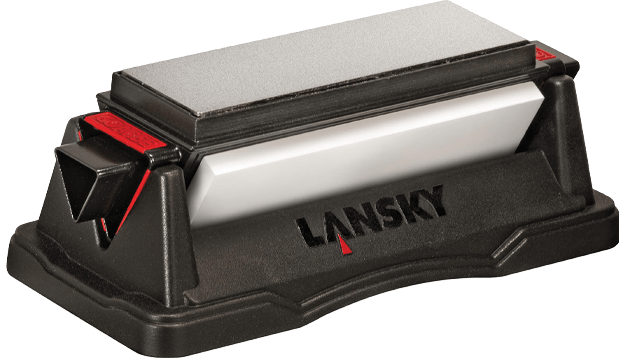
Explore this need in the finder →This research-based assessment covers the exact Lansky Tri-Stone Benchstone, SKU BSTR100. Its manufacturer identifies 200-grit diamond, 280-grit alumina oxide and 1,000-grit ceramic surfaces in one plastic base, plus manual full-edge instructions. It is distinct from Lansky clamp kits and the pivoting Work Sharp Benchstone. I have not used or tested it; this reading relies on its own manufacturer record. Lansky's exact BSTR100 page is the primary source.
Three surfaces with different jobs
The three surfaces have different maker-assigned roles. The continuous 200-grit diamond is for serious repair or re-profiling a very dull or damaged edge, not an every-session starting point. The 280-grit alumina-oxide stone is the maintenance surface for an undamaged, slightly dull edge. Fine 1,000-grit ceramic is for honing and finishing. These roles are not comparative test results or promises of speed on a particular steel.
For an undamaged knife, Lansky suggests beginning on the medium surface and moving finer if needed; the coarser diamond is reserved for substantial repair. The shared base packages the stages together, but the page does not prescribe a sequence for every steel, bevel or sharpening goal.
What the hand-guided routine asks of you
Set the base flat with the chosen stone facing up. Lansky asks the user to observe the existing bevel, match it, and push the blade across the stone in one light stroke while holding a consistent angle. Its basic directions use several strokes per side; further suggestions reduce the count on later passes before moving finer. This is a user-guided routine, not an angle-clamped system.
The record gives no numeric degree mark, adjustment interval or angle convention. If a documented 20° or 22.5° setting is essential, BSTR100 does not verify it. Nor does Lansky give a blade-length or clearance chart, so the listed stone size is not an individual-knife fit guarantee.
Kitchen use is named; other tasks need separate evidence
The maker's use list names regular, filet, kitchen-blade and woodworking/chisel work. Kitchen blades are therefore a supported comparison, but the list is not a guarantee for every chef's knife or geometry. The page says the ceramic can turn a micro-serrated edge smooth; it gives no scallop-by-scallop serration method, so this is not evidence of dedicated serration support.
Woodworking chisels are named, but scissors and pocket/hunting knives are not. The source supplies no procedure for those tasks. That is a limit on what can be verified here, not proof the stones could never contact another blade.
Dry sharpening, then different cleaning for each surface
Sharpening and cleaning directions differ. Lansky says no lubrication while sharpening on any surface and specifically warns against oil on the diamond. After use, wipe the diamond with a damp rag, clean alumina oxide with Nathan's Honing Oil, and clean ceramic with a Lansky Eraser Block. The oil is a post-use cleaning instruction for the medium stone, not a sharpening lubricant. The page names the oil and block for care but does not verify either is included in a seller's package.
Bench setup and comparisons
All three surfaces are listed as 2 × 6 inches. The plastic base has non-slip rubber feet and screw holes for optional bench mounting. Lansky does not give the base's overall footprint or working clearance; measure the available spot rather than infer base size from the stone dimensions. The directions call for a flat, stable support but do not require permanent mounting.
The Work Sharp Benchstone has a pivoting abrasive assembly and documented guide positions; BSTR100 instead asks the user to follow the existing bevel across three Lansky surfaces. For a clamp-guided format, the Deluxe 5-Stone System is a separate product with a knife clamp and rod-mounted hones. Their controls and package contents do not transfer to BSTR100.
Checks before choosing this exact package
Confirm SKU BSTR100 and the three-surface/base configuration; an image alone cannot verify a seller's bundle. The page does not state whether a leather strop is included, so do not assume one. If you need a numeric angle, serration method, scissors support, named pocket/hunting use or blade-clearance limit, seek exact evidence rather than treating an unreported feature as compatible.
BSTR100 suits a shopper seeking a manual repair/maintenance/finish progression, an explicitly named kitchen-blade use, and hand-controlled angle work. Its key tradeoffs are no numeric guide or clearance limit and different care for each surface. This is a reading of the U.S. product record, not a performance, price or availability report.
Key specifications
Key details at a glance
| Power | Manual |
|---|---|
| Sharpening format | Three-surface manual benchstone in an included plastic base; select the maker-described abrasive stage, set the base flat, and guide the blade across it while following the existing bevel. |
| Included abrasive surfaces | Continuous diamond surface, maker-listed coarse 200 grit, for serious repair or re-profiling of a very dull or damaged edge / Alumina-oxide stone, maker-listed medium 280 grit, for maintenance of an undamaged, slightly dull edge / Ceramic stone, maker-listed fine 1,000 grit, for honing and finishing |
| Benchtop base included | Yes |
| Use dry (no oil or water) | Yes |
| Angle-guide positions | ° |
Use the exact model’s instructions for operating limits, supplied equipment and version differences.
Sources for this review
Sources for this assessment

Check the requirements that matter to you
Use the finder to compare documented sharpener formats and limits; an unknown capability is not treated as a match.