
Your needs, this model
Does it fit your priorities?
Does LCD5D offer every setting between 20° and 25°?
No. The exact LCD5D record shows two discrete guide positions, 20° and 25°. Lansky describes a two-stage sequence that moves from one to the other, but that is not evidence of intermediate settings. The page also does not resolve per-side versus inclusive angle convention, so compare the marks with the knife maker's specification.
Explore this need in the finder →Which ceramic rods are listed in the LCD5D package?
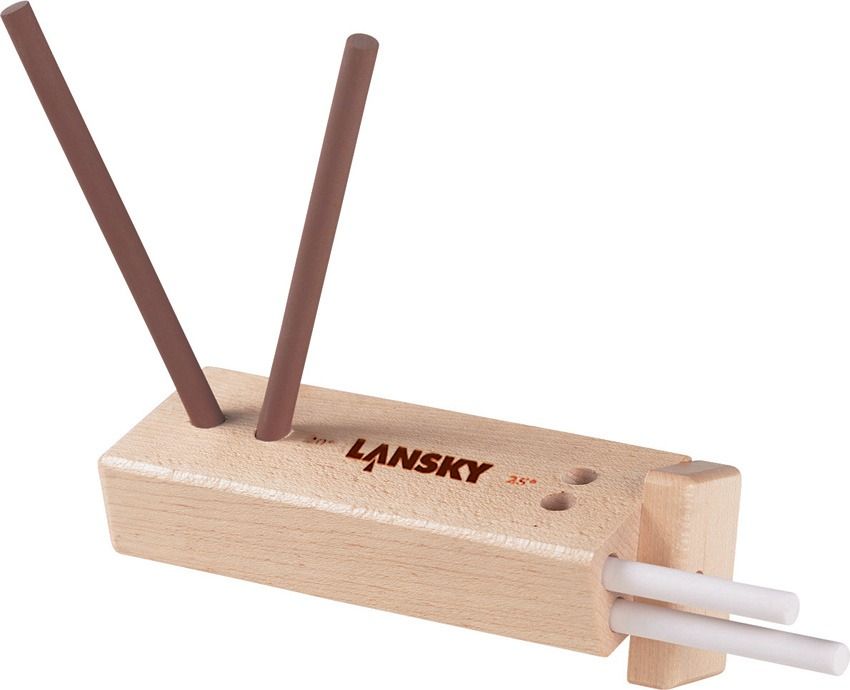
The exact SKU description lists four 5-inch alumina-ceramic rods: two medium 600-grit brown rods for sharpening and two fine 1,000-grit white rods for polishing. It also describes a hardwood TurnBox base with internal rod storage. These are maker-listed package details, not a tested grit progression.
Explore this need in the finder →Is a leather strop included with LCD5D?
The exact LCD5D manufacturer package description lists the four ceramic rods and hardwood base, but not a leather strop or compound. A separate LCD5DL record explicitly adds both. If a leather finishing surface is essential, verify the exact SKU and offer instead of assuming every TurnBox package includes one.
Explore this need in the finder →This is a source-based assessment of Lansky's 4-Rod Ceramic TurnBox Crock Stick Knife Sharpener, exact SKU LCD5D; it is not a hands-on test. The manufacturer describes a hardwood holder, four ceramic rods, two marked guide positions and a storage space for the rods inside the base. The model is a compact manual alternative to a clamp-and-stone arrangement, but the user still controls the knife's movement. The exact LCD5D product page and directions are the basis for the package and procedure discussed here.
Identify the package before comparing TurnBoxes
Lansky lists two 5-inch medium, 600-grit brown ceramic rods for sharpening and two 5-inch fine, 1,000-grit white ceramic rods for polishing. The hardwood base stores the rods internally. The page describes a two-stage arrangement, but its single-stage directions let the user choose a rod type and one guide position; it does not assign one ceramic pair to each angle. LCD5D's exact package description does not list a leather strop or compound.
This package differs from LCD5DL, which adds a leather strop and compound, and from TB2D2C/TB2D2CL, whose medium pair is diamond rather than ceramic. Verify the model code rather than treating “four-rod TurnBox” as a full package specification. Read the separate LCD5DL review for the strop-equipped all-ceramic version.
Two marked positions, not a continuous dial
The base provides guide holes marked 20° and 25°. Lansky associates 20° with slicing, fillet, butcher, paring and skinning knives and says lower settings require more regular maintenance. Its page associates 25° with hunting, camping, utility and chef's knives and describes that setting as a durable edge. These are the maker's named use examples, not a recommendation to alter every knife to those settings. The exact product description does not clarify whether the markings mean per-side or inclusive angles, so compare the convention with the knife manufacturer's specification before using a number as a target.
Lansky also describes a two-stage procedure: use the 20° holes for 10–12 strokes on each rod to thin an edge, then move the rods to 25° for a finishing pass that forms a compound bevel. That sequence is not evidence that every half-degree or degree between the marks is available. In this assessment the 20° and 25° arrangements remain separate operating plans; a numeric match at one point must not imply support for an intermediate setting. Nor does the fact that a single two-stage routine uses both positions make it an interchangeable substitute for a user's exact one-angle requirement.
What the stroke asks of the user
The manufacturer's setup starts with a stable, flat work surface at a comfortable height. The user chooses the desired rod pair and guide holes, holds the base firmly with the non-dominant hand, keeps fingers away from the rods, and holds the knife upright. The described stroke begins with the heel below the top of a rod and moves down and toward the user as the blade travels toward its tip; the opposite rod is used for the other side. This is a hand-guided motion, not a clamp that locks the blade or an electric mechanism that moves the abrasive for the user.
That distinction matters for the purchase decision. The base constrains the rod path, but hand position and tip control remain part of the task. Lansky specifically warns against rolling the tip off the rod, and its caution says that careless handling of a blade or pointed object can cause injury. A shopper who wants a system to secure the knife should compare a compatible clamp kit instead; one who wants a freehand surface may prefer a bench stone. Neither comparison makes LCD5D unsuitable by itself—it clarifies what skill and setup the maker's own instructions assume.
Limits the product record leaves open
The exact LCD5D page does not provide a blade-length or handle-clearance limit, a serrated-edge procedure, scissor directions, steel compatibility table, rod-cleaning routine, dimensions or measured sharpening results. The 5-inch rod length does not answer all of those fit questions. The source describes kitchen and hunting use, but it does not identify every knife model or edge profile that can pass safely through the stroke. Treat those as evidence gaps, not proof that a use is impossible or confirmed. For unusual geometry, a bolster close to the edge, a very long blade or serrations, check the knife maker's guidance and seek model-specific instructions before assuming the ordinary rod routine applies.
The grit values distinguish the pairs, but this review has not measured cutting rate or finish. “Medium” and “fine” are maker labels, not a guarantee of how much steel a particular knife needs removed. LCD5D's page calls the white pair for polishing; LCD5DL instead calls its white rods a touch-up surface and adds a strop. Do not transfer those sibling instructions wholesale.
Bottom line and purchase checks
LCD5D is a manual, compact TurnBox with four ceramic rods, internal storage and two discrete guide positions. It may suit someone whose knife task aligns with the manufacturer's 20° or 25° examples and who is comfortable controlling a vertical down-rod stroke. Its key limits are the unresolved angle convention, the absence of a listed leather strop, and the lack of model-specific serration, scissor or clearance evidence. This is an editorial reading of the manufacturer's current exact-SKU record, not an ownership or performance claim.
Before buying, check that the offer is SKU LCD5D and that the seller's written contents match the four-rod ceramic package. Confirm that a 20° or 25° marked position is appropriate under the knife maker's convention, and verify whether your knife's handle and blade geometry can be worked with the described path. If an included strop is essential, compare LCD5DL or another exact package whose manufacturer record lists one; do not assume LCD5D includes that accessory because a TurnBox sibling does.
Key specifications
Key details at a glance
| Power | Manual |
|---|---|
| Sharpening format | Hardwood turnbox with in-base rod storage; choose the discrete 20° or 25° marked guide holes, insert the selected ceramic pair, hold the blade upright and draw it down and toward the user along alternating rods. the maker also describes a separate 20° thinning pass followed by a 25° finishing pass. |
| Lowest angle setting | 20° |
| Highest angle setting | 25° |
| Included abrasive surfaces | Two 5-inch medium 600-grit brown ceramic rods for sharpening / Two 5-inch fine 1,000-grit white ceramic rods for polishing / Hardwood TurnBox base with internal rod storage |
| Strop included | No |
| Angle-guide positions | 20 / 25° |
Use the exact model’s instructions for operating limits, supplied equipment and version differences.
Sources for this review
Sources for this assessment

Check the requirements that matter to you
Use the finder to compare documented sharpener formats and limits; an unknown capability is not treated as a match.