
Your needs, this model
Does it fit your priorities?
Is LDB6E suitable as the only stone for repairing a very dull edge?
The exact instructions position Ultra Fine for honing or polishing a finished edge and recommend a separate Medium-to-Fine-to-Ultra-Fine progression. They do not assign LDB6E the initial repair role or include the preceding stages in this one-surface product record.
Explore this need in the finder →Is the LDB6E 1,000-grit value consistent across the inspected maker sources?
Yes: the current exact LDB6E record and the Lansky-branded 2022 catalog copy both list Ultra Fine at 1,000 grit. That is a consistent manufacturer claim, not a grit measurement made for this assessment.
Explore this need in the finder →Does LDB6E set a particular sharpening angle or include a strop?
The exact instructions publish no numeric angle or guide and say to match the blade's existing bevel. The product record does not confirm a leather strop in the package; unknown inclusion should be checked against the exact seller offer rather than assumed.
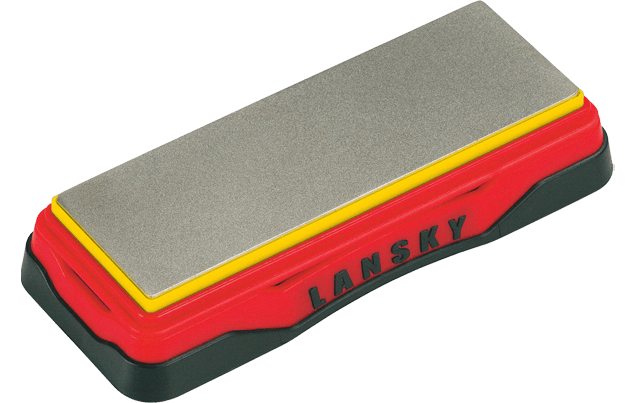
Explore this need in the finder →This assessment is about Lansky Diamond Benchstone Ultra Fine, exact US SKU LDB6E, listed in the manufacturer's current Knife Sharpeners and Benchstones categories. It is a manual single-face 1,000-grit diamond benchstone. I have not used or tested it; this is a research-based reading of the exact product record and instructions, selected attributes, a Lansky-branded catalog copy and the exact gallery image. See Lansky's LDB6E page.
A finishing stone with one job in the sequence
The LDB6E product data identify one Ultra Fine diamond surface, listed at 1,000 grit, on a raised plastic storage-case base with a non-slip rubber frame. The current exact source and Lansky's 2022 catalog copy agree on the same SKU, 6-by-2-inch size and 1,000-grit value. As with any manufacturer grit label, that agreement is not a measurement performed for this review, but I found no contradictory number for LDB6E in those sources.
Lansky's instructions place Ultra Fine after Medium and Fine and describe Fine and Ultra Fine as surfaces for honing or polishing a finished edge. That makes the exact task clearer than a broad promise of “sharpness”: LDB6E is the final stage in a suggested progression, not the documented starting surface for repairing a badly damaged edge. The preceding Medium and Fine stones are separate LDB6M and LDB6F products; the record does not say they are included with LDB6E.
What the user still controls
The maker's procedure begins with a stable flat surface and asks the user to look at the existing bevel and match it. It then describes a light, one-motion push across the face, changing sides and repeating as needed. There is no clamp or guide rod to hold a set angle for you. The exact product record provides no numeric degree, adjustable range, marked positions or statement about per-side versus inclusive geometry.
The nominal six-inch length and two-inch width are the stated stone dimensions, not the full footprint of the base or a safe-clearance chart for every knife. If a broad chef's knife, a high handle or an unusual grind may contact the base or nearby worktop, check the actual layout. The product image can help identify the raised case and yellow edge trim associated with LDB6E, but cannot establish a knife's clearance or the seller's box contents.
Kitchen use and fit limits
The exact selected attributes list Regular, Filet, Kitchen Blade and Woodworking/Chisels, so kitchen-blade work is explicit for this product. The current record does not separately name pocket or hunting knives, and “Regular” is not used as a substitute for that narrower use. Nor does the exact page set out a scissor procedure or a method for sharpening the scallops of an existing serrated blade. An ultra-fine flat abrasive is not a documented replacement for a dedicated serrated hone.
LDB6E also uses the same dry-stone routine as Lansky's other diamond benchstones: the exact directions prohibit lubrication on the surface. Afterward, they call for a damp-rag wipe and cool, dry storage. The selected attributes list a storage case, non-slip base and optional mounting. That last label does not settle whether fasteners are supplied, and the exact product record does not inventory an included strop or seller-specific kit contents.
Comparing the three single-face choices
The nearby LDB6M is the Medium surface: its current exact data say 400, but a 2022 catalog lists the same code at 280, so the disagreement remains open. LDB6F is Fine 600, while LDB6E is Ultra Fine 1,000; those two numbers match between the inspected current and catalog sources. Lansky recommends moving in the order Medium, Fine, Ultra Fine. That gives a useful map of the stages but does not change the fact that each reviewed SKU here is one stone, not a bundled progression.
Against a complete station such as the BSTR100, LDB6E is a more specialized single finishing surface. The BSTR100's three stone types sit on one base; LDB6E's source describes only one ultra-fine diamond face. A shopper can value the narrower role if it fills a specific stage in an existing setup, but should not count it as a complete repair-to-finish kit without separately sourcing the other stages.
Who should shortlist LDB6E?
It fits the documented task when you want a manual ultra-fine diamond surface for honing or polishing a finished kitchen-knife edge, can hold the existing bevel by hand and already have a workable way to establish the edge before this stage. It is a poor match if your essential requirement is an included angle guide, a complete multi-grit restoration set, an explicitly documented serration/scissor process or a confirmed leather strop.
Its strongest fit signals are the exact model identity, the 1,000-grit claim that agrees across two maker sources, the described final-stage role and a kitchen-use label. The limitations are equally concrete: one abrasive face, freehand angle control, no individual clearance specification and unconfirmed seller extras. This is an original source-based assessment, not a personal-use report, test result, angle recommendation, stock statement or price comparison.
Key specifications
Key details at a glance
| Power | Manual |
|---|---|
| Sharpening format | Single flat-faced ultra-fine diamond benchstone in a raised plastic storage-case base with a non-slip rubber frame; the user guides the knife by hand while matching the existing bevel. |
| Included abrasive surfaces | One full-face ultra-fine diamond benchstone surface, labelled 1,000 grit in both current exact LDB6E data and the inspected Lansky-branded 2022 catalog copy. / The exact maker directions include Ultra Fine in a separate Medium-to-Fine-to-Ultra-Fine progression and assign it to honing or polishing an already-finished edge; the other grits are separate product choices, not included surfaces in this exact record. |
| Benchtop base included | Yes |
| Use dry (no oil or water) | Yes |
| Angle-guide positions | ° |
Use the exact model’s instructions for operating limits, supplied equipment and version differences.
Sources for this review
Sources for this assessment

Check the requirements that matter to you
Use the finder to compare documented sharpener formats and limits; an unknown capability is not treated as a match.